AI Agents in Partner Motions

Partner ecosystems have always moved at the pace of quarterly planning: onboarding takes weeks, enablement takes a class, and a co-sell deal waits on a human to answer a question. AI agents change that clock. This module shows partner, alliance and business-development professionals where agents genuinely help across partner motions, how those agents plug into the systems that already run the ecosystem, and how to add agent capability without handing your ecosystem to a single vendor. The core idea is speed: an agent lets the ecosystem respond in seconds instead of quarters.

  • ai-agents
  • partner-automation
  • co-sell
  • agent-design
  • partner-experience
  • ecosystem-strategy
12 min · Core

Where AI Agents Help in Ecosystems

AI agents are not a general miracle for partner programs. They earn their place in specific, high-friction motions: getting a new partner productive, answering enablement questions on demand, supporting a co-sell deal in real time, and giving partners fast, accurate answers instead of a ticket queue. This lesson names the concrete places agents move the needle and the places they do not.

~4 min

By the end you can

  • Identify the specific partner motions where agents create real value.
  • Explain why high-friction, repetitive, answer-shaped work is the sweet spot.
  • Give concrete examples across onboarding, enablement and co-sell.
  • Recognize where an agent is the wrong tool for a partner problem.

Not everywhere, but somewhere real

An AI agentSoftware that takes a goal, decides the steps to reach it, and acts on systems through their interfaces. Unlike a fixed script, it chooses its actions as it goes. is software that can take a goal, decide what steps to take, and act on systems to reach it. That makes it tempting to point at every partner problem at once. Resist that. Agents earn their keep in motions that are repetitive, answer-shaped, and slowed down today by a human bottleneck. In a partner ecosystem four motions fit that description cleanly, and knowing them keeps you from spending on the ones that do not.

Onboarding a new partner

The first weeks of a partnership are mostly the same questions asked by every partner: how do I register a deal, where is the price list, what does my tier unlock, who is my contact. Today a partner manager answers these by hand, and a new partner waits days for a reply that a colleague already gave last week. An onboarding agent can walk a partner through registration, pull the right documents, and confirm each step is done, turning a two-week ramp into an afternoon. The manager is freed for the judgment work no agent should touch: reading whether this partner is worth deep investment.

Enablement on demand

Enablement usually means a scheduled class and a slide deck that goes stale. A partner rep in the middle of a customer conversation cannot wait for next month's session. An enablement agent answers the exact product or positioning question at the moment it is asked, drawing on current material, so a partner learns in the flow of selling rather than in a classroom. The best use is narrow and current: the newest objection handling, the latest competitive point, the specific integration a customer just asked about.

Co-sellA motion where a vendor and a partner work a deal together, coordinating on discounts, engagement and technical fit; often stalled by missing information an agent can surface. support and partner-facing answers

Co-sell is where deals stall on missing information. A partner rep needs to know if a discount is approved, whether the vendor's team is engaged, or what the reference architecture is for this customer's stack. An agent that supports the co-sell motion can surface that answer in the deal thread instead of routing a ticket that returns in three days. More broadly, most partner-facing questions are answers waiting to be looked up. An agent that reliably gives partners fast, correct answers replaces a queue that quietly erodes trust every time it is slow.

Where an agent is the wrong tool

Some partner work is not answer-shaped and should stay human. Negotiating the terms of a strategic alliance, deciding which partner to bet the year on, repairing a relationship after a lost deal: these need judgment, trust and accountability that an agent cannot carry. Point agents at volume and friction, not at the relationships and decisions that define the ecosystem. Used this way, agents remove the drag so people spend their time where only people can.
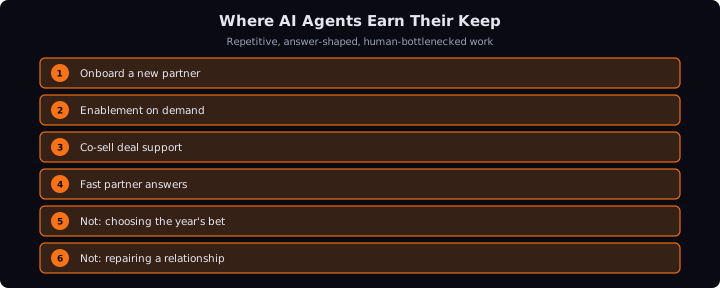
Agents fit high-friction motions; strategic bets and relationship repair stay with people.

Check your understanding

Answer each from memory. Your results are saved in this browser and count toward your readiness — sign in (account panel above) to keep them across devices.

  1. Which trait best identifies a partner motion where an AI agent adds real value?

  2. How does an enablement agent differ from a traditional enablement class?

  3. Which task is the wrong fit for an AI agent in a partner ecosystem?
13 min · Core

How Agents Interact With Partner Infrastructure

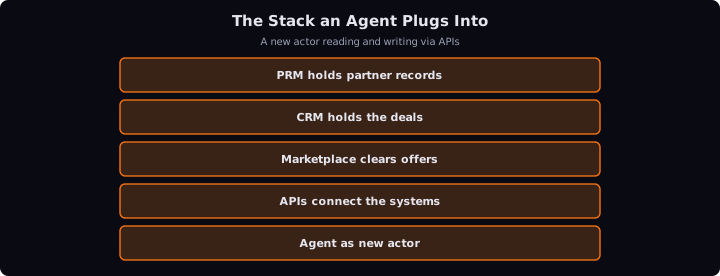
An agent is only as useful as the systems it can reach. In a partner ecosystem those systems are the PRM, the CRM, the marketplace and a set of APIs that already move data between them. This lesson treats the agent as a new actor on that stack, one that reads and writes through the same interfaces people and integrations use, and explains what that means for access, permissions and trust.

~3 min

By the end you can

  • Name the core systems an agent connects to in a partner ecosystem.
  • Explain how an agent reads and writes through APIs rather than replacing systems.
  • Describe the agent as a new actor that needs its own access and limits.
  • Recognize why permissions and traceability matter when an agent can act.

The stack an agent plugs into

Every mature partner program already runs on a few systems. The PRMPartner relationship management platform: the system that holds partner records, tiers, deal registrations and enablement content for a partner program., or partner relationship management platform, holds partner records, tiers, deal registrations and enablement content. The CRMCustomer relationship management system: where a company tracks its accounts and sales opportunities, including the deals a co-sell motion runs through. holds the opportunities and accounts the deals live in. The marketplace is where offers are listed and transactions clear. Tying them together are APIs, the defined doorways through which one system asks another for data or tells it to do something. An agent does not replace any of these. It joins them as another user of the same doorways.

Reading and writing through APIs

When an onboarding agent confirms a partner's tier, it is not inventing the answer; it calls the PRM's APIApplication programming interface: a defined doorway through which one system asks another for data or tells it to act. An agent can only automate what the APIs expose. and reads the record. When a co-sell agent checks whether a deal is registered, it queries the CRM. When it registers a deal on the partner's behalf, it writes back through the same API a human would use through a screen. This matters because it sets the ceiling on what an agent can do: an agent can only reach what the APIs expose. If the marketplace has no API for a certain action, the agent cannot perform it either. Understanding the stack tells you exactly what an agent can and cannot automate before you build anything.

The agent as a new actor

The useful shift in thinking is to treat the agent as a new actor on the stack, alongside people and traditional integrations. A person logs in with an account and permissions. An integration runs with a service credential. An agent, likewise, needs its own identity, its own permissions, and its own record of what it did. It is not a person and not a fixed script; it decides steps as it goes, which is what makes its access model worth deliberate thought rather than an afterthought.

Why permissions and traceability matter

Because an agent can write, not only read, its permissions decide how much it can affect. An agent that can register deals should not also be able to change tier definitions or approve discounts unless you intend that. Give it the narrowest access the job needs, the same discipline you apply to any account that can change records. Just as important, every action an agent takes should be traceable: which agent, on whose behalf, at what time, changing what. When a partner disputes a registered deal or a wrong tier, that trail is what lets you answer. An agent that acts without a clear record is a liability, however helpful it seems on a good day.

An agent joins the existing systems through their APIs and can only reach what they expose.

Check your understanding

Answer each from memory. Your results are saved in this browser and count toward your readiness — sign in (account panel above) to keep them across devices.

  1. How does an agent get the answer to 'is this partner in the Gold tier'?

  2. What sets the ceiling on what an agent can automate in the ecosystem?

  3. Why does an agent that can write to systems need narrow permissions and a traceable record?

14 min · Core

Designing Agents for Speed, Not Quarterly Cycles

This is the module's central insight. Partner ecosystems have run on quarterly rhythms because human coordination is slow: onboarding waits for a manager, enablement waits for a class, co-sell waits for a reply. Agents remove the wait. Designed well, they let the ecosystem operate at machine speed, responding in seconds where it used to respond in weeks. The design goal is not to automate the quarter; it is to make the quarter obsolete as the unit of response.

~4 min

By the end you can

  • Explain why partner ecosystems have historically moved at quarterly speed.
  • Describe how agents change the unit of response from weeks to seconds.
  • Distinguish automating the old cycle from designing for machine speed.
  • Identify what a leader must redesign to capture the speed benefit.

Why the quarter became the clock

Partner programs plan in quarters for a simple reason: people are the bottleneck, and coordinating people is slow. A partner manager can only onboard so many partners a week. Enablement gathers reps into a scheduled class because running one costs a person's time. A co-sell question waits in a queue because a human has to read it, find the answer and reply. Every one of these waits is the cost of human coordination, and the quarter is the rhythm a business settles into when that cost is high. It is not a law of nature; it is a symptom.

What changes when the wait disappears

An agent does not get tired, does not batch its work into a class, and does not sleep through a time zone. When an agent handles onboarding, a partner productive in an afternoon is normal, not exceptional. When an agent answers enablement questions, learning happens the second a rep needs it, hundreds of times a day, in parallel. When an agent supports co-sell, the answer that used to take three days arrives in the thread while the deal is still warm. The unit of response drops from weeks to seconds. That is the real change: not that the work is cheaper, but that the ecosystem can now move as fast as its opportunities appear.

The trap: automating the old cycle

The common mistake is to point an agent at the quarterly process and speed it up a little, keeping the same shape. A firm that runs a quarterly onboarding cohort and adds an agent to send the welcome emails faster has automated the cycle, not escaped it. The partner still waits for the cohort. The gain is small because the design still assumes human-paced coordination. The insight is to ask a different question: if response is instant, why batch at all? Why should a partner wait for a cohort, a class or a reply cycle that only existed because people were slow?

Designing for machine speed

Capturing the benefit means redesigning the motion, not just accelerating it. Onboarding becomes continuous: a partner starts the moment they sign, not at the next cohort. Enablement becomes ambient: answers are always available, so the class becomes optional reinforcement rather than the gate. Co-sellA motion where a vendor and a partner work a deal together, coordinating on discounts, engagement and technical fit; often stalled by missing information an agent can surface. becomes real time: the deal never stalls waiting for information the agent can surface instantly. A leader's job here is to look at each quarterly ritual and ask whether it exists because the work truly needs a cycle, or only because humans could not keep up. Most rituals are the second kind. Removing them is where the speed actually lives, and it is the difference between a faster ecosystem and a fundamentally faster one.

Speeding a batched step keeps the wait; machine-speed design removes the cycle entirely.

Check your understanding

Answer each from memory. Your results are saved in this browser and count toward your readiness — sign in (account panel above) to keep them across devices.

  1. Why have partner ecosystems traditionally moved at quarterly speed?

  2. A firm keeps its quarterly onboarding cohort but adds an agent to send welcome emails faster. What has it done?

  3. What does designing an onboarding agent for machine speed look like?

12 min · Core

The Agent-Assisted Partner Experience

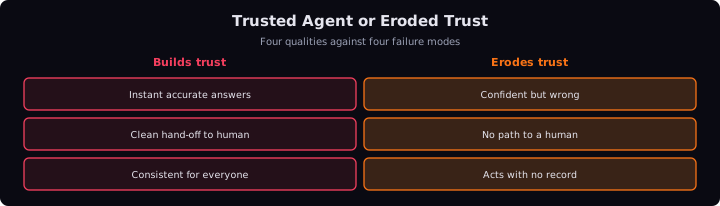
Speed and infrastructure only matter if the partner's experience improves. This lesson describes what a great partner experience looks like with agents in the loop: instant, accurate answers; a clear hand-off to a human when judgment is needed; and consistency across every partner without a manager stretched thin. It also names the failure modes that turn an agent from an asset into a source of distrust.

~3 min

By the end you can

  • Describe the qualities of a strong agent-assisted partner experience.
  • Explain why a clean hand-off to a human is part of a good experience.
  • Connect agent consistency to fairness across a partner base.
  • Identify the failure modes that erode partner trust in an agent.

What good feels like to a partner

From a partner's seat, a strong agent-assisted experience has a clear shape. Questions get answered immediately and correctly, at any hour, without a ticket number. The partner does not have to know which system holds the answer; the agent reaches across the PRMPartner relationship management platform: the system that holds partner records, tiers, deal registrations and enablement content for a partner program., CRMCustomer relationship management system: where a company tracks its accounts and sales opportunities, including the deals a co-sell motion runs through. and marketplace and returns one clear response. Progress on onboarding or a co-sell deal is visible, not stuck in someone's inbox. The overall feeling is of an ecosystem that is responsive and easy to work with, which is precisely what makes a partner choose to lead with you over a competitor.

Knowing when to hand off

A great experience is not an agent that pretends to handle everything. It is an agent that knows its edge. When a partner asks something judgment-heavy, an unusual discount, a contract exception, a strained relationship, the agent should recognize the limit and hand off cleanly to the right person, carrying the context so the partner does not repeat themselves. The hand-off is a feature, not a failure. A partner trusts an agent more, not less, when it says plainly that a human will take this and then makes that happen fast. An agent that bluffs past its limit does far more damage than one that escalates well.

Consistency as fairness

Human partner management is uneven by nature. The partners a manager likes, or has time for, get faster and better answers. An agent gives every partner the same quality of response regardless of size, region or who happens to be free. For a small partner that used to wait at the back of the queue, this is a real upgrade, and it makes the program feel fair. Consistency also protects the vendor: the same policy is applied the same way every time, so a partner cannot play one manager against another. Fairness at scale is one of the quieter but stronger benefits of putting an agent in the loop.

How it goes wrong

The failure modes are worth naming because they are what destroy trust. An agent that answers confidently but wrongly is worse than no agent, because the partner acts on it. An agent with no path to a human traps the partner in a loop. An agent that cannot see the partner's context gives generic answers that feel like a wall. And an agent that acts without leaving a record makes disputes unwinnable. A good partner experience is therefore not just a capable agent; it is a capable agent that is accurate, escalates cleanly, sees context and is accountable. Miss any one of those and the agent becomes the reason a partner stops trusting the program.

Accuracy, escalation, context, and a record define a good experience; bluffing destroys it.

Check your understanding

Answer each from memory. Your results are saved in this browser and count toward your readiness — sign in (account panel above) to keep them across devices.

  1. Why is a clean hand-off to a human part of a good agent-assisted experience?

  2. How does agent consistency improve fairness across a partner base?

  3. Which is a failure mode that erodes partner trust in an agent?

13 min · Core

Build, Buy, or Orchestrate Agent Capability

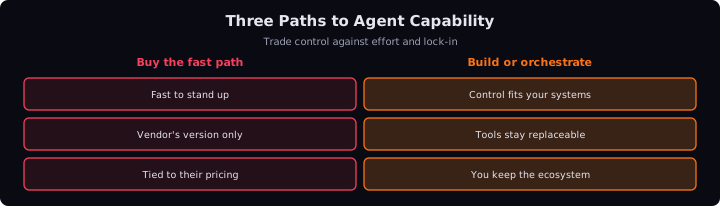
Once you know where agents help, the practical question is how to add the capability. There are three paths: build agents yourself, buy them inside a vendor's platform, or orchestrate agents across the tools you already run. Each trades control against effort and lock-in. This lesson gives partner and BD leaders a way to choose, with a strong bias toward keeping the ecosystem yours rather than surrendering it to one vendor's roadmap.

~3 min

By the end you can

  • Describe the build, buy and orchestrate paths to agent capability.
  • Compare the paths on control, effort and lock-in.
  • Explain why lock-in is a specific risk for an ecosystem owner.
  • Recommend a path for a given situation without surrendering the ecosystem.

Three ways to add agents

Adding agent capability is not one decision but a choice among three shapes. You can build, creating agents in-house against your own systems and APIs. You can buy, switching on the agent features your PRMPartner relationship management platform: the system that holds partner records, tiers, deal registrations and enablement content for a partner program. or CRMCustomer relationship management system: where a company tracks its accounts and sales opportunities, including the deals a co-sell motion runs through. vendor already offers inside their platform. Or you can orchestrate, running a layer that coordinates agents across the several tools you already use, so no single tool owns the whole motion. Most ecosystems end up with a mix, but the shape you lead with sets your position for years.

Control, effort and lock-in

The three paths trade three things. Build gives the most control and fits your systems exactly, but it costs real engineering time and ongoing upkeep, so it suits your highest-value, most distinctive motions. Buy is the fastest to stand up and needs little effort, but you get the vendor's version of the motion and you are tied to their pace and their pricing. OrchestrateRunning a coordinating layer that directs agents across the several tools you already use, keeping each tool replaceable rather than captive inside a single vendor's stack. sits between: more effort than buying, but it keeps each tool replaceable and lets you assemble the best pieces rather than accepting one vendor's whole stack. Reading a path means asking which of control, speed and independence you can least afford to give up for this particular motion.

Why lock-in bites an ecosystem owner

Lock-in deserves special weight when you run an ecosystem, because your ecosystem is your asset. If your onboarding, enablement and co-sell agents live entirely inside one vendor's platform, that vendor now sits between you and your partners. Their roadmap decides what your partners can do. Their price increase is your cost. If you ever want to move, the agents, and the partner experience built on them, do not come with you. Buying a feature is fine; handing a vendor the connective tissue of your partner relationships is a strategic mistake dressed as convenience. The deeper the agent reaches into the partner motion, the more the lock-in question matters.

Choosing without surrendering the ecosystem

A workable rule keeps the ecosystem yours. Buy agents for commodity, low-differentiation tasks where the vendor's version is good enough and switching later is cheap. Build agents for the motions that are your competitive edge, where control is worth the effort. And orchestrate as the default connective layer, so the agents coordinate across your tools rather than living captive inside one. The test to apply before any agent decision is simple: if this vendor doubled their price or changed direction next year, could I move without breaking my partners' experience. If the answer is no, you are not adding a capability, you are giving your ecosystem away. Keep the answer yes, and agents make the ecosystem faster while it stays yours.

Buy commodity tasks, build your edge, orchestrate as the layer so the ecosystem stays yours.

Check your understanding

Answer each from memory. Your results are saved in this browser and count toward your readiness — sign in (account panel above) to keep them across devices.

  1. What is the main trade-off of the 'buy' path for agent capability?

  2. Why does vendor lock-in carry special weight for an ecosystem owner?

  3. Which rule keeps the ecosystem yours while still adding agents?

Flashcards

Recall-first review of the load-bearing facts.

0 reviewed · 8 left

Ready to test yourself?

12 graded questions with real explanations. You commit a confidence before each reveal — that is how you find what you only think you know.

Start practice quiz →
AI Agents in Partner Motions — The Strategic Infrastructure Architect | Contested Futures Academy · The Contested Futures Institute