Capstone: Architect an Ecosystem

Every prior module gave you one part of the machine: the ecosystem map, the commercial architecture, the technology stack, AI agents in the workflow, governance and outcome metrics. This capstone puts them together. It shows what a great end-to-end partner-ecosystem architecture looks like, how the parts reinforce each other into one coherent design, how to turn that design into a portfolio piece that proves you can do the work, and how to position yourself for a role fewer than one in twenty people are ready for. It ends with a self-attested walkthrough where you design a full ecosystem for a company of your choice.

  • capstone
  • ecosystem-architecture
  • portfolio
  • positioning
  • systems-thinking
  • career-strategy
13 min · Core

The Target Architecture

Before you can build an ecosystem you need a picture of what a finished, excellent one looks like. This lesson lays out the target architecture: the six layers a great partner ecosystem runs on, how a signal moves from a partner touch all the way to booked revenue, and the three tests that separate a real architecture from a pile of disconnected programs.

~4 min

By the end you can

  • Name the six layers that make up an end-to-end partner-ecosystem architecture.
  • Trace how a single partner signal flows from first touch to booked revenue.
  • Apply the three tests that distinguish an architecture from scattered programs.
  • Explain why the layers must reinforce each other rather than stand alone.

What finished looks like

You cannot build toward a picture you have never seen. A great partner ecosystem is not a longer list of signed logos; it is an architecture, a set of parts arranged so that each one makes the others stronger. Picture it as six layers stacked on top of each other. At the base sits the strategy and map: who your partners are, which type each one is, and what role they play in reaching a customer. Above it is the commercial architecture: the deal shapes, incentives and money flows that make partnering worth someone's time. Then the technology stack: the systems that register deals, share leads and track what happens. Above that, AI agents that do the repetitive routing and matching a human used to do by hand. Then governance: the rules, guardrails and decision rights that keep the whole thing honest. At the top, outcomes and metrics: the small set of numbers that prove the ecosystem creates value.

Follow one signal

The test of an architecture is whether a signal can travel cleanly through it. Imagine a partner mentions that their client is evaluating a new system. In a great architecture that signal is captured in the stack, matched by an agent to the right internal owner, shaped into a registered co-sell deal under the commercial rules, governed so both sides know who does what, and finally counted in the outcome metrics as sourced revenue. In a weak one, the same signal dies in an inbox because no layer was ready to receive it. The difference is not effort. It is design.

Three tests of a real architecture

Three questions separate an architecture from a pile of programs. First, the coherence test: does each layer assume and support the ones around it, or were they bought and built in isolation? Second, the flow test: can you trace a partner interaction end to end without it falling through a gap? Third, the proof test: when leadership asks what the ecosystem produced, is there a clean number, or a story? A design that passes all three is rare, and that is exactly why the skill is scarce.

Why the layers need each other

The layers are not independent. Metrics you cannot instrument are wishes, so the outcome layer depends on the stack. Incentives with no governance become fraud, so the commercial layer depends on the rules. Agents with no clean data amplify noise, so automation depends on the map underneath. When people treat these as separate projects, run by separate teams on separate timelines, they get six half-built things that do not connect. The architect's job is to hold the whole shape in mind and make the parts fit. The rest of this capstone helps you do exactly that.

A great ecosystem is an architecture of six reinforcing layers, not a list of logos.

Check your understanding

Answer each from memory. Your results are saved in this browser and count toward your readiness — sign in (account panel above) to keep them across devices.

  1. What best describes an excellent partner ecosystem?

  2. In a strong architecture, what happens to a partner's signal that a client is evaluating a new system?

  3. Which set correctly names the three tests of a real architecture?
14 min · Core

Bringing It Together

The hardest part of this role is not any single skill but integration. This lesson shows how to weave the map, the commercial architecture, the technology stack, AI agents, governance and metrics into one design where each choice is made in light of the others, and how to sequence the build so you never ship six disconnected halves.

~3 min

By the end you can

  • Explain why integration, not any single skill, is the core of the architect role.
  • Show how a decision in one layer constrains and enables the others.
  • Sequence an ecosystem build so foundations come before automation.
  • Identify the seams where integrated designs most often break.

IntegrationHolding all six layers in mind at once and making each choice fit the others, rather than optimizing any single layer on its own. is the job

Anyone can learn to draw a partner map, and plenty of people can name good metrics. The scarce skill is holding all of it in mind at once and making choices that fit together. An architect does not ask what is the best incentive plan in the abstract; they ask what incentive plan fits this map, is supported by this stack, stays inside this governance, and shows up in these metrics. The moment you optimize one layer on its own, you break its neighbors. This is why the role pays: it demands a systems mind, not a checklist.

How one choice ripples

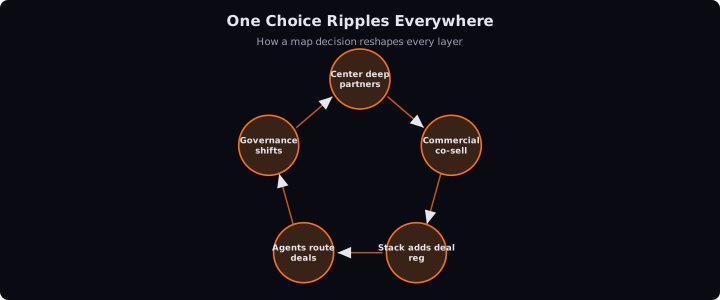
Watch a single decision travel. Suppose you decide the map should center on a few deep service partners rather than many light referral partners. That choice reshapes the commercial architecture, because deep partners need co-sell economics and joint planning, not a flat referral fee. It reshapes the stack, because you now need deal registration and shared pipeline, not just a lead form. It reshapes the agents, because they route complex opportunities instead of scoring cold leads. It reshapes governance, because larger shared deals need clear rules on conflict and credit. And it reshapes metrics, because you now measure sourced and influenced revenue, not sign-ups. One choice at the base moved every layer above it. That is what integration means in practice.

Build in the right order

Because the layers depend on each other, order matters. You cannot automate a process you have not defined, and you cannot define a process without knowing which partners it serves. So the sequence runs upward: settle the strategy and map first, then the commercial architecture, then the stack that carries it, then the agents that speed it up, with governance and metrics designed alongside from the start rather than bolted on at the end. Teams that start with the shiny automation layer, because it demos well, almost always rebuild it once the foundation underneath finally arrives. Sequencing is not bureaucracy; it is how you avoid paying for the same work twice.

Where designs break

Integrated designs fail at their seams, the handoffs between layers. A lead the stack captures but no incentive rewards. A deal the incentive rewards but no governance rule covers. A metric leadership wants but no system can measure. Each seam is a place where one layer assumed something the next did not deliver. A good architect walks every seam before the build starts and asks a blunt question: when work crosses from this layer to the next, does the next one actually catch it. Answer that honestly for every handoff and you have done the real work of bringing it together.

Choosing deep partners at the base moves every layer above it into a co-sell shape.

Check your understanding

Answer each from memory. Your results are saved in this browser and count toward your readiness — sign in (account panel above) to keep them across devices.

  1. Why is integration the core skill of the strategic infrastructure architect?

  2. If you choose to center the map on a few deep service partners, what follows?

  3. What is the correct build order for an ecosystem?

12 min · Core

The Portfolio Artifact

Employers do not hire for claims, they hire for evidence. This lesson shows how to turn the design you build in this capstone into a portfolio artifact: a tight, professional document that proves you can architect an ecosystem, what to put in it, what to leave out, and how to make it survive a skeptical hiring manager's skim.

~3 min

By the end you can

  • Explain why a portfolio artifact beats a resume claim for this role.
  • List the sections a strong ecosystem architecture artifact contains.
  • Decide what to include and what to cut to keep the artifact sharp.
  • Prepare the artifact to survive a hiring manager's skeptical skim.

Claims are cheap, evidence is rare

Anyone can write partner ecosystem strategist on a resume. Almost no one can hand you a document that shows them actually designing one. That gap is your opening. A portfolio artifact is a short, self-contained piece of work that demonstrates the skill instead of asserting it. For this role it is a written architecture: you take a real company, design its full partner ecosystem across all six layers, and present the design the way you would present it to that company's leadership. It moves you from the pile of people who say they can do the work to the tiny group who visibly have.

What goes inside

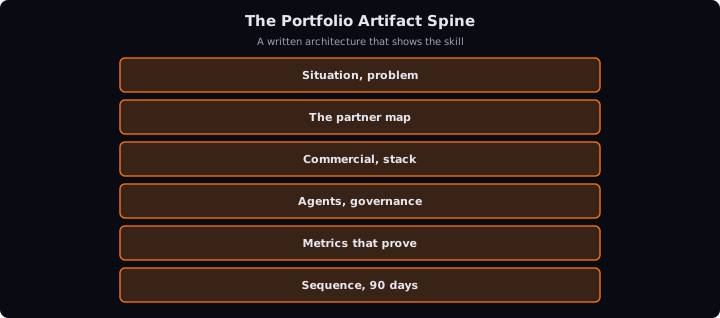
A strong artifact has a predictable spine. It opens with the situation: the company, its go-to-market, and the specific problem partnering should solve. Then the map: the partner types and the role each plays. Then the commercial architecture, the stack, the agents, the governance and the metrics, each stated as a clear decision with a reason, not a menu of options. It closes with a build sequence and the first ninety days, so the reader sees you can execute, not just theorize. Diagrams help, but only where they earn their place; a clean one-page map is worth more than five busy slides.

Cut until it is sharp

The most common mistake is including everything you know. An artifact is judged by its clarity, not its weight. Cut every sentence that does not advance a decision. Drop the background theory the reader already accepts. Replace hedging with a stated choice and a reason you would defend. If a section could apply to any company, it is too generic to earn a place; specificity is the proof that you actually thought about this one. The goal is a document a busy leader can read in ten minutes and come away certain you understand the whole machine.

Survive the skeptical skim

Assume the hiring manager will skim, not study. That means the structure has to carry the argument on its own. Use plain section headers that name each layer, lead every section with its key decision in the first sentence, and make the metrics concrete enough to argue about. A skeptical reader is looking for the seam where your thinking falls apart, so close the seams yourself: show that your incentives match your map and your metrics match your stack. An artifact that survives the skim, and rewards the closer read, is the single strongest thing you can bring to the interview for this role.

Evidence beats a claim: each section is one clear decision, closing with a build sequence.

Check your understanding

Answer each from memory. Your results are saved in this browser and count toward your readiness — sign in (account panel above) to keep them across devices.

  1. Why does a portfolio artifact beat a resume claim for this role?

  2. What should the artifact close with, so it shows execution and not just theory?

  3. What is the most common mistake people make with a portfolio artifact?

12 min · Core

Positioning Yourself for the Role

The profile this course builds is rare on purpose. Very few people can span strategy, commercial design, technology and AI in one head. This lesson shows how to tell that story on a resume and in conversation, how to translate a non-traditional background into the role, and how to make a hiring manager see the profile fewer than one in twenty candidates actually have.

~4 min

By the end you can

  • Describe the rare cross-domain profile this role requires.
  • Translate a non-traditional or career-changer background into the role's language.
  • Frame a resume and narrative around architecture, not activity.
  • Show the profile in an interview through a design conversation, not a claim.

The profile that is scarce

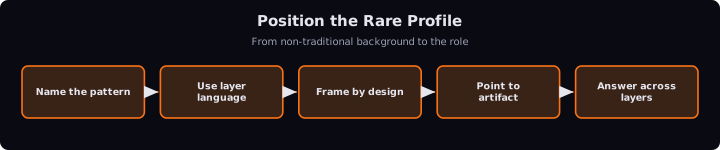
Most partner professionals live inside one layer. Some know deals, some know tools, some know strategy, few know AI, and almost none can hold all of them together. The role this course prepares you for asks for exactly that span, which is why the qualified pool is so thin. That scarcity is your advantage, but only if you can name the profile out loud. When you describe yourself, do not list the layers as separate skills; describe yourself as someone who designs how the parts fit. The phrase that lands is architect, not administrator: you build the machine, you do not just run one corner of it.

Translate the background you have

Many people arriving at this role come from somewhere else: sales operations, a channel job, consulting, even a career change from an unrelated field. That is not a weakness to hide; it is raw material to translate. A career-changer who ran logistics already understands flow, handoffs and the cost of a broken seam, which is precisely systems thinking. A former salesperson understands why partners act on incentives and not on slogans. The move is to take what you did and restate it in the language of the six layers. You did not just coordinate suppliers; you designed a flow across a chain of parties, which is the same shape as an ecosystem map. Name the transferable pattern, not the old job title.

Frame the resume around architecture

A weak resume lists activities: ran webinars, managed partners, hit quota. A strong one shows architecture and outcome: redesigned the deal-registration flow so partner-sourced revenue could be measured, and it rose. Lead with the design decision and the result it produced, because that is the evidence of the profile. Where you lack a past example, your capstone artifact fills the gap; a self-directed architecture of a real company is legitimate proof of capability, and for a career-changer it is often stronger than a thin line of unrelated history. Point to the artifact and let it carry the claim.

Prove it in the room

The interview is where the profile is confirmed or exposed. Do not assert that you think in systems; demonstrate it. When asked about a partner problem, answer across layers: name the map implication, the commercial implication, the stack implication and the metric that would prove it worked. A candidate who instinctively connects the layers in a live conversation shows the hiring manager the rare profile in real time, in a way no resume line can. Fewer than one in twenty candidates can do this. Practice the design conversation until it is your natural way of answering, and you become the one they remember.

Translate your background, lead with decisions, and prove the profile in a live talk.

Check your understanding

Answer each from memory. Your results are saved in this browser and count toward your readiness — sign in (account panel above) to keep them across devices.

  1. Why is the profile this course builds scarce, and how should you describe it?

  2. How should a career-changer treat a non-traditional background?

  3. What is the strongest way to prove the profile in an interview?

15 min · Supplement

Capstone: Your Ecosystem Blueprint

This is the synthesizing exercise for the whole course. You choose a real company and design its complete partner ecosystem, layer by layer, applying everything from every module. The walkthrough below is a self-attested build: you work through each step on your own, honestly check your output against the marks of a strong design, and end with a portfolio-ready blueprint.

~4 min

By the end you can

  • Choose a suitable company and frame the problem its ecosystem must solve.
  • Design each of the six layers as a set of connected decisions.
  • Self-check the design against coherence, flow and proof.
  • Produce a portfolio-ready blueprint and first-ninety-days plan.

How this walkthrough works

This is a self-attested capstone. No system grades it; you do, honestly, the same way a working architect checks their own design before showing it. Work through the steps in order, write your answers down as you go, and hold each one against the marks of a strong design named in the earlier lessons. When you finish you will have a real blueprint you can refine into the portfolio artifact. Set aside a focused block of time and treat it as if a company were paying for the result.

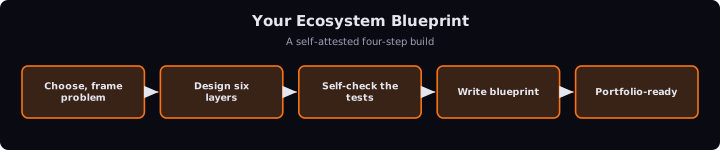
Step one: choose the company and frame the problem

Pick a real company you understand well enough to reason about, ideally one whose products and go-to-market you can describe from memory. Write two or three sentences on how it reaches customers today and the specific problem a partner ecosystem should solve, such as reaching a market its direct sales force cannot cover economically. If you cannot state the problem in plain terms, choose a different company; a vague problem produces a vague design. Attest to yourself: is the problem specific enough that success would be recognizable.

Step two: design the six layers as connected choices

Now build upward, and after each layer check that it fits the ones below. First the map: which partner types matter and the role each plays. Then the commercial architecture: the deal shapes and incentives that make those partners act. Then the stack: the systems that register, route and track. Then the AI agents: the repetitive routing and matching you hand to software. Then governance: the guardrails, conflict rules and decision rights. Finally the metrics: the few numbers that would prove the ecosystem works. After each layer, write one sentence on how it depends on the layer beneath it. If you cannot write that sentence, the layers are not yet connected.

Step three: self-check against the three tests

Turn the three tests on your own work. For coherence, read the layers as a set and mark any place two of them contradict each other, such as an incentive that rewards behavior your governance forbids. For flow, trace one partner signal from first touch to booked revenue and mark every point it could fall through a gap. For proof, ask whether your metrics could actually be measured by the stack you designed, or whether they are wishes. Fix what fails before moving on. Attest honestly: a design that fails these tests on paper will fail harder in the room.

Step four: write the blueprint and the first ninety days

Assemble your work into a single document with the spine from the portfolio lesson: situation, map, commercial, stack, agents, governance, metrics, then a build sequence and a first-ninety-days plan. Cut every sentence that does not advance a decision. Read it once as a skeptical hiring manager would and close any seam you find. When it reads clean in ten minutes and holds up on a second look, you have completed the course: a full partner-ecosystem architecture, designed by you, for a real company, ready to carry into an interview.

Work each step honestly, checking coherence, flow, and proof, until it reads clean.

Check your understanding

Answer each from memory. Your results are saved in this browser and count toward your readiness — sign in (account panel above) to keep them across devices.

  1. What does it mean that this capstone is self-attested?

  2. What is the right first step of the walkthrough?

  3. After designing each layer, what should you write, and why?

Flashcards

Recall-first review of the load-bearing facts.

0 reviewed · 8 left

Ready to test yourself?

12 graded questions with real explanations. You commit a confidence before each reveal — that is how you find what you only think you know.

Start practice quiz →
Capstone: Architect an Ecosystem — The Strategic Infrastructure Architect | Contested Futures Academy · The Contested Futures Institute