Closing the Strategy-Execution Gap

The strategic infrastructure architect role has changed. It is no longer enough to design elegant partner strategies and hand them off. The market now rewards people who personally execute: who ship the first integration, land the first joint deal, and carry a real revenue number. This module reframes the senior partner professional as an individual contributor who owns outcomes end to end. It covers the IC-at-VP mandate, the builder mindset behind personally shipping, land-and-expand inside a partner ecosystem, owning the number, and a concrete first-ninety-days plan for landing the role and proving the profile fast.

  • individual-contributor
  • execution
  • land-and-expand
  • ownership
  • partner-ecosystems
  • revenue-accountability
12 min · Core

The IC-at-VP Mandate

Senior partner and alliance roles used to be measured by the quality of the strategy you produced and the size of the team you ran. That has flipped. Companies now want people who operate at a VP's level of judgment but do the work themselves. This lesson explains why the individual contributor who executes has become the most valuable profile in partnerships, and what that means for how you position yourself.

~3 min

By the end you can

  • Explain what the IC-at-VP mandate means and why it emerged.
  • Contrast the old manage-and-delegate model with the new own-and-execute model.
  • Describe the market forces pushing companies toward leaner, execution-heavy teams.
  • Position your own experience against the profile hiring managers now want.

The profile that changed

For a long time, a senior partnerships hire was judged on two things: could you think at a strategic level, and could you run a team that carried out the plan. The strategy deck and the org chart were the deliverables. That model is fading fast. What companies now want is someone who has the judgment of a vice president and the hands of an operator, one person who both sets the direction and does the work. This is the IC-at-VP mandateThe expectation that a senior partner or alliance professional combines a vice-president's strategic judgment with the hands-on execution of an individual contributor, doing the work rather than only managing it.: operate at the altitude of a leader, but execute like an individual contributor.

Why it emerged

Three forces drove the shift. First, budgets tightened, and companies stopped funding large partner teams whose leaders mostly managed. Second, the AI era made small teams far more capable, so a single person with good tools can now cover ground that once took five. Third, buyers and partners lost patience with layers of coordination; they want to talk to the person who can actually make a decision and then make it happen. Put together, these forces reward the operator who owns the outcome and punish the manager who only orchestrates.

Manage-and-delegate versus own-and-execute

The old model was manage-and-delegate: you scoped the partnership, assigned pieces to your team, and reported up on progress. The new model is own-and-execute: you scope the partnership, then you personally write the joint solution brief, get the first customer on a call, and push the integration over the line. The difference is not that strategy stopped mattering. It is that strategy with no personal execution behind it is now treated as talk. A hiring manager reading two resumes will pick the person who says I built and closed over the person who says I oversaw and enabled.

What this means for you

If you come from a management-heavy background, this is not a threat, it is a repositioning task. The judgment you built is exactly what the mandate demands; what you must add and show is proof that you can still do the work yourself. If you are changing careers into partnerships, this is good news: you do not need a title or a team to be credible. You need a shipped result. The rest of this module is about how to build and show that proof, so that when someone asks what you own, you have a concrete answer rather than a description of what you coordinated.

The mandate pairs a leader's judgment with hands-on work; built and closed wins the seat.

Check your understanding

Answer each from memory. Your results are saved in this browser and count toward your readiness — sign in (account panel above) to keep them across devices.

  1. What does the IC-at-VP mandate ask a senior partner professional to do?

  2. Which force is a real driver of the IC-at-VP shift?

  3. A hiring manager compares two resumes for a senior alliances role. Which phrasing wins under the new mandate?
13 min · Core

Personally Shipping

The heart of the new profile is a builder mindset: owning delivery from first idea to shipped result, rather than delegating each piece until nothing is actually finished. This lesson defines what it means to personally ship a partnership outcome, why delegation-to-death fails, and how to think like a builder even when your job is officially about relationships and strategy.

~3 min

By the end you can

  • Define what personally shipping a partnership outcome looks like.
  • Explain why delegating every piece leads to work that never lands.
  • Describe the builder mindset applied to alliances and BD.
  • Identify what a partner professional can personally build without engineering skills.

What shipping means here

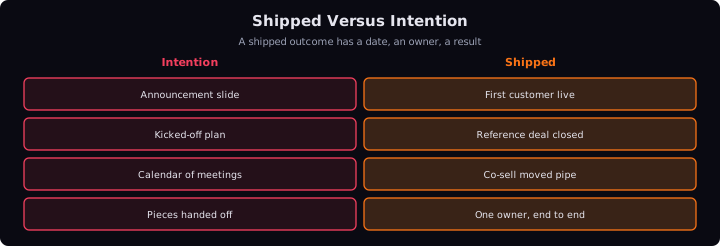
To ship is to take something all the way to a real, usable result that a customer or partner can point to. In partnerships, shipping is not a signed slide or a kicked-off initiative. It is the first joint customer live on the integration, the reference deal closed, the co-selling motion that actually moved pipeline this quarter. A shipped outcome has a date, an owner, and a result you can name. Everything before that is intention. The builder holds themselves to the shipped result, not to the activity that surrounds it.

Why delegation-to-death fails

The classic failure mode of a senior person is to break a partnership into pieces and hand each one off: the deck to marketing, the integration to a partner engineer, the pricing to finance, the deal to a rep. Each handoff feels like leverage, but with no one owning the whole, the pieces never assemble. The partner engineer waits on the pricing, the rep waits on the deck, and six months later there is activity everywhere and nothing shipped. This is delegation-to-death: so much passing-off that ownership evaporates. The builder still uses other people, but keeps the end-to-end result in their own hands and personally clears the blocks that stall it.

The builder mindset in a relationship job

People assume partnerships is purely a relationship role, so shipping does not apply. That is wrong. A builder in this seat asks, at every step, what can I personally produce today that moves this to done. Sometimes that is writing the one-page joint value proposition instead of asking marketing for it. Sometimes it is drafting the mutual close plan and walking both sales teams through it. Sometimes it is sitting in the first technical scoping call so it does not slip. The mindset is bias to action and personal responsibility for the finish, applied to a job that is usually run on meetings and follow-ups.

What you can build without being an engineer

You do not need to write code to be a builder in partnerships. You can build the joint solution narrative, the reference-able first customer, the enablement kit both sales teams actually use, the demo environment scoped with a partner engineer, the deal desk that unblocks co-sell pricing. Each of these is a concrete artifact you can own and deliver. For a career-changer this is the fastest path to credibility: pick one partnership, take a single outcome all the way to shipped, and you have a story no title can give you. The next lessons take that shipped beachhead and grow it.

To ship is a real result a customer can point to; slides and meetings are only intention.

Check your understanding

Answer each from memory. Your results are saved in this browser and count toward your readiness — sign in (account panel above) to keep them across devices.

  1. Which of these counts as a shipped partnership outcome?

  2. What is delegation-to-death?

  3. A career-changer with no engineering background wants to prove the builder mindset. What is the strongest move?

14 min · Core

Land and Expand Inside Ecosystems

A partnership rarely starts big. It starts as a beachhead: one use case, one champion, one small win. Land and expand is the discipline of turning that beachhead into a major joint motion. This lesson walks through choosing where to land, proving value fast, and expanding across products, teams and geographies inside a partner's ecosystem.

~3 min

By the end you can

  • Explain the land-and-expand model in a partner ecosystem context.
  • Choose a beachhead that is small enough to win and strategic enough to grow.
  • Describe how a first win creates the credibility to expand.
  • Map the expansion paths across products, teams and regions.

Start with a beachhead

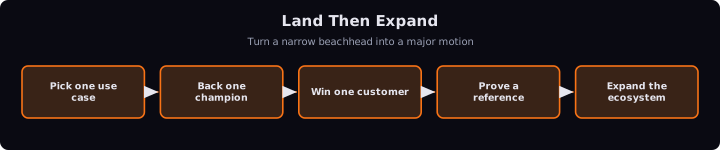
The instinct in a new partnership is to announce everything at once: every product, every region, every joint use case. It almost never works, because a broad launch has no owner on the other side and no early proof. Land and expandThe discipline of winning a narrow, winnable beachhead in a partnership first, then growing it across products, teams and geographies once a first result proves value. takes the opposite path. You land with a narrow, winnable beachhead, one specific use case, backed by one internal champion at the partner, aimed at one clear customer outcome. A small, real win beats a large, vague ambition, because the win gives you something to point to when you go back for more.

Choosing where to land

A good beachhead is small enough to win this quarter and strategic enough to be worth growing. Look for the intersection of three things: a use case where your two offerings genuinely fit together, a champion at the partner who benefits personally from it succeeding, and a customer who feels the pain today. If any of the three is missing, the landing stalls. Avoid the beachhead that is easy but leads nowhere, and avoid the one that is strategic but too big to prove. The art is picking the smallest first step that still points at the big prize.

The first win buys credibility

Inside a partner's ecosystem you are one of hundreds of alliances competing for attention. The only currency that reliably buys more of it is a proven result. When you land a beachhead and produce a referenceable customer, you change the conversation. Now the partner's other teams have a reason to take your call, because you are the alliance that actually delivered, not the one that pitched. This is why the sequence matters: you cannot expand on a promise, only on proof. The first shipped win is the key that unlocks the rest of the ecosystem.

Mapping the expansion

Once you have landed, expansion runs along three axes. You can expand by product, adding a second and third joint use case to the same customers. You can expand by team, moving from one champion's group to adjacent business units inside the partner. And you can expand by geography, taking a motion proven in one region and repeating it in others. The skilled architect maps these paths early, so each win is chosen partly for the doors it opens next. A beachhead in the partner's most connected business unit is worth more than an isolated one of the same size, because expansion is the whole point. Landing is the entry fee; expanding is where the number gets made, which is the subject of the next lesson.

You expand on proof, not a promise; a referenceable win opens the ecosystem's other doors.

Check your understanding

Answer each from memory. Your results are saved in this browser and count toward your readiness — sign in (account panel above) to keep them across devices.

  1. What is the core idea of land and expand in a partner ecosystem?

  2. Which combination makes the strongest beachhead?

  3. Why must you land a first win before you can expand inside an ecosystem?

13 min · Core

Owning the Number

The clearest sign that partnerships has become an execution role is that it now carries a revenue number. Owning the number means being accountable for ecosystem-sourced or ecosystem-influenced revenue, forecasting it honestly, and hitting it. This lesson explains what carrying a number means, how partner revenue is measured, and how to hold yourself accountable to it.

~3 min

By the end you can

  • Explain what it means for a partner professional to own a revenue number.
  • Distinguish partner-sourced from partner-influenced revenue.
  • Describe how to forecast and stand behind an ecosystem number honestly.
  • Explain why carrying a number changes how you prioritize your work.

From soft metrics to a hard number

Partnerships used to be measured by soft signals: partners recruited, deals registered, satisfaction scores. Those still have a place, but the role has moved to a harder standard. To own the number is to be accountable for a specific revenue target the ecosystem must produce, the same way a sales rep owns a quota. You are not judged on how much activity you generated but on whether the money showed up. This is the sharpest expression of the execution shift: an outcome you can be right or wrong about at the end of the quarter.

Sourced versus influenced

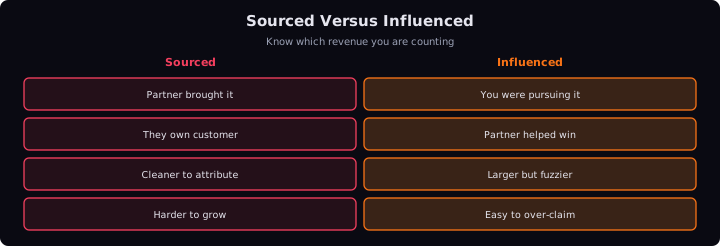
Two kinds of revenue sit under the number, and confusing them is a common trap. Partner-sourced revenue is a deal the partner brought that you would not otherwise have seen: they own the customer relationship and handed you the opportunity. Partner-influenced revenue is a deal you were already pursuing that the partner helped win, through a joint solution, a reference or co-selling. Sourced is cleaner to attribute but harder to grow; influenced is larger but fuzzier and can be over-claimed. A credible architect knows which they are counting, states it plainly, and does not inflate influenced numbers to look good, because inflated attribution collapses the moment finance examines it.

Forecasting you can stand behind

Owning a number means forecasting it, and an honest forecast is worth more than an optimistic one. Build the number bottom-up from real, named opportunities with real close dates, not top-down from a percentage of last year. Apply the same discipline a good sales forecast uses: stage the pipeline, weight it by likelihood, and call your commit and your best case separately. When you tell leadership you will land a figure, that word should mean something. The partner professional who consistently forecasts within a small margin earns trust and budget; the one who sandbags or over-promises loses both.

How the number changes your work

Carrying a number reorders your priorities in a healthy way. Activities that do not plausibly connect to revenue this year get cut. The partnership with a warm logo but no path to a deal loses to the smaller partnership with a live pipeline. Enablement gets aimed at the sales teams closest to closing. You stop measuring yourself by how busy the alliance looks and start measuring by whether the pipeline is real and moving. For the career-changer, this is the most transferable proof point of all: if you can point to a number you owned and hit, you have shown the exact accountability the role now demands.

Sourced is a deal the partner handed you; influenced is one they helped you win.

Check your understanding

Answer each from memory. Your results are saved in this browser and count toward your readiness — sign in (account panel above) to keep them across devices.

  1. What does owning the number mean for a partner professional?

  2. What is the difference between partner-sourced and partner-influenced revenue?

  3. Why is an honest, bottom-up forecast better than an optimistic one?

12 min · Core

The First 90 Days

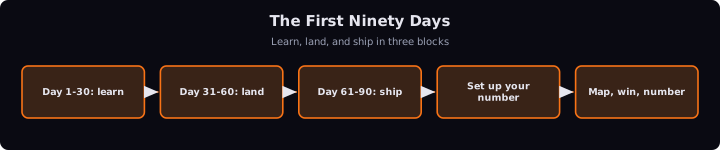
Whether you are landing the role or proving yourself in a new seat, the first ninety days decide how you are perceived. This lesson gives a concrete plan: learn the ecosystem fast, pick one winnable beachhead, ship a first proof, and set up a number you can own. It is written both for the interview, where you present this plan, and for the job, where you run it.

~3 min

By the end you can

  • Lay out a ninety-day plan structured around learning, landing and shipping.
  • Identify what to prioritize in each thirty-day block.
  • Explain how presenting this plan wins the role in an interview.
  • Choose an early win that proves the execution profile fast.

Why the first ninety days decide everything

People form their view of a new hire quickly, and in an execution role that view is built on evidence, not effort. A ninety-day plan focused on a visible early win does two jobs at once. In an interview, presenting the plan proves you think like an operator before you are even hired. In the seat, running it gives you a shipped result to point to before anyone starts to wonder what you are doing. The structure below breaks the ninety days into three blocks, each with one dominant goal.

Days one to thirty: learn the terrain

The first block is for mapping, not heroics. Learn the ecosystem: which partners actually drive revenue, who the internal champions are on both sides, where past joint efforts stalled and why. Meet the sales teams whose deals you will influence and find out where the friction sits. Resist the urge to announce a big plan in week two. The goal of the first thirty days is a clear, evidence-based map of where a winnable beachhead exists, so that when you commit, you commit to something real.

Days thirty-one to sixty: land the beachhead

The second block is for landing. Pick one narrow use case at the intersection of product fit, a willing champion, and a customer in pain, and commit to it. Write the joint value proposition yourself. Get a real customer into a scoping conversation. Line up the small internal pieces, pricing, enablement, a demo, and personally clear the blocks. The aim by day sixty is not a signed mega-deal; it is a live, credible opportunity that would not exist without you, and a partner who now sees you as someone who moves.

Days sixty-one to ninety: ship the proof

The third block is for shipping and setting up the number. Take the beachhead to a first result you can name: a customer live, a deal closed, a co-sell motion that moved pipeline. Then build the number you will own from here, forecast bottom-up from the real opportunities now in play, and share it with leadership so your accountability is explicit. By day ninety you should be able to say three concrete things: here is the ecosystem as it really is, here is the first win I shipped, and here is the number I now own. That sentence is what wins the role in an interview and what earns trust in the job. It is the whole module in miniature: judgment, personal execution, a landed beachhead, and a number.

By day ninety you can name the ecosystem, the first win you shipped, and your number.

Check your understanding

Answer each from memory. Your results are saved in this browser and count toward your readiness — sign in (account panel above) to keep them across devices.

  1. What is the dominant goal of the first thirty days?

  2. Why does presenting a ninety-day plan help win the role in an interview?

  3. By day ninety, which set of statements best shows the execution profile?

Flashcards

Recall-first review of the load-bearing facts.

0 reviewed · 8 left

Ready to test yourself?

12 graded questions with real explanations. You commit a confidence before each reveal — that is how you find what you only think you know.

Start practice quiz →
Closing the Strategy-Execution Gap — The Strategic Infrastructure Architect | Contested Futures Academy · The Contested Futures Institute