The Commercial Architecture

Most partner professionals are taught to build relationships. The best ones build a commercial architecture: the system of money, incentives and selling motions that decides whether a partnership actually produces revenue. This module shows how margins, discounts, funds and rebates line up (or fail to), how co-sell really works across the vendor-partner-customer triangle, how pipeline gets categorized and argued over, and how cloud marketplaces reshape the economics of every deal. It is written for alliance and BD professionals moving from relationship management into owning the numbers.

  • commercial-architecture
  • partner-economics
  • co-sell
  • pipeline
  • marketplace
  • incentive-design
12 min · Core

Owning the Commercial Architecture

Commercial architecture is how money, incentives and selling motions fit together inside a partnership. It is the difference between a friendly relationship and a channel that reliably produces revenue. This lesson defines the term, shows why the strategic partner professional owns it rather than just managing relationships, and lays out the pieces the rest of the module examines.

~4 min

By the end you can

  • Define commercial architecture and name its three core elements.
  • Explain why relationships alone do not produce partner revenue.
  • Describe what it means for the architect to own the numbers, not just the account.
  • Recognize the pieces of the architecture this module will examine in turn.

What commercial architecture means

When a company signs a partnership, the press release talks about a relationship. The revenue, when it comes, is produced by something else entirely: the commercial architecture. That is the system of three things working together. First, money, meaning where the margin lives, who discounts what, and how each side gets paid. Second, incentives, meaning the rewards and funds that pull a partner toward selling one product rather than a competitor's. Third, selling motions, meaning the specific way a deal moves from a lead to a closed contract, and who does what along the way. A partnership succeeds or fails on whether these three line up.

Why relationships are not enough

Alliance professionals are trained to build trust, run quarterly business reviews, and keep executives on both sides happy. All of that matters, but none of it moves revenue on its own. Consider two partnerships with identical goodwill. In the first, the partner earns twenty points of margin, gets marketing funds, and has a clear co-sell path into the vendor's sales team. In the second, the partner earns four points, funds nothing, and has no way to bring the vendor into a deal. The relationship is warm in both. Only the first produces revenue, because only the first has an architecture that pays the partner to sell. Warmth without economics is a friendship, not a channel.

Owning the numbers

The strategic partner professional owns this architecture, not just the account. That is a real shift. It means being fluent in what margin a reseller keeps, how a rebate is triggered, why a deal is registered, and how pipeline is counted on both sides. When a partner's leadership asks whether the partnership is worth the investment, the answer is a set of numbers, not a description of a good relationship. An architect who cannot explain the economics is at the mercy of whoever can, usually the vendor's finance team, whose incentives point elsewhere. Owning the numbers is what lets you design the deal rather than merely accept it.

The pieces ahead

The rest of this module walks the architecture piece by piece. We start with partner economics: margins, discounts, funds and rebates, and how to make the partner's math and the vendor's math point the same direction. Then co-sell mechanics: how a deal actually moves through the vendor-partner-customer triangle, and why deal registration exists. Then the pipeline categories, sourced, influenced and co-sell, that every partner scorecard argues over. Finally, marketplace transaction flows: private offers, committed spend and billing through a cloud provider, which are rewriting the economics of the whole field. Each piece is a lever. Together they are the machine.
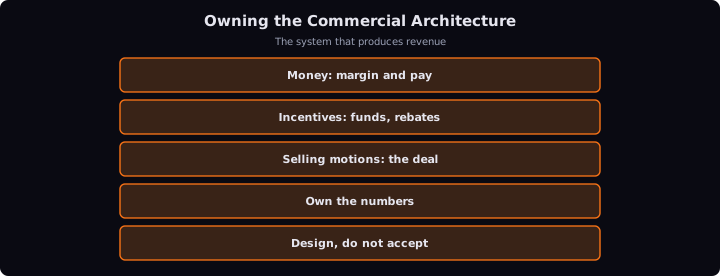
Money, incentives, and selling motions must line up, or warmth stays a friendship not a channel.

Check your understanding

Answer each from memory. Your results are saved in this browser and count toward your readiness — sign in (account panel above) to keep them across devices.

  1. Which three elements make up a partnership's commercial architecture?

  2. Why can two partnerships with equal goodwill produce very different revenue?

  3. What does it mean for a strategic partner professional to own the commercial architecture?
14 min · Core

Partner Economics and Incentives

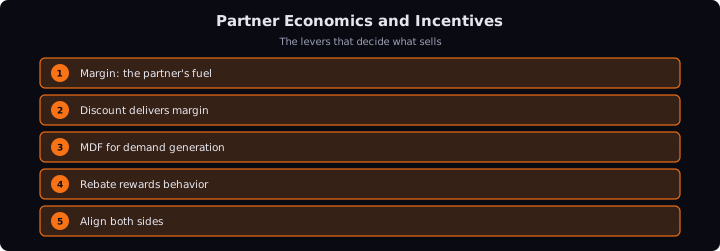
A partner sells what pays it to sell. This lesson covers the levers that decide that: margin and discount, marketing development funds, and rebates. It shows how each works, why they exist, and how a strategic architect aligns the partner's economics with the vendor's so both sides pull the same deal in the same direction.

~4 min

By the end you can

  • Explain how margin and discount determine what a partner earns on a deal.
  • Describe what marketing development funds (MDF) are for and how they are misused.
  • Explain how rebates reward behavior the vendor wants to see more of.
  • Show how to align partner and vendor economics so incentives point the same way.

MarginThe gap a reseller keeps between the price it pays the vendor and the price it charges the customer. The partner's core fuel and the clearest signal of what the vendor wants sold.: what the partner actually earns

The first question any partner asks is simple: what do I make on this deal. For a reseller, the answer is margin, the gap between the price it pays the vendor and the price it charges the customer. If a vendor sells a license to the partner at a twenty-percent discount off list, and the partner sells it at list, the partner keeps twenty points. That gap is the fuel. A partner earning four points on a hard-to-sell product will quietly steer customers toward a competitor's product that pays twenty. Margin is not a detail; it is the single strongest signal you send about what you want sold. Thin margin on a strategic product is a design error, not a saving.

Discount and its discipline

Discount is how margin is delivered, but it is also where control lives. A flat discount to every partner treats a specialist who invests in engineers the same as an order-taker who does nothing. Tiered discounts, more margin for partners who certify staff, build practices, or hit volume, are how a vendor pays for the behavior it values. The discipline is that discount, once given, is hard to claw back. Partners plan their business around it. An architect protects the discount structure the way a company protects its pricing, because a discount handed out to win one quarter becomes the floor everyone expects forever.

Marketing development funds

Marketing development funds, or MDFMarketing development funds: money a vendor gives a partner to spend on demand generation such as campaigns and events. Effective only when tied to tracked activity and pipeline., are money the vendor gives the partner to spend on demand generation: events, campaigns, content that brings in leads. Used well, MDF is a shared bet: the vendor funds the partner to go find customers it could not reach alone. Used badly, it becomes a slush fund the partner treats as extra margin, spent on golf days that generate no pipeline. The test of good MDF is whether it is tied to activity and outcomes, a co-branded campaign with tracked leads, not handed over as a reward for existing. An architect who cannot connect MDF spend to pipeline has funded goodwill, not growth.

Rebates: paying for behavior

A rebate is money paid back to the partner after the fact for hitting a target: a growth number, a new-logo count, a push into a product the vendor is trying to grow. Where discount is paid up front on every deal, a rebate is earned by behavior over a period. That makes rebates a precise tool. A vendor that wants partners to sell its new security product, not just its established one, can attach a rich rebate to the new product and watch attention shift. The design risk is rewarding what would have happened anyway; a rebate for volume a partner was always going to hit is a gift, not an incentive.

Aligning both sides

The architect's job is to make the partner's math and the vendor's math point at the same deal. The vendor wants a particular product sold to a particular kind of customer. The partner wants to earn the most for the least effort. Alignment means designing margin, MDF and rebates so that the easiest way for the partner to make money is to sell exactly what the vendor wants sold. When those two are aligned, the partnership runs itself; the incentives do the managing. When they diverge, no amount of relationship work fixes it, because you are asking a partner to act against its own economics, and it will not, for long.

Align the partner's math with the vendor's so the easiest money is the deal you want sold.

Check your understanding

Answer each from memory. Your results are saved in this browser and count toward your readiness — sign in (account panel above) to keep them across devices.

  1. What is a reseller's margin on a deal?

  2. What is the test of well-used marketing development funds (MDF)?

  3. How does a rebate differ from a discount as an incentive tool?

14 min · Core

Co-Sell Mechanics

Co-sell is the motion where a vendor and a partner sell together into the same customer. This lesson walks the motion end to end, explains deal registration and the protection it provides, and maps the vendor-partner-customer triangle so the architect can see who holds what and where deals break down.

~4 min

By the end you can

  • Describe how a co-sell deal moves from lead to close, end to end.
  • Explain what deal registration is and the protection it gives a partner.
  • Map the vendor-partner-customer triangle and each party's role.
  • Identify the common points where a co-sell motion breaks down.

What co-sell actually is

Co-sellA selling motion where a vendor's sellers and a partner's sellers work the same opportunity together, each bringing what the other lacks: relationship and delivery from the partner, product and proof from the vendor. is the motion where the vendor's sellers and the partner's sellers work the same opportunity together, each bringing something the other lacks. The partner often owns the customer relationship, the industry knowledge, and the ability to deliver; the vendor brings the product, technical depth, and sometimes the budget to close. Done well, co-sell means a customer meets one team, not two vendors competing for credit. Done badly, it means the customer watches a vendor rep and a partner rep argue over who owns the account while the deal stalls.

The motion, end to end

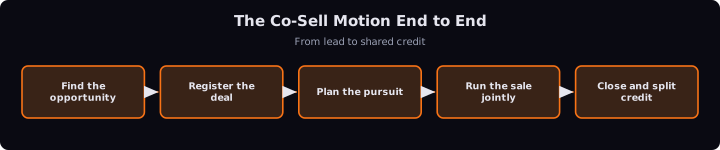
A co-sell deal runs through recognizable stages. Someone finds the opportunity, the partner spots a need at a client, or the vendor passes a lead to a partner who can deliver. The deal is then registered so both sides agree who is working it. The two teams plan the pursuit together, agreeing who talks to whom and who leads which conversation. They run the sales process jointly, the partner on relationship and delivery, the vendor on product and proof. At close, the contract is signed, often through the partner, and both sides claim their share of the credit and the money. Every one of these stages needs an explicit handoff, because a co-sell deal with unclear handoffs falls into the gaps between the two companies.

Deal registrationA mechanism by which a partner declares it is working a specific opportunity and, in return, receives priority and protection from being undercut by another partner or the vendor's direct team.

Deal registration is the mechanism that makes co-sell safe for the partner. When a partner registers a deal, it tells the vendor: I found this, I am working it, protect me. In return the vendor grants that partner priority, often a better discount and a promise not to let another partner or its own direct sales team undercut it on the same opportunity. Without registration, a partner that invests months developing a customer can watch a rival partner swoop in at the last moment with a lower price, or the vendor's own direct team close the deal and cut the partner out. Registration is the contract of trust that makes a partner willing to invest ahead of the sale. Break it once and partners stop bringing you deals.

The triangle

Every co-sell deal is a triangle: vendor, partner, customer. The customer wants a solution and a single accountable throat to choke, not a turf war. The partner wants margin, protection, and to keep ownership of its client. The vendor wants the product sold, the customer happy, and the partner motivated to do it again. Tension is built in. The vendor's direct sales team may want the same customer the partner is working, which is channel conflict in its purest form. The architect's job is to keep the three corners of the triangle pointed at the same outcome, usually by making the rules, who registers, who gets protected, who gets paid, clear before the deal, not during the fight.

Where it breaks

Co-sell breaks at the seams. It breaks when a lead is passed and no one owns the follow-up. It breaks when the vendor's rep and the partner's rep both think they are leading. It breaks when registration is vague and two partners claim the same deal. It breaks at close, when credit and money are split in a way one side considers unfair, and the wronged side quietly stops co-selling. An architect who has watched a motion fail learns to design the handoffs and the credit rules first, because the relationship survives a hard deal only when the rules were agreed before the money was on the table.

Each stage needs an explicit handoff, or the deal falls into the gaps between the two companies.

Check your understanding

Answer each from memory. Your results are saved in this browser and count toward your readiness — sign in (account panel above) to keep them across devices.

  1. What does deal registration protect a partner from?

  2. In the vendor-partner-customer triangle, what does channel conflict most often look like?

  3. Where does a co-sell motion most commonly break down?

13 min · Core

Sourced vs Influenced vs Co-Sell Pipeline

Partner pipeline gets sorted into categories, sourced, influenced and co-sell, and those categories decide who gets credit, budget and belief. This lesson defines each, explains how they are counted, and shows why they are among the most argued-over numbers in any partner organization.

~4 min

By the end you can

  • Define partner-sourced, partner-influenced and co-sell pipeline.
  • Explain how each category is counted and why counting is contested.
  • Describe why influenced pipeline is the category most easily inflated.
  • Explain how pipeline categories drive credit, budget and executive belief.

Why the categories exist

Partner organizations live and die by one question from the CFO: what did the partnership actually produce. Answering it requires sorting pipeline into categories, because not all partner involvement is equal. A deal a partner found from scratch is worth more than a deal the partner merely touched. The three standard buckets, sourced, influenced and co-sell, exist to answer that question honestly. Getting them right is how a partner leader defends a budget; getting them wrong, or gaming them, is how a partner organization loses credibility the moment finance looks closely.

Sourced: the partner found it

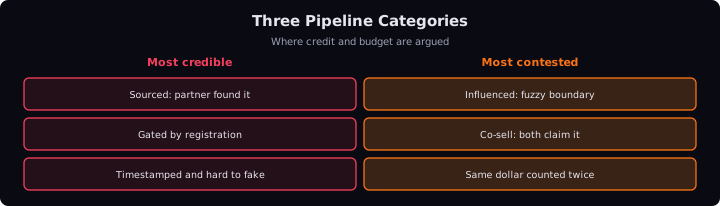
Partner-sourced pipeline is a deal the partner originated, a customer the vendor would not have reached without the partner bringing it in. This is the gold standard, because it is net-new business attributable to the partnership. It is also the hardest to fake: either the partner registered the deal before the vendor knew the customer, or it did not. Sourced pipelinePipeline for deals a partner originated that the vendor would not have reached on its own. The most credible category, usually gated by early, timestamped deal registration. is what justifies the whole program, so it is counted strictly, usually gated by early deal registration with a timestamp that proves the partner was there first.

Influenced: the partner helped

Partner-influenced pipeline is a deal the vendor might have found on its own, but where the partner made a real difference, a technical proof, a trusted recommendation, an integration that clinched the choice. This is genuine value, but it is soft. How much influence counts as influence? If a partner attends one call on a deal the vendor sourced, did it influence it? Because the boundary is fuzzy, influenced pipeline is the category most easily inflated. A partner under pressure to show impact will claim influence on every deal it brushed against, and a vendor eager to justify its program will let them. Everyone knows the number is generous, which is exactly why finance discounts it.

Co-sellA selling motion where a vendor's sellers and a partner's sellers work the same opportunity together, each bringing what the other lacks: relationship and delivery from the partner, product and proof from the vendor.: they sold it together

Co-sell pipeline is a deal both sides actively worked together, the motion from the previous lesson. It sits between sourced and influenced in credibility: more active than influence, but shared origination rather than pure partner sourcing. Co-sell numbers are contested for a different reason: both the vendor and the partner want to count the full deal value as theirs, so the same dollar can appear on two scorecards. When a vendor reports its co-sell number and a partner reports the same deal, adding them up double-counts reality. Honest architecture states clearly whose scorecard a co-sell dollar lands on and resists the temptation to let both claim it in full.

Why the fight matters

These categories are not accounting trivia; they decide real outcomes. Sourced pipeline justifies the partner budget for next year. Influenced pipelinePipeline for deals the vendor might have found alone but where the partner made a real difference. Genuine but soft, and the category most easily inflated because its boundary is fuzzy. is used to argue the partnership is bigger than it looks. Co-sell numbers decide which partners get invested in. Because credit, budget and executive belief all flow from the categories, everyone has a reason to push their deals up the ladder, calling influenced sourced, calling a brush co-sell. The strategic architect's edge is intellectual honesty: reporting numbers a skeptical CFO would accept, because a partner leader whose numbers survive scrutiny is trusted with more, while one caught inflating loses the budget and the benefit of the doubt at once.

Sourced is the gold standard; influenced inflates easily; co-sell risks double-counting.

Check your understanding

Answer each from memory. Your results are saved in this browser and count toward your readiness — sign in (account panel above) to keep them across devices.

  1. What is partner-sourced pipeline?

  2. Why is influenced pipeline the category most easily inflated?

  3. Why can the same co-sell dollar end up double-counted?

14 min · Core

Marketplace Transaction Flows

Cloud marketplaces have changed how software gets bought and paid for. This lesson explains private offers, committed spend drawdown, and billing through the cloud provider, then examines the economics: the marketplace fee, the speed and the drawdown pull that make transacting through a marketplace attractive to buyers and complicated for partners.

~4 min

By the end you can

  • Explain how a private offer works on a cloud marketplace.
  • Describe committed spend drawdown and why it pulls deals to the marketplace.
  • Explain what billing through the cloud provider changes for the seller.
  • Weigh the economics of transacting via marketplace against a direct deal.

A new place to transact

The cloud marketplaces run by the big providers have become a serious channel in their own right. Instead of a customer signing a contract directly with a software vendor, the deal is transacted through the marketplace: the customer buys the software there, the cloud provider handles billing, and the money flows through the provider's platform. For a partner professional this is not a side note. It is a shift in where deals close and how money moves, and it changes the economics of every transaction that runs through it.

Private offers

A marketplace list price is fine for small purchases, but enterprise deals are negotiated. A private offer is how that negotiation lands on the marketplace: the seller creates a custom deal, a specific price, term and terms, visible only to one named customer. The customer accepts it inside the marketplace and the deal transacts there at the negotiated price rather than the public one. Private offers are what let large, bespoke enterprise contracts, the kind that used to be paper, run through the marketplace while keeping their negotiated economics. For a partner, being able to build and manage private offers is now a core skill, because that is where the real deals live.

Committed spend drawdownThe mechanism by which software bought through a cloud provider's marketplace counts against a customer's multi-year committed spend, pulling deals to the marketplace to use budget already promised.

Here is the mechanism that pulls deals to the marketplace. Large customers sign multi-year committed spend agreements with a cloud provider, promising to spend, say, fifty million dollars over three years in exchange for discounts. That commitment is use-it-or-lose-it. Software bought through the provider's marketplace counts against that commitment, it draws down the balance the customer has already promised to spend. So a customer with unspent commitment has a powerful reason to buy software through the marketplace: it turns a new purchase into progress against money it was going to spend anyway. This drawdown is the single strongest force pulling enterprise software deals onto marketplaces, and a partner who understands it can steer a hesitant buyer by pointing at their unspent commitment.

Billing through the provider

When a deal transacts on the marketplace, the cloud provider does the billing. The customer gets one bill from the provider covering cloud and software together; the provider collects the money and passes the seller's share along. This simplifies life for the customer, one invoice, one vendor relationship for payment, and it is part of the appeal. For the seller it changes things: cash arrives through the provider on the provider's cycle, and the seller gives up some direct control of the billing relationship. The convenience for the buyer is real, and it is a reason deals move to the marketplace even when the seller would rather bill directly.

The economics, weighed

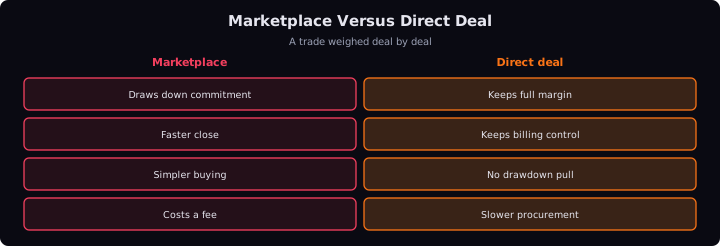
None of this is free. The cloud provider takes a marketplace fee, a percentage of the transaction, in exchange for the platform, the billing and the access to committed spend. So a seller weighs a real trade. Transacting on the marketplace can close a deal faster, tap the customer's committed budget, and simplify buying, but it costs a slice of margin and hands billing to the provider. A direct deal keeps the full margin and the billing relationship but loses the drawdown pull and the buying convenience. The strategic architect does not treat the marketplace as automatically good or bad. They calculate: does the drawdown and speed win more than the fee costs on this deal, with this customer, at this moment. That calculation, deal by deal, is the new commercial literacy.

The architect calculates whether drawdown and speed outweigh the fee and lost billing control.

Check your understanding

Answer each from memory. Your results are saved in this browser and count toward your readiness — sign in (account panel above) to keep them across devices.

  1. What is a private offer on a cloud marketplace?

  2. Why does committed spend drawdown pull deals onto the marketplace?

  3. What trade does a seller weigh when choosing to transact via marketplace instead of a direct deal?

Flashcards

Recall-first review of the load-bearing facts.

0 reviewed · 8 left

Ready to test yourself?

12 graded questions with real explanations. You commit a confidence before each reveal — that is how you find what you only think you know.

Start practice quiz →
The Commercial Architecture — The Strategic Infrastructure Architect | Contested Futures Academy · The Contested Futures Institute