What a Partner Ecosystem Actually Is
A partner ecosystem is the network of companies that surround a vendor and help it build, sell, deliver and support its product. This lesson defines the ecosystem, explains why ecosystems now beat going it alone, and traces the shift from a simple linear channel to a web of interdependent partners that a modern software business cannot succeed without.
By the end you can
- Define a partner ecosystem in plain terms.
- Explain why ecosystems outperform a go-it-alone strategy.
- Describe the shift from a linear channel to a networked ecosystem.
- Recognize the vendor's product as a platform others build on.
More than a list of resellers
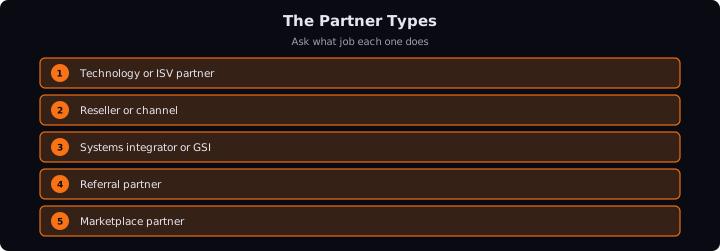
A partner ecosystem is the network of outside companies that help a vendor build, sell, deliver and support its product. When people first hear the word partner they picture a reseller, a company that buys software at a discount and sells it on. That is one kind of partner, but the ecosystem is far wider. It includes software makers whose products plug into yours, consulting firms that install and customize what you sell, referral partners who send you leads, and cloud marketplaces that handle the transaction. Think of the companies around Salesforce, ServiceNow or Snowflake: thousands of apps, integrators and specialists whose combined work makes the core product worth far more than it would be on its own.
Why going it alone loses
A vendor could try to do everything itself: build every feature, hire every salesperson, staff every implementation. In a small market that can work. In a large one it does not, because no single company can match the reach, the local knowledge and the specialized skills spread across an ecosystem. A partner in Germany already has the customer relationships and the language. An integrator already has five hundred consultants trained on a rival product who can retrain on yours. A software partner already serves a customer segment you have never touched. Trying to replicate all of that in-house is slower and more expensive than sharing the work, and the customer usually wants a choice of who helps them anyway.
From a line to a web
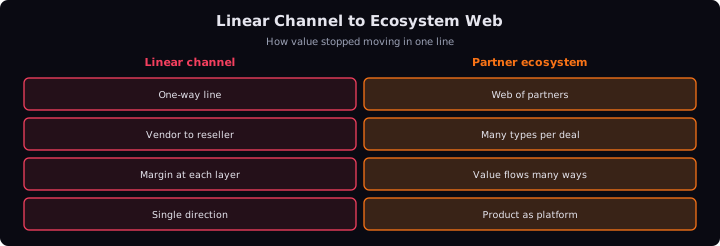
The older model was a linear channel: the vendor sold to a distributor, the distributor sold to a reseller, and the reseller sold to the customer. Value moved in one direction down a straight line, and each layer took a margin. That model still exists, but it no longer describes how modern software reaches people. Today a single deal might involve a software partner whose app triggered the customer's interest, a cloud marketplace that processes the purchase, and a systems integrator that does the rollout, all at once. Value flows in several directions among partners who also depend on each other. The straight line has become a web.
The product as a platform
The deepest shift is that a successful product becomes a platform that others build on. When a vendor opens up its software so partners can extend it, integrate with it and sell alongside it, each partner adds value the vendor never had to create. The ecosystem grows because it is in everyone's interest to make the shared platform succeed. This is why the strongest software companies compete less on features and more on the size and health of the ecosystem around them. For anyone entering partner or alliance work, the first mental shift is this: you are not managing a list of vendors, you are cultivating a network whose combined strength is the real product.
Check your understanding
Answer each from memory. Your results are saved in this browser and count toward your readiness — sign in (account panel above) to keep them across devices.
Which statement best defines a partner ecosystem?
Why does a go-it-alone strategy usually lose in a large market?
What best describes the shift from a linear channel to an ecosystem?