The Ecosystem Tech Stack

A modern partner program runs on software, not just relationships. Deal registration, portals, product integrations, shared pipeline data and clean records in a CRM decide whether a partnership actually produces revenue. This module teaches the systems that power partner ecosystems in plain English, so partner, alliance and business-development professionals can read the stack, ask sharp questions, and hold their own with technical teams, without writing a line of code.

  • prm
  • apis
  • integration
  • technical-literacy
  • crm
  • ipaas
12 min · Core

The Infrastructure Behind Modern Ecosystems

A partner program is no longer run on handshakes and a shared spreadsheet. It runs on a stack of connected systems that track partners, register deals, share leads, and move data between two companies. This lesson maps that stack at a high level and explains why technical literacy has become table stakes for the partner role.

~4 min

By the end you can

  • Name the main systems that run a modern partner program.
  • Explain why a partner program is now a software problem, not only a relationship one.
  • Describe why technical literacy is now table stakes for the partner role.
  • Distinguish literacy (reading the stack) from implementation (building it).

Handshakes do not scale

A partnership starts as a relationship between two people, but a partner program is something else. When a software company works with two hundred resellers, referral partners and technology partners at once, no relationship can hold that together on its own. The program runs on a stack of connected systems: a place to manage the partners themselves, a place for partners to log in and get what they need, a way for a partner to claim a deal before anyone else, and a set of pipes that move data between the two companies. Learn to see that stack and a partner program stops looking like a mystery and starts looking like a machine with named parts.

The parts of the machine

Five kinds of system do most of the work, and the rest of this module takes them one at a time. A CRMCustomer relationship management system, such as Salesforce or HubSpot, where a company records its customers and deals. Every other system in the stack ultimately feeds it. tracks customers.">PRMPartner relationship management system: the home base and system of record for a partner program, tracking partners, their tier, certifications, revenue and onboarding, much as a CRM tracks customers., or partner relationship management system, is the home base that tracks who your partners are and how they are performing. A partner portal is the website partners log into for training, marketing assets and support. Deal registrationA portal feature letting a partner claim a live opportunity so they get the credit and often better margin for a set window, preventing two parties from chasing the same customer. lets a partner stake a claim on an opportunity so two partners do not fight over the same customer. APIs and integrations connect the vendor's product to the partner's product so they work better together. And a CRM, the customer relationship management system, is where all the sales data ultimately lives. Each has a plain job, and together they run the program.

Why this is now your job to understand

For years a partner manager could succeed on charm and follow-through alone. That era is closing. When a partner asks why their deal registration was rejected, or whether your product can share data with theirs, or how co-sell revenue gets credited, the answer lives inside these systems. A partner professional who cannot follow that conversation gets sidelined, deferring to an operations team for every question and losing the partner's confidence in the meantime. Technical literacy is now table stakes: not because you will build anything, but because you cannot lead a program whose machinery you cannot read.

Literacy, not coding

Here is the reassuring part. Reading the stack and building the stack are two different jobs. You do not need to write software, configure a database or design an integration. You need to know what each system does, what good and bad look like, and which questions to ask. Think of a general contractor who cannot lay a brick but knows exactly what the bricklayer, the electrician and the plumber each do, and can tell when the work is going wrong. That is the level of literacy this module builds: enough to ask sharp questions, spot trouble early, and be taken seriously in the room where the program is designed.
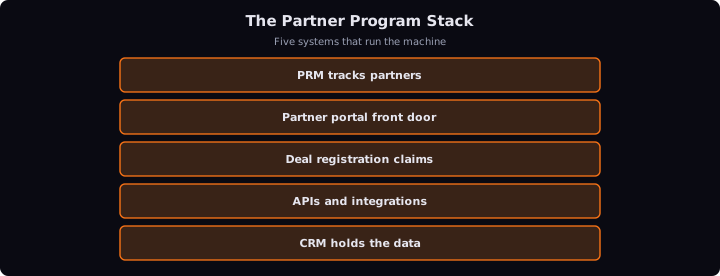
Read the stack to lead the program; literacy means asking sharp questions, not writing code.

Check your understanding

Answer each from memory. Your results are saved in this browser and count toward your readiness — sign in (account panel above) to keep them across devices.

  1. Why is a modern partner program described as running on a stack of systems rather than on relationships alone?

  2. Which set best describes the core systems that run a partner program?

  3. What level of technical understanding does this module aim to build for a partner professional?
12 min · Core

PRM and Partner Portals

The partner relationship management system, or PRM, is the home base of a partner program, and the partner portal is the front door partners walk through. This lesson explains what each does, how deal registration works inside them, and how to tell a portal that helps partners from one that quietly drives them away.

~4 min

By the end you can

  • Explain what a PRM is and the job it does for a partner program.
  • Describe what a partner portal offers and why partners use it.
  • Explain how deal registration protects a partner's opportunity.
  • Identify signs of a healthy portal versus one that frustrates partners.

The home base: what a CRMCustomer relationship management system, such as Salesforce or HubSpot, where a company records its customers and deals. Every other system in the stack ultimately feeds it. tracks customers.">PRMPartner relationship management system: the home base and system of record for a partner program, tracking partners, their tier, certifications, revenue and onboarding, much as a CRM tracks customers. does

If a sales team has a CRM to track customers, a partner team has a PRM to track partners. Think of it as the system of record for the whole program. It holds the list of who your partners are, what tier each one sits in, which certifications their people have earned, how much revenue each has driven, and where they are in the onboarding journey. Tools such as Impartner, Allbound and PartnerStack play this role. When a partner leader asks how the program is doing, the honest answer comes out of the PRM, not out of memory. It is the difference between running a program and guessing at one.

The front door: the partner portal

The partner portal is the website a partner logs into, and it is the part of the stack a partner actually feels every day. Behind that login sits the material a partner needs to sell your product: training courses and certifications, marketing assets they can brand as their own, price lists and product sheets, and a way to raise a support ticket or ask a question. A good portal makes a partner feel equipped and looked after. A neglected one, full of dead links and a two-year-old price list, quietly tells the partner they are not a priority, and they will put their effort behind a vendor who makes selling easier.

Deal registrationA portal feature letting a partner claim a live opportunity so they get the credit and often better margin for a set window, preventing two parties from chasing the same customer., and the conflict it prevents

Buried inside most portals is one feature that partners care about more than any other: deal registration. When a partner finds a live opportunity, they register it, in effect planting a flag that says this customer is mine, I found them first. Once approved, that registration protects them: for a set window, they get the credit and often a better margin, and the vendor will not hand the same deal to another partner or to its own direct sales team. This solves the ugliest problem in any channel, channel conflict, where two parties chase the same customer and the partner who did the work loses out. A slow or unfair registration process is one of the fastest ways to lose partner trust.

Reading a portal's health

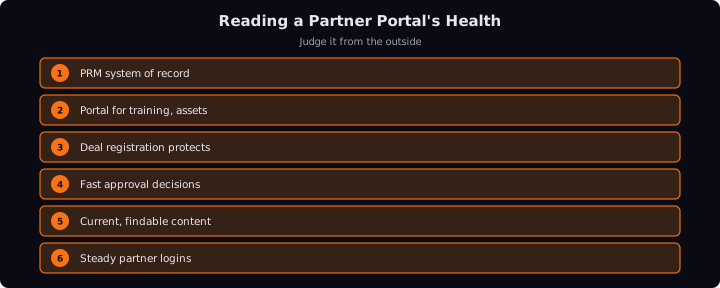
You do not need to log into the database to judge a portal; you can read its health from the outside. Ask a few questions. How long does deal registration take to approve, hours or weeks? Is the content current, or stale? Can a partner find the one asset they need in under a minute, or do they give up? Do partners actually log in, or is the portal a ghost town the data quietly reveals? A healthy portal shows steady logins, fast registration decisions and fresh material. A struggling one shows the opposite, and the partners drift to a competitor whose front door is easier to walk through.

Steady logins, fast approvals, and fresh content signal health; the opposite drives partners away.

Check your understanding

Answer each from memory. Your results are saved in this browser and count toward your readiness — sign in (account panel above) to keep them across devices.

  1. What is a PRM the system of record for?

  2. What is the main job of deal registration inside a partner portal?

  3. Which pattern signals a healthy partner portal that you can read from the outside?

14 min · Core

APIs and Integrations, Explained for Non-Coders

The word API scares non-technical people, but the idea is simple. This lesson explains an API in plain terms, shows why product integrations are the engine of technology-partner ecosystems, introduces webhooks, and makes the case that in many partnerships the integration is the partnership.

~4 min

By the end you can

  • Explain what an API is using a plain, non-technical analogy.
  • Describe why product integrations drive technology-partner ecosystems.
  • Explain in plain terms what a webhook does.
  • Explain the idea that the integration is often the partnership itself.

What an APIApplication programming interface: the agreed way one piece of software asks another for something and gets a clean answer, without either side needing to know how the other works internally. really is

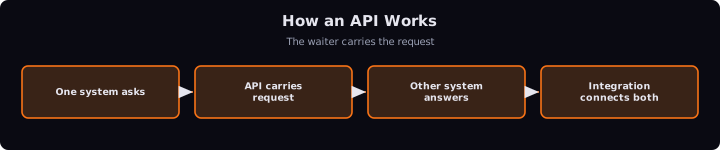
An API, short for application programming interface, sounds technical but the idea is everyday. Picture a restaurant. You sit at the table, you do not walk into the kitchen, and you do not need to know how the chef cooks. You give your order to a waiter, who takes it to the kitchen and brings back your food. An API is that waiter. It is the agreed way one piece of software asks another for something and gets a clean answer back, without either side having to know how the other works inside. When your travel app shows a live map, it is not drawing the map itself; it is ordering it from a mapping service through an API. The waiter carries the request and returns the dish.

Why integrations are the engine

For technology partners, this matters enormously, because an integration is simply two products connected through each other's APIs so they work together. A customer using an accounting tool and a payments tool wants the payment to appear in the accounts automatically, without anyone retyping it. When those two products integrate, the customer's life gets easier, and both vendors become stickier and harder to leave. That is why product integrations are the engine of a technology-partner ecosystem: each new connection makes the product more useful and gives two companies a shared reason to sell together. A vendor with hundreds of integrations has hundreds of built-in reasons for customers to stay.

Webhooks: do not call us, we will call you

One term you will hear alongside API is the webhook, and it is worth understanding because it flips the direction. A normal API call is you phoning the kitchen to ask if your order is ready. A webhook is the kitchen phoning you the moment it is done, so you do not have to keep asking. In software terms, instead of one system constantly checking another for news, the second system automatically sends a message the instant something happens, a new sale, a cancelled subscription, a support ticket raised. Webhooks are how integrations feel instant rather than delayed, and knowing the word lets you follow the conversation when engineers explain why an integration updates in real time.

The integration is the partnership

Here is the strategic point a partner professional must hold. In technology partnerships, the integration is often not a nice extra on top of the relationship; it is the relationship. Two companies can sign a glossy partnership agreement, put out a press release and shake hands, but if their products never actually connect, customers feel nothing and no revenue follows. A working integration, by contrast, delivers value even when no one is talking, quietly making both products better every day. So when you assess a technology partnership, the sharp question is not did we sign a deal but does the integration exist, does it work, and do customers use it. The paperwork is the promise; the integration is whether the promise came true.

An API is the agreed way one system asks another for something and gets a clean answer back.

Check your understanding

Answer each from memory. Your results are saved in this browser and count toward your readiness — sign in (account panel above) to keep them across devices.

  1. In the restaurant analogy, what does the API represent?

  2. Why are product integrations described as the engine of a technology-partner ecosystem?

  3. What best describes a webhook compared with a normal API call?

13 min · Core

iPaaS and Partner Data Sharing

When a vendor and a partner want to connect their systems and share pipeline data, they rarely wire everything by hand. An integration platform, or iPaaS, sits in the middle and connects the two safely. This lesson explains what an iPaaS does, why sharing pipeline data matters, and how to share it without giving away the whole house.

~4 min

By the end you can

  • Explain what an iPaaS is and the problem it solves.
  • Describe why sharing pipeline data between a vendor and a partner matters.
  • Explain how data can be shared selectively and safely, not all at once.
  • Recognise the risks of poor data sharing and how to reduce them.

The universal adapter in the middle

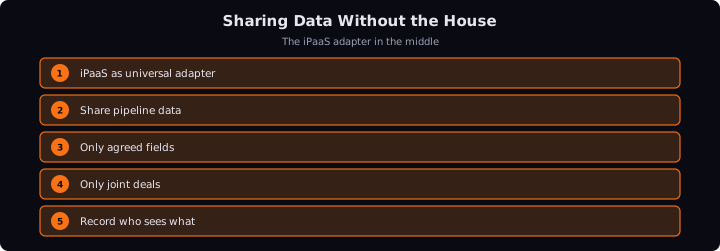
Two companies that want their systems to talk face a mess: each uses different software, and wiring every product to every other product by hand is slow and fragile. An iPaaSIntegration platform as a service: a middle-layer platform that connects different companies' systems like a universal adapter, avoiding a fragile custom build for every connection. Examples include Zapier, Workato, MuleSoft and Boomi., an integration platform as a service, solves this by sitting in the middle as a universal adapter. Tools such as Zapier, Workato, MuleSoft and Boomi let one system connect to another through the platform rather than through a one-off custom build. Think of it as the power adapter you carry when travelling abroad: rather than rewiring every device for every country, you plug into one adapter that handles the differences. The iPaaS handles the differences between two companies' systems so they can exchange data without a fragile hand-built bridge.

Why shared pipeline data matters

The data a partner and vendor most want to share is pipeline data, the list of live deals moving toward a sale. When both sides can see the same pipeline, co-selling actually works. The vendor knows which customers the partner is working, the partner knows where the vendor can help, and neither is flying blind or tripping over the other. Without shared pipeline visibility, co-sell collapses into guesswork: the partner reports a deal by email weeks late, the vendor's team stumbles into the same account cold, and the customer gets two disjointed conversations. Shared pipeline data turns two separate sales motions into one coordinated push.

Sharing without giving away the house

Here is the fear that stops many partnerships, and the answer to it. Sharing data does not mean handing over your entire customer database. A well-run integration shares only the specific fields both sides agreed to, for the specific deals they are working together, and nothing more. You can share the name of a jointly worked account, its stage and its value, while keeping every other customer, contact and number private. It is the difference between letting a colleague see one shared document and giving them the keys to your whole filing cabinet. Good data sharing is narrow and deliberate by design, which is exactly what makes partners comfortable enough to do it.

Reading the risks

A partner professional should be able to spot when data sharing is set up badly. The warning signs are broad rather than narrow access, no clear agreement on which fields flow and in which direction, and no record of who can see what. Sloppy sharing leaks sensitive customer information, breaches privacy expectations, and can end a partnership overnight when one side feels exposed. The questions to ask are simple and powerful: exactly which fields are we sharing, for which deals, in which direction, and who has agreed to it. When you can ask those, you can protect both companies without needing to configure a single connection yourself.

Good data sharing is narrow and deliberate: agreed fields, joint deals, and a record of access.

Check your understanding

Answer each from memory. Your results are saved in this browser and count toward your readiness — sign in (account panel above) to keep them across devices.

  1. What problem does an iPaaS solve?

  2. Why does sharing pipeline data between a vendor and a partner matter for co-selling?

  3. How should a vendor and partner share data safely?

13 min · Core

CRM and the Data Plumbing

Every system in the stack eventually feeds the CRM, where sales and partner data lives. This lesson explains how partner data sits inside the CRM, what attribution plumbing does, and why clean data is what actually decides whether co-sell revenue gets credited and whether partnerships survive.

~4 min

By the end you can

  • Explain how partner deals and sources are recorded inside a CRM.
  • Define attribution and explain why it decides who gets credit.
  • Explain why clean, consistent data decides whether co-sell works.
  • Recognise the business damage caused by messy partner data.

Where it all ends up

Every system covered so far eventually pours into one place: the CRMCustomer relationship management system, such as Salesforce or HubSpot, where a company records its customers and deals. Every other system in the stack ultimately feeds it., the customer relationship management system, where a company records its customers and deals. Salesforce and HubSpot are the common names. For a partner program, the CRM is where the truth of the relationship is finally written down: which deals came from which partner, which are being co-sold, and how much revenue each partner ultimately drove. A deal registered in the portal, an opportunity shared through an iPaaSIntegration platform as a service: a middle-layer platform that connects different companies' systems like a universal adapter, avoiding a fragile custom build for every connection. Examples include Zapier, Workato, MuleSoft and Boomi., a lead passed from a partner, all of it is meant to land here as a clean record. If the CRM does not know a deal came from a partner, then as far as the business is concerned, it did not.

AttributionThe recording of where a deal came from, using source fields in the CRM, which decides who gets credit for a sale, whether a partner earns commission, and whether the program can prove its value.: who gets the credit

Attribution is the plumbing that answers a single loaded question: who gets the credit for this sale. It works through fields on each deal that record the source, such as a partner name, a referral tag or a deal-registration link. When a customer buys, those fields decide whether the partner earns their commission, whether the partnership shows a return, and whether next year's budget for that partner survives. Attribution sounds like dry back-office detail, but it is where money changes hands. A partner whose deals are not properly attributed watches their contribution vanish from the numbers, and no amount of goodwill survives that for long.

Why clean data decides co-sell

This is the quiet truth of the whole stack: clean data is what decides whether co-sell works. Co-selling depends on both sides agreeing on which deals are shared, what stage each is at, and who sourced it, and all of that lives in CRM fields that must be filled in correctly and consistently. When the plumbing is clean, a partner leader can prove the program made money and defend its budget. When it is messy, the same deal appears twice under different names, a partner-sourced sale is logged as direct, and the true value of the partnership becomes impossible to see. The relationship can be strong and the strategy sound, yet the program still fails on paper because the data underneath it is a mess.

The cost of messy plumbing

The damage from bad partner data is concrete, not abstract. Partners lose trust when their deals are mis-credited and their commission goes missing. Leaders cannot report the program's value, so it loses funding in the next budget round despite doing real work. Disputes erupt when two teams claim the same deal because the source field was left blank. Consider two identical programs: one keeps disciplined records so every partner deal is tagged at the moment it is created, the other lets fields go blank and names drift. A year later the first can prove its worth and grow, while the second cannot account for its own results and gets cut. The plumbing is invisible until it fails, and then it decides everything.

Clean source fields decide who gets credit, whether co-sell works, and if budget survives.

Check your understanding

Answer each from memory. Your results are saved in this browser and count toward your readiness — sign in (account panel above) to keep them across devices.

  1. Why does it matter whether the CRM records that a deal came from a partner?

  2. What does attribution do in a CRM?

  3. Why can a partnership with a strong relationship and sound strategy still fail on paper?

Flashcards

Recall-first review of the load-bearing facts.

0 reviewed · 8 left

Ready to test yourself?

12 graded questions with real explanations. You commit a confidence before each reveal — that is how you find what you only think you know.

Start practice quiz →
The Ecosystem Tech Stack — The Strategic Infrastructure Architect | Contested Futures Academy · The Contested Futures Institute