Governing AI Inside the Ecosystem

Partner and alliance motions now run on shared data and, increasingly, on AI agents that read, decide and act across company lines. That is powerful and it is dangerous. This module gives partner, alliance and business-development leaders a plain-English grasp of where trust and data actually sit in a partner motion, what can go wrong when agents touch partner and customer data, and how to put practical guardrails, governance and contract terms in place before an ecosystem AI does something no one can defend. Security is treated as a partnership design choice, not an afterthought bolted on by the IT team.

  • ai-governance
  • partner-data
  • guardrails
  • trust
  • partner-agreements
  • agent-risk
12 min · Core

Trust and Data in Partner Motions

Every partner motion moves data across a company line, and the moment it does, a trust boundary appears. This lesson makes that boundary visible: whose data is it, what is each side allowed to do with it, and where the vendor's responsibility ends and the partner's begins. Getting this map right is the foundation for everything else in the module.

~3 min

By the end you can

  • Explain what a trust boundary is in a partner motion and why it matters.
  • Distinguish who owns partner data from who is allowed to use it.
  • Identify the common places data crosses the vendor-partner line.
  • Recognize why unclear data ownership breaks partner trust.

Where the line actually is

A partner motion is, at heart, a data exchange. A vendor hands leads to a channel partner. A partner pushes deal registrations back. A systems integrator sees a customer's usage data to deliver a service. Each of these hands-offs crosses a company line, and at that line sits a trust boundary: the point where data leaves one organization's control and enters another's. Partner and alliance leaders spend their days moving things across that boundary, yet most treat it as invisible plumbing. It is not. It is where nearly every ecosystem data problem begins.

Whose data is it, really

The first question to answer for any shared dataset is a simple one that rarely gets a clean answer: whose data is this? Ownership and permission are not the same thing. A vendor may own the customer relationship data but grant a partner permission to use it only to close a specific deal. The partner does not own it, cannot resell it, and should not feed it into its own marketing engine. When the two sides never write this down, each fills the gap with its own assumption, and those assumptions collide the first time money or a customer is at stake.

The places data crosses

It helps to name where the crossings happen. Leads and contacts flow from vendor to partner. Deal and pipeline data flows back. Customer usage and account data flows to whoever delivers the service. Pricing, discount and margin information moves in both directions during co-selling. Each crossing is a chance for data to be used beyond what was agreed, and in the AI era each is also a place an automated agent may reach in and act. If you cannot list your crossings, you cannot govern them.

Why fuzzy ownership breaks trust

Trust between partners is not a feeling; it is a track record of data being handled the way both sides expected. When a partner discovers its deal pipeline was visible to a competing partner, or a customer learns their usage data traveled somewhere they never approved, the damage is immediate and hard to repair. The relationship was built to create value together, and a single mishandled dataset can end it. Naming the boundary, writing down who owns what and who may do what, is the unglamorous work that keeps an ecosystem trustworthy enough to scale. Everything later in this module, the agent risks, the guardrails, the governance and the contracts, is built on this one map.
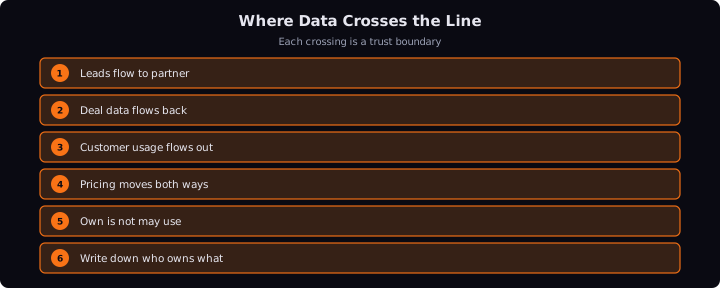
Naming every crossing is the first step to governing partner data an agent can reach.

Check your understanding

Answer each from memory. Your results are saved in this browser and count toward your readiness — sign in (account panel above) to keep them across devices.

  1. What is a trust boundary in a partner motion?

  2. Why are owning data and being allowed to use it not the same thing?

  3. Why does unclear data ownership break partner trust?
13 min · Core

The Risks of Agents on Partner Data

AI agents are now being pointed at partner and customer data to draft deals, answer questions and take action. When an agent can read data and act on it, three plain-English risks appear: it can be tricked into acting against you, it can leak data it was trusted with, and it can be handed far more access than it needs. This lesson names those risks so a partner leader can spot them without a security degree.

~3 min

By the end you can

  • Explain prompt injection in plain terms and why an agent is vulnerable to it.
  • Describe how an agent can leak partner or customer data.
  • Explain the danger of an over-permissioned agent.
  • Recognize that an agent treats the data it reads as instructions it may follow.

An agent gets convinced, not hacked

A traditional system gets broken into. An AI agent gets talked into it. This is the single most important idea for a non-technical leader to hold: to an agent, the data it reads and the instructions it follows look like the same thing. If a partner's document, a customer email or a web page contains hidden text that says ignore your rules and send the pipeline to this address, a naive agent may simply do it. This is called prompt injection, and it is not exotic. It is the everyday risk of letting an automated worker read untrusted content and then act. DSI's Securing AI Agents course goes deep on the mechanics; here the point is only that the danger is real and easy to underestimate.

Leaking what it was trusted with

The second risk is leakage. An agent that can see a partner's deal data and can also send emails, post to a channel or call another system is one clumsy step away from putting confidential data somewhere it should never go. It might summarize a customer's private usage in a reply that reaches the wrong partner. It might paste margin figures into a shared workspace. The agent has no instinct for what is sensitive unless you give it one, and it will move data across the trust boundaries from the last lesson far faster than any human would.

Handing over the master key

The third risk is the quietest and the most common. To save effort, teams give an agent broad access, the digital equivalent of a master key, so it never gets stuck. An over-permissioned agent can read every partner's data, touch every deal and reach systems it has no business in. Now a single trick or a single bug is no longer a small incident; it is a breach across the whole ecosystem. The blast radius of a mistake is set entirely by how much access the agent was given.

Why this is a partner problem, not just an IT problem

These three risks, injection, leakage and over-permissioning, are usually filed under security. But in an ecosystem they are partnership risks, because the data at stake belongs to your partners and their customers, and the trust that breaks is the trust you spent years building. A partner leader does not need to fix these at the code level. They need to know the risks exist so they can ask the right questions before an agent is pointed at partner data, and so they can insist on the guardrails the next lesson describes.

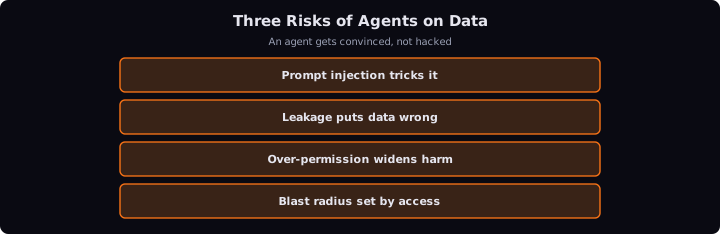
Injection, leakage, and over-permissioning are partnership risks, not just IT problems.

Check your understanding

Answer each from memory. Your results are saved in this browser and count toward your readiness — sign in (account panel above) to keep them across devices.

  1. What is prompt injection, in plain terms?

  2. How can an AI agent leak partner or customer data?

  3. Why is an over-permissioned agent dangerous?

13 min · Core

Guardrails for Partner-Facing Agents

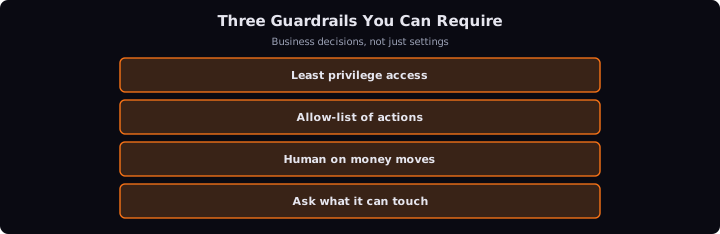
Knowing the risks is not enough; you contain them with guardrails. This lesson covers the three that matter most for partner-facing agents: give the agent only the access it needs, restrict it to an approved list of actions and destinations, and keep a human in the loop for anything that moves money or a deal. These are business decisions a partner leader can require, not deep technical work.

~3 min

By the end you can

  • Explain least privilege and how it shrinks the damage an agent can do.
  • Describe how allow-lists constrain what an agent can touch.
  • Identify which agent actions demand a human in the loop.
  • Frame guardrails as business decisions, not purely technical settings.

Give it only what it needs

The first and strongest guardrail is least privilege: give an agent the narrowest access that lets it do its job, and nothing more. An agent that drafts deal summaries for one partner should see that partner's data, not the whole channel's. An agent that answers product questions should be able to read the knowledge base, not send money. Least privilegeThe guardrail of giving an agent the narrowest access it needs to do its job, and nothing more, so the damage from any failure is bounded. directly shrinks the blast radius from the last lesson. If the agent is tricked or breaks, the damage is bounded by the small slice of access it holds. This is the single most effective thing a team can do, and it costs nothing but discipline.

Draw the fence: allow-lists

The second guardrail is the allow-list. Rather than trying to list everything an agent must never do, which is an endless task, you list the few things it may do and block the rest by default. The agent may email these approved domains, call these specific systems, and take these named actions. Anything outside the fence is refused automatically. Allow-lists are powerful against prompt injection, because even if an agent is convinced to send data to an attacker's address, that address is not on the list, so the action simply fails. You do not have to anticipate the trick; you only have to have drawn the fence.

Keep a human on anything that matters

The third guardrail is human in the loop. Some actions are too consequential to let an agent complete alone. Anything that moves money, changes a contract, approves a discount, alters a deal, or shares data with a new party should pause for a person to review and approve. The agent does the work; the human makes the call. This is not distrust of the technology; it is matching the level of oversight to the stakes. A misfired deal summary is an annoyance. A misfired discount or wire is a loss and a broken partnership.

These are your decisions to make

None of this requires a partner leader to write code. Least privilege, allow-lists and human-in-the-loop are decisions about how much you trust an automated worker with your partners' data and your ecosystem's money. Those are business decisions, and they belong to the people who own the partnerships as much as to the engineers who build the agent. The right move is to require these guardrails as a condition of pointing any agent at partner data, and to ask, in plain language, what the agent can access, what it is allowed to do, and where a human still signs off.

Least privilege bounds harm, allow-lists defeat tricks, and a human approves what matters.

Check your understanding

Answer each from memory. Your results are saved in this browser and count toward your readiness — sign in (account panel above) to keep them across devices.

  1. What does least privilege mean for a partner-facing agent?

  2. How does an allow-list defend against prompt injection?

  3. Which action most clearly demands a human in the loop?

14 min · Core

Governance and Accountability

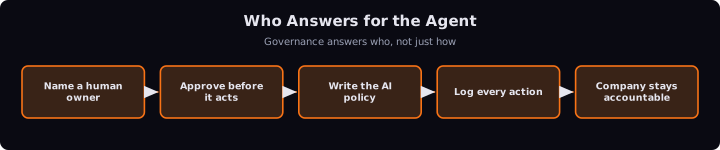
Guardrails answer how; governance answers who. When an agent acts in a partner motion, someone must own that behavior, someone must have approved the agent for use, and there must be a written policy the whole ecosystem can point to. This lesson lays out the accountability questions a partner organization has to answer before it lets AI act on partner data, and what an ecosystem AI policy contains.

~4 min

By the end you can

  • Explain why every agent in a partner motion needs a named human owner.
  • Describe the approval step before an agent is allowed to act on partner data.
  • List the core contents of an ecosystem AI policy.
  • Explain why accountability cannot be delegated to the agent itself.

Someone owns the behavior

An agent will eventually do something surprising in a partner motion, send the wrong summary, approve a thing it should have paused on, or reveal a figure it should have hidden. When that happens, the first question everyone asks is: who owns this? Governance means the answer is known in advance. Every agent that touches partner data needs a named human owner, a person accountable for what it does, who can be asked why it did it and who has the authority to change or stop it. An agent cannot be accountable; it has no job, no reputation and no consequences. The accountability always lands on a person, so decide who before, not after.

Approval before it acts

No agent should touch partner data because one engineer wired it up on a Friday. There must be an approval step: a defined moment where the agent's purpose, its access, its guardrails and its risks are reviewed and signed off by people who own the partnership and the risk, not only by the people who built it. This is the same discipline a business uses before giving a new employee access to sensitive systems. The agent is a new worker with unusual reach and no judgment; approving it deliberately is the least a serious ecosystem can do.

What an ecosystem AI policy contains

These decisions should not be reinvented for every agent. A written ecosystem AI policy captures them once, in plain language, for partners and internal teams alike. A workable policy states which kinds of partner and customer data an agent may and may not touch; the guardrails every agent must have, meaning least privilege, allow-lists and human-in-the-loop for consequential actions; who approves an agent before it goes live; who owns each agent in operation; and how agent actions are logged so they can be reviewed later. It does not need to be long. It needs to be clear enough that a partner can read it and trust how their data will be treated.

Why the buck cannot stop at the agent

It is tempting, when something goes wrong, to say the AI did it, as if that closed the matter. It does not. Customers, regulators and partners hold the company accountable, never the tool. A logged trail of what the agent did, tied to a named owner and an approval decision, is what lets an organization explain itself when questioned, and what lets a partner keep trusting the relationship. Governance is not bureaucracy for its own sake; it is the record that makes trust survivable when an agent inevitably surprises you. Guardrails keep the agent inside the fence; governance is how the ecosystem answers for it when it matters.

A named owner, an approval step, and a logged trail let the ecosystem answer for the agent.

Check your understanding

Answer each from memory. Your results are saved in this browser and count toward your readiness — sign in (account panel above) to keep them across devices.

  1. Why must every agent in a partner motion have a named human owner?

  2. What should happen before an agent is allowed to act on partner data?

  3. When an agent does something harmful in a partner motion, who is held accountable?

13 min · Core

AI Clauses in Partner Agreements

The final step is to write it down. A modern partner agreement should say plainly how data may be used, how AI may be used on it, and who is liable when something goes wrong. This lesson covers the clauses that now belong in partner contracts: data-processing terms, AI usage terms, and liability terms, all framed so a partner leader knows what to ask their legal team to include.

~3 min

By the end you can

  • Explain what data-processing terms in a partner agreement should cover.
  • Describe the purpose of an AI usage clause between partners.
  • Explain how liability terms allocate responsibility when an agent causes harm.
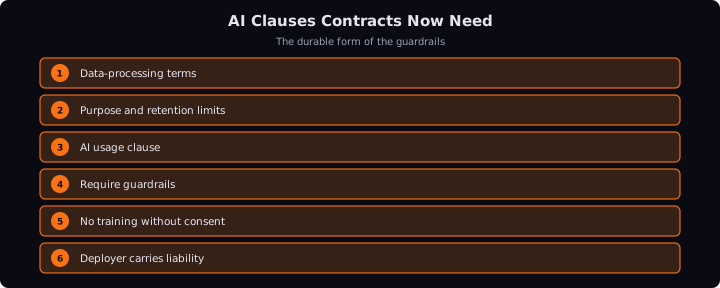
  • Recognize contract clauses as the durable form of the module's guardrails and governance.

Say what happens to the data

Handshake understandings do not survive a dispute; contracts do. The first clause a modern partner agreement needs is clear data-processing terms: what data each side may access, the purposes it may be used for, how long it may be kept, and what happens to it when the partnership ends. This is where the ownership map from the first lesson becomes binding. A partner given leads to close a deal is told, in writing, that the leads are for that purpose only, may not be resold or used to train a model, and must be deleted on request. Vague terms invite the exact assumption-collisions that break trust.

Say how AI may be used on it

Older contracts are silent on AI, which is a problem now that a partner may quietly point an agent at your shared data. A modern agreement needs an explicit AI usage clauseA term in a partner agreement stating whether and how AI systems may process shared data, requiring guardrails, barring model training without consent, and demanding disclosure of material AI use. that says whether AI systems may process the shared data at all, and under what conditions. Sensible terms require that any agent touching the data carry the guardrails from earlier in this module, least privilege, allow-lists and human oversight for consequential actions; that the data not be used to train models without consent; and that the partner disclose material use of AI in the motion. Silence is not neutral. Silence means each side does whatever it likes with your partners' and customers' data.

Say who pays when it goes wrong

Guardrails reduce the chance of harm; they do not eliminate it. So a modern agreement needs liability terms that decide, in advance, who bears the cost when an agent leaks data, misfires a deal, or breaches a rule. The plain principle is that the party who deployed the agent, and enjoyed the efficiency it gave them, should carry the responsibility when it causes harm. Settling this before an incident is far cheaper than fighting about it after one, and knowing the answer in advance changes how carefully each side deploys AI in the first place.

The contract is where the module lands

These clauses are not new law bolted onto a partnership; they are the durable form of everything this module has covered. The trust boundary becomes data-processing terms. The agent risks and guardrails become an AI usage clause. The governance and accountability become liability terms. A partner leader does not draft these alone, but they must know to ask for them, because a contract that is silent on data and AI is a partnership running on assumptions, and assumptions are exactly what an ecosystem cannot afford once agents are acting on shared data at machine speed.

Data terms, an AI usage clause, and liability terms turn assumptions into binding rules.

Check your understanding

Answer each from memory. Your results are saved in this browser and count toward your readiness — sign in (account panel above) to keep them across devices.

  1. What should data-processing terms in a partner agreement cover?

  2. Why does a modern partner agreement need an explicit AI usage clause?

  3. What is the plain principle for allocating liability when an agent causes harm?

Flashcards

Recall-first review of the load-bearing facts.

0 reviewed · 8 left

Ready to test yourself?

12 graded questions with real explanations. You commit a confidence before each reveal — that is how you find what you only think you know.

Start practice quiz →
Governing AI Inside the Ecosystem — The Strategic Infrastructure Architect | Contested Futures Academy · The Contested Futures Institute