The Activity Trap
Partner programs drift toward measuring what is easy to count rather than what matters. Signed partners, webinars held, and decks shipped feel like progress, but they are inputs, not results. This lesson names the pattern as activity theater and shows why it quietly starves a program of the credibility it needs to survive a budget review.
By the end you can
- Distinguish an activity from an outcome in a partner program.
- Explain why programs drift toward counting activities.
- Recognize activity theater and the risk it creates at budget time.
- Diagnose a partner program's current altitude from its dashboard.
Busy and broke at the same time
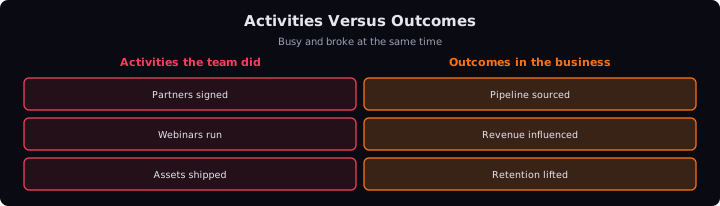
Walk into most partner-program reviews and you will hear a proud list: forty new partners signed this quarter, twelve webinars run, a refreshed enablement portal, six co-branded assets shipped. The energy is real and the team is working hard. Then someone asks the only question that matters, which is what all of it did to revenue, and the room goes quiet. This is the activity trap. A program can be extraordinarily busy and still have no idea whether it moved the business, and busy is not the same as effective.
Activities versus outcomes
An activity is something you do. An outcome is something that changes in the business because you did it. Signing a partner is an activity; that partner sourcing a deal that closes is an outcome. Running a webinar is an activity; a qualified opportunity that traces back to it is an outcome. The distinction sounds obvious, yet almost every partner dashboard is built entirely from the first column. Activities are inputs, outcomes are results, and a program judged only on inputs has no way to prove it earned its budget.
Why programs drift toward activities
The drift is not laziness, it is gravity. Activities are easy to count, they happen on your own schedule, and they produce a clean number by Friday. Outcomes are slow, they depend on the sales cycle and on the partner, and they are harder to attribute. So a team under pressure to show motion reports what it can control, and what it can control is activity. Over time the activity count becomes the goal itself. The webinar gets run because running webinars is what the program does, not because anyone expects it to change a number.
Activity theaterThe pattern of measuring and reporting what the team did (partners signed, webinars run, assets shipped) as if it were the goal, leaving the program unable to prove value in revenue terms when a cost review demands it. and its cost
When activity becomes the point, the program is performing rather than producing. Call it activity theater. It looks healthy right up until the moment a new CFO or a cost review asks the ecosystem to justify itself in the language of revenue and retention. A program that has only ever reported activity has no answer, and no answer is how good ecosystems get cut in a downturn. The uncomfortable truth is that the busiest partner programs are often the most exposed, because motion has been mistaken for value.
Reading your own dashboard
You can diagnose a program in about thirty seconds by looking at its top-line dashboard. If every headline number is a count of things the team did, the program lives in the activity trap. If the headline numbers describe things that changed in the business, pipeline sourced, revenue influenced, retention lifted, the program is being run for outcomes. Most programs sit somewhere in between, and the job of the rest of this module is to move the headline numbers from the first kind to the second.
Check your understanding
Answer each from memory. Your results are saved in this browser and count toward your readiness — sign in (account panel above) to keep them across devices.
Which of these is an outcome rather than an activity?
Why do partner programs tend to drift toward counting activities?
What is the main danger of activity theater?