Mapping Partners to Outcomes
Most partner maps start with the wrong question. They list the partners a company already has and then invent reasons to keep them. A strategist reverses that: name the business outcomes the company must reach, then map which partners actually move each one. Partners with no outcome behind them are noise, and outcomes with no partner behind them are gaps.
By the end you can
- Start ecosystem mapping from business outcomes rather than from the existing partner list.
- Attach each partner to the specific outcome it moves, and flag those attached to none.
- Identify outcomes that have no partner behind them as strategic gaps.
- Explain why an outcome-first map resists the pull of legacy relationships.
The list is the wrong starting point
Ask most partner teams for their ecosystem and you get a slide of logos, grouped by tier or region, each with a relationship manager beside it. The trouble is that the slide answers the question who are our partners when the question that matters is what are we trying to achieve, and who helps us achieve it. A map built from the existing list inherits every accident of history: the reseller signed three years ago for a deal that no longer exists, the technology partner kept because someone senior likes the founder. The map looks full, but fullness is not the same as fit.
Start from the outcome you owe
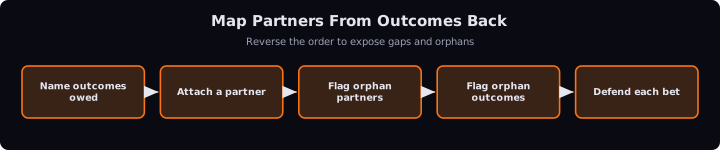
A strategist begins with the small set of business outcomes the company actually owes: enter a new market, reach a customer segment it cannot reach alone, complete a product it cannot build alone, win credibility it has not yet earned. These are the reasons the ecosystem exists at all. Write them down first, before a single partner name appears. Then, and only then, ask which partners move each outcome. A cloud marketplace partner might move reach the enterprise buyer. A systems integrator might move land large deployments the sales team cannot deliver alone. Each partner earns its place by being attached to an outcome that matters.
Two things the outcome-first map reveals
Reversing the order exposes what the logo slide hides. First, it surfaces orphan partners, the ones attached to no current outcome. They are not necessarily bad relationships, but they are consuming attention that an outcome-linked partner is not getting. Second, it surfaces orphan outcomes, the goals the company is committed to but has no partner positioned to move. An orphan outcome is a strategic gap, and it is far more dangerous than an orphan partner, because it is a promise with nothing behind it. A team that only ever manages its existing partners will never notice the gap, because the gap is defined by what is absent.
Why this discipline holds under pressure
Legacy relationships exert a constant pull. They come with history, personal rapport, and the discomfort of ending something. An outcome-first map gives you a clean, defensible answer to the question every partner manager dreads: why are we investing here, or why are we not. When the outcome is named and the partner is measured against it, the conversation stops being personal and becomes strategic. That is the real value of mapping partners to outcomes: it turns a collection of relationships into a set of deliberate bets, each one you can explain, defend, or retire on the merits.
Check your understanding
Answer each from memory. Your results are saved in this browser and count toward your readiness — sign in (account panel above) to keep them across devices.
What is the correct starting point when mapping a partner ecosystem?
Why is an orphan outcome more dangerous than an orphan partner?
What does the outcome-first map give a partner manager under pressure to justify an investment?