The Talent Reshuffle

Partner ecosystems have become one of the fastest-growing corners of the US tech economy, and the people who run them are being replaced by a different kind of professional. This module explains why money and hiring are pouring into ecosystems, why the old relationship-first partner manager is being phased out, and what the new Strategic Infrastructure Architect actually does. It closes with an honest self-assessment so you can see where you already fit the profile and where your gaps are, then use the rest of the course to close them.

  • partner-ecosystems
  • strategic-infrastructure-architect
  • tech-careers
  • ai-economy
  • ecosystem-strategy
  • commercial-architecture
12 min · Core

Why Partner Ecosystems Are On Fire

Money, hiring, and software are all flowing into partner ecosystems at once. Ecosystem partnership job postings have roughly doubled year over year since 2023, around ninety percent of companies say they are growing their partnerships, and the software market built to manage ecosystems is large and expanding fast. This lesson explains what is driving the surge and why it is not a passing trend.

~3 min

By the end you can

  • Describe the scale of hiring and investment now flowing into partner ecosystems.
  • Explain why companies increasingly grow through partners rather than only through direct sales.
  • Recognize the partner-ecosystem software market as a signal of durable demand.
  • Distinguish a structural shift from a passing hiring fad.

The numbers are moving in one direction

Something unusual is happening in the US technology market. Hiring for partner and ecosystem roles has roughly doubled year over year since 2023, while many other go-to-market functions have been flat or cut. Around ninety percent of companies report that they are actively growing their partnerships. And the software market built specifically to run these ecosystems, the tools that track partners, route deals, and manage co-selling, is large and growing quickly. When hiring, executive attention, and software spending all point the same way at once, it is worth asking why.

Why growth now runs through partners

The short answer is that selling directly has become expensive and slow, while partners multiply reach. A software company that sells through a cloud provider's marketplace can reach customers who already have budget approved and a trusted procurement path. A startup that integrates with a large platform inherits some of that platform's credibility overnight. Instead of hiring a hundred salespeople to knock on doors, a company can plug into partners who already sit inside the customer's world. For many US tech firms, a growing share of revenue now arrives through partners rather than through their own direct teams, which is exactly why the function is getting funded.

The software market is the tell

Follow the money into tooling and the picture sharpens. Companies do not buy dedicated software to manage a side project. The rise of platforms for partner relationship management and for cloud marketplace selling shows that firms are treating the ecosystem as core infrastructure, something worth measuring, automating, and staffing. A market this size does not form around a fashion. It forms because buyers expect the spending to pay back for years.

A structural shift, not a fad

It would be easy to read doubling job postings as a bubble. The deeper reading is that the way software reaches customers has changed. Cloud marketplaces, product integrations, and platform partnerships have become a primary route to market, not a supplement to it. That is a structural change in how value moves, and structural changes create durable demand for the people who can build and run the connections. Consider a data company whose fastest-growing channel is a single marketplace listing on a major cloud: that one relationship can outproduce an entire regional sales team. When a channel like that becomes central, the company cannot treat it casually, and neither can the person who owns it.

Hiring, executive attention, and software spending all rise together, marking a structural shift.

Check your understanding

Answer each from memory. Your results are saved in this browser and count toward your readiness — sign in (account panel above) to keep them across devices.

  1. Which set of signals best shows that partner ecosystems are surging in the US tech market?

  2. Why do many US tech firms now grow through partners rather than only through direct sales?

  3. What does the size of the partner-ecosystem software market most strongly suggest?
13 min · Core

The Role Is Changing: Relationship-First to Technical

The traditional partner manager, whose value was mostly warm relationships and golf-course rapport, is being phased out. The replacement is a professional who is technical and commercial at the same time: someone who understands how products connect, how deals get built, and how to design a partnership that scales. This lesson explains what is dying, what is replacing it, and why.

~3 min

By the end you can

  • Describe the traditional relationship-first partner manager role.
  • Explain why that role is being phased out.
  • Characterize the replacement as both technical and commercial.
  • Recognize why relationships alone no longer create durable value.

What the old role looked like

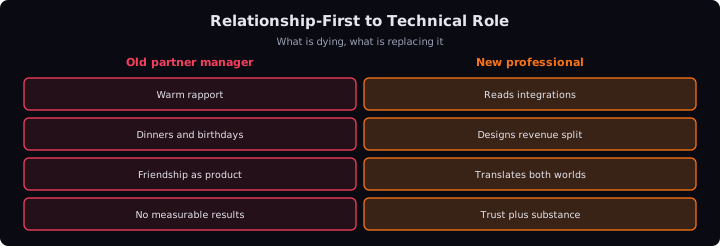
For a long time the partner manager job was mostly about relationships. The best people were warm, well connected, and good in a room. They took counterparts to dinner, remembered birthdays, smoothed over conflicts, and kept the relationship friendly. The implicit belief was that if the human connection stayed strong, deals would follow. In a slower market where products were simpler and integrations were rare, that belief often held. Rapport was the product.

Why it is being phased out

That world has thinned out. Products are now deeply technical, partnerships often mean connecting two systems, and buyers can see through a purely social relationship that produces no measurable results. A warm lunch does not answer whether two products can integrate, how revenue is shared, or what happens when an AI agentSoftware that acts on a user's behalf without a person clicking each step, able to discover a service, choose a provider, and complete a transaction, which changes how partners must be found and trusted. starts routing work between the partners. When a company measures a partnership by revenue and by how well the two products actually work together, a manager who can only offer friendship has little to contribute. The role is not being cut because relationships stopped mattering; it is being cut because relationships alone stopped being enough.

What is replacing it

The replacement is a hybrid professional who is technical and commercial at once. Technical enough to understand how the products connect, what an integration requires, and how automated systems move data and decisions between partners. Commercial enough to design how the partnership makes money, who sells what, and how value is shared so both sides win. Picture a partnership between a payments company and a retail platform. The new professional can sit with engineers to scope the integration in the morning and with finance to design the revenue split in the afternoon, then translate each conversation for the other. The old partner manager could do neither.

Relationships still matter, but differently

None of this means relationships are worthless. Trust still greases every deal. But trust now has to sit on top of real substance. The professionals who thrive are the ones who can be trusted and can architect something that works. A relationship with no technical or commercial depth is a pleasant conversation that produces nothing the business can measure. That is why the market is quietly retiring one profile and paying a premium for another.

Rapport alone no longer wins; the new professional is technical and commercial at once.

Check your understanding

Answer each from memory. Your results are saved in this browser and count toward your readiness — sign in (account panel above) to keep them across devices.

  1. What mainly defined the traditional partner manager role?

  2. Why is the relationship-first partner manager being phased out?

  3. What best describes the professional replacing the old partner manager?

14 min · Core

The Strategic Infrastructure Architect Profile

The professional replacing the old partner manager has a name in this course: the Strategic Infrastructure Architect. This person owns the commercial architecture of the ecosystem, understands how AI agents interact with partner infrastructure, is technically literate without being a deep engineer, and designs for speed rather than quarterly cycles. Fewer than five percent of partner people fit this profile today, which is exactly why it is valuable.

~3 min

By the end you can

  • Define what it means to own the commercial architecture of an ecosystem.
  • Explain why understanding how AI agents interact with partner infrastructure matters.
  • Describe the level of technical literacy the profile requires, and the level it does not.
  • Explain why the profile's scarcity makes it valuable.

Owning the commercial architecture

The Strategic Infrastructure ArchitectThe professional who owns the commercial architecture of a partner ecosystem: technically literate, aware of how AI agents transact with partner infrastructure, and designing for speed and scale rather than quarterly relationship management. owns the commercial architecture of the ecosystem, which is the design of how the whole set of partnerships creates and shares value. That is bigger than managing one relationship. It means deciding which partners fit, how deals flow between them, how revenue is split, and how the pieces connect into a system that grows. Think of an architect of a building versus a person who paints one room. The old partner manager painted rooms. The architect decides the structure that all the rooms hang from.

How AI agents change the picture

The newest and most demanding part of the profile is understanding how AI agents interact with partner infrastructure. Increasingly, software does not wait for a human to click. An automated agent may search for a service, choose a provider, and complete a transaction between two companies with no person in the loop. That changes what a partnership even is. If agents are going to discover and use your product on a customer's behalf, the partnership has to be built so machines, not only people, can find it, trust it, and transact through it. An architect who grasps this designs ecosystems for a world where the buyer might be another company's software.

Technically literate, not a deep engineer

This profile is often misread as an engineering job. It is not. The architect must be technically literate: able to read an integration diagram, understand what an interface between two products does, and hold a credible conversation with engineers about what is feasible. But they do not need to write production code or design the system themselves. The skill is translation and judgment, knowing enough to make good structural decisions and to earn engineers' respect, without becoming one. A non-technical professional can absolutely reach this bar with focused effort.

Designing for speed, not the quarter

The old role moved on quarterly rhythms: sign a deal, report it, wait for the next review. The architect designs for speed. Ecosystems that win are the ones where a new partner can integrate and start producing quickly, where value compounds week over week rather than being tallied every ninety days. Designing for speed means building repeatable ways to onboard and connect partners, not bespoke, slow, one-off arrangements.

Why scarcity equals value

Fewer than five percent of people in partner roles today fit this profile. Most are still relationship-first. That gap is the opportunity. When demand is surging and almost no one has the combination of commercial ownership, AI awareness, technical literacy, and a bias for speed, the few who do become extremely valuable. The rest of this course is a path to join that small group.

The Strategic Infrastructure Architect combines ownership, AI awareness, literacy, and speed.

Check your understanding

Answer each from memory. Your results are saved in this browser and count toward your readiness — sign in (account panel above) to keep them across devices.

  1. What does it mean for the Strategic Infrastructure Architect to own the commercial architecture?

  2. Why does understanding how AI agents interact with partner infrastructure matter?

  3. What level of technical ability does the architect profile require?

13 min · Core

The New Mandate: Builders, Not Operators

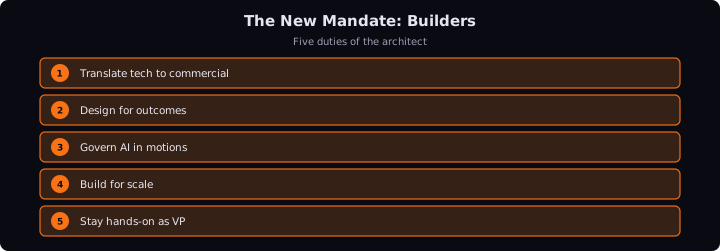
The Strategic Infrastructure Architect operates under a different mandate from the old partner manager. The job is to translate technical to commercial, design for outcomes rather than activities, govern how AI behaves inside partner motions, build for scale rather than comfort, and remain a hands-on individual contributor even at the VP level. This lesson unpacks each part of that mandate.

~3 min

By the end you can

  • Explain the shift from measuring activities to designing for outcomes.
  • Describe what it means to govern AI inside partner motions.
  • Contrast building for scale with building for comfort.
  • Explain why the architect stays an individual contributor even at senior levels.

Translate technical to commercial

The first duty of the mandate is translation. Engineers describe what is possible in the language of systems and interfaces; executives care about revenue, risk, and time. The architect stands in the middle and turns one into the other. When an engineer says two products can share data through a defined interface, the architect can explain to leadership what new revenue that unlocks and what it will cost to build. Without this translation, good technical ideas die in meetings and bad commercial promises get made to customers.

Design for outcomes, not activities

The old role reported activities: meetings held, deals registered, events attended. Activities are easy to count and easy to fake. The new mandate designs for outcomes: revenue produced through partners, customers successfully served by an integration, growth that compounds. An architect does not brag about signing twenty partners; they point to the three partnerships that actually move the business. Counting activity feels productive but can hide the fact that nothing real is happening.

Govern AI inside partner motions

A genuinely new duty is governing how AI behaves inside partner motions. As automated agents begin to route deals, recommend partners, and complete transactions, someone has to set the rules: which decisions a machine may make alone, where a human must approve, and how to keep an automated system from steering customers badly or sharing data it should not. The architect owns those guardrails. This is not optional caution; a partner motion run by ungoverned AI can damage customers and trust at machine speed.

Build for scale, not comfort

Building for comfort means arrangements that feel easy today: a friendly one-off deal, a manual process everyone tolerates, a partner who is pleasant but small. Building for scale means designing so that the tenth and hundredth partner are as easy to bring on as the first. That often requires doing the harder, less comfortable work now, standardizing how partners connect, so the ecosystem can grow without breaking. The comfortable path quietly caps how big the ecosystem can ever become.

Stay an individual contributor, even as a VP

Perhaps the most surprising part of the mandate is that this role stays hands-on even at senior levels. A VP-level architect is not merely managing a team of relationship managers; they are personally designing partnerships, sitting in the technical and commercial conversations, and making structural calls. The value lives in the doing, not only in the supervising. This is why the profile can command senior pay while remaining an individual contributor: the market pays for the architecture, and the architecture cannot be fully delegated.

The architect designs the ecosystem instead of merely operating one relationship.

Check your understanding

Answer each from memory. Your results are saved in this browser and count toward your readiness — sign in (account panel above) to keep them across devices.

  1. What is the difference between the old and new mandates on measurement?

  2. What does governing AI inside partner motions involve?

  3. Why does the architect remain an individual contributor even at the VP level?

12 min · Core

Is This You, and What Are Your Gaps?

This lesson turns the profile into an honest mirror. It walks through a candid self-assessment against the Strategic Infrastructure Architect profile, sets out the pay range the role commands in the US market, from around two hundred twenty-five thousand to three hundred fifty thousand dollars and above, and shows how to use the rest of this course to close whatever gaps you find. The point is not to feel qualified or unqualified, but to locate yourself and plan the climb.

~3 min

By the end you can

  • Assess yourself honestly against the four parts of the architect profile.
  • State the pay range the role commands in the US market.
  • Identify which gap is most worth closing first for your own background.
  • Explain how the rest of the course is structured to close those gaps.

An honest mirror

The best way to use the profile is as a mirror, not a verdict. Ask yourself four questions plainly. Can you design how a set of partnerships creates and shares value, or do you mostly manage one relationship at a time? Do you understand how automated systems and AI agents might discover and transact with your product? Are you technically literate enough to hold your own with engineers, even if you cannot code? Do you instinctively build for scale and speed rather than for what is comfortable this quarter? Few people answer a confident yes to all four today, and that is fine. The value of the exercise is precision about where you stand.

What the role pays

The stakes are real. In the US market this profile commands roughly two hundred twenty-five thousand to three hundred fifty thousand dollars and above, comparable to senior engineering and product roles, and well beyond what the old relationship-first partner manager earned. That premium is not a reward for tenure; it is what scarcity and surging demand pay for a rare combination of skills. Naming the number matters because it makes the climb worth the effort and sets a realistic target for what closing your gaps can unlock.

Find your first gap

Different backgrounds have different gaps. A relationship-first partner manager usually needs technical literacy and AI awareness most. A technical person moving into partnerships usually needs the commercial and value-design side. A non-technical professional leveling in often needs both, plus the confidence that literacy, not engineering, is the real bar. Be specific with yourself. It is more useful to say I cannot yet read an integration diagram than to say I am not technical enough. A named gap can be closed; a vague fear cannot.

How the course closes them

The rest of this course is built around exactly these gaps. Later modules develop the commercial architecture skill, the technical literacy needed to work with engineers, the awareness of how AI agents reshape partner motions, and the design-for-scale mindset. You do not need to master everything at once. Treat this module as the map: you now know the destination, the profile, and the reward, and you have a rough sense of your own starting point. Everything that follows is the route from where you are to the small group of professionals who can architect an ecosystem, not just manage a relationship.

Name a specific gap so it becomes fixable, then use the course as the route to close it.

Check your understanding

Answer each from memory. Your results are saved in this browser and count toward your readiness — sign in (account panel above) to keep them across devices.

  1. What pay range does the Strategic Infrastructure Architect profile command in the US market?

  2. Why is naming a specific gap better than a vague feeling of being unqualified?

  3. For a relationship-first partner manager, which gaps usually matter most first?

Flashcards

Recall-first review of the load-bearing facts.

0 reviewed · 8 left

Ready to test yourself?

12 graded questions with real explanations. You commit a confidence before each reveal — that is how you find what you only think you know.

Start practice quiz →
The Talent Reshuffle — The Strategic Infrastructure Architect | Contested Futures Academy · The Contested Futures Institute