Scenario Archetypes
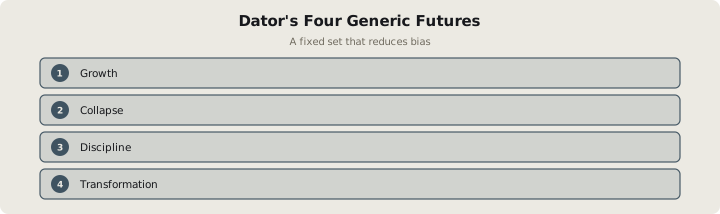
Rather than invent scenarios from a blank page, an analyst can draw on a ready-made set of generic futures. Jim Dator's four archetypes, growth, collapse, discipline and transformation, give a disciplined starting frame that forces coverage of outcomes the mind tends to skip. DSI's own forecasting shows the archetype instinct in practice.
By the end you can
- Name Dator's four generic futures and describe the logic of each.
- Explain how a fixed archetype set reduces the analyst's own bias.
- Apply the archetypes to widen a narrow single-forecast view.
- Recognise the limits of a generic set and when to move beyond it.
The problem archetypes solve
Ask an analyst to imagine the future of a technology or a region and the mind almost always reaches for one story, usually a continuation of the present. That single story feels like analysis but it is really a projection of the analyst's current beliefs. Scenario archetypes exist to break this habit. Instead of asking what will happen, they ask the analyst to populate a fixed set of qualitatively different futures, so that outcomes the mind prefers to skip get written down and taken seriously.
Dator's four generic futures
Jim Dator, who founded the Hawaii Research Center for Futures Studies, argued from decades of surveying futures work that almost every image of the future collapses into one of four kinds. Growth is the official future of most institutions: more of the present, bigger, richer, more connected. Collapse is the failure of the system through economic, ecological or social breakdown. Discipline is a future organised around a constraint, where society reins itself in to live within limits, whether ecological, moral or resource-based. Transformation is discontinuity, usually technological or spiritual, in which the rules of the game themselves change and the old measures stop applying. Dator's claim is not that these are equally likely but that a serious foresight exercise should hold all four in view at once.
Why a fixed set reduces bias
The power of the archetypes is that they are chosen for you. A blank-page brainstorm tends to cluster around a single mood, optimistic in a boom, fearful in a crisis. By contrast, a fixed set of four forces the analyst to write a credible growth story even when they feel gloomy, and a credible collapse story even when they feel confident. This is the same logic that structured analytic techniques bring to intelligence work: the method compensates for the known tilt of the individual mind. The archetypes are a bias-reduction device before they are anything else.
Archetypes in DSI's own work
DSI's briefing The Architecture of the Watched World closed not with a single prediction but with five explicit forecasts about the trajectory of the surveillance state. Read against Dator, that set is doing archetype work: some forecasts describe growth of the watched world, one describes a disciplined settlement in which societies accept limits on surveillance, and others gesture at transformation as new technologies rewrite the terrain. Presenting a spread rather than a point is the archetype instinct in action, even when the four names are not used explicitly.
Where the generic set runs out
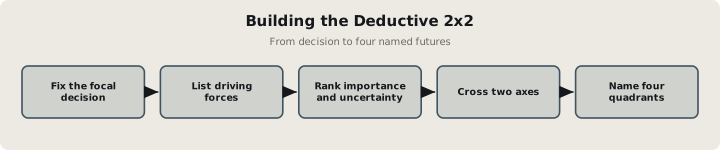
Archetypes are a strong starting frame, not a finished product. Because they are generic, they say nothing about the specific driving forces of your particular question, and four boxes can flatten a rich problem into caricature. The honest use is as scaffolding: begin with the four to guarantee coverage, then move to a method that engages the actual forces at work. The next lesson does exactly that, replacing generic futures with quadrants built from the specific uncertainties that matter most.
Check your understanding
Answer each from memory. Your results are saved in this browser and count toward your readiness — sign in (account panel above) to keep them across devices.
What are Jim Dator's four generic futures?
Why does a fixed set of archetypes reduce the analyst's bias?
What is the main limitation of Dator's archetypes as a finished method?