The American Probabilistic and Institutional School

The dominant tradition of foresight in the United States grew out of Cold War military planning and matured into a set of disciplined, quasi-quantitative methods for reasoning about the future. This module traces its lineage from RAND's Delphi technique, through the Houston school's Framework Foresight and Jerome Glenn's Futures Wheel, to the Institute for the Future's signal-driven forecasting, and finally to Philip Tetlock's work on calibrated probability judgement. The through-line is a conviction that estimates about the future can be structured, made explicit, scored and improved, a conviction DSI shares and practises through its own published Predictions Scorecard.

  • delphi
  • superforecasting
  • framework-foresight
  • calibration
  • cross-impact-analysis
  • signals-scanning
13 min · Core

Delphi and the RAND Origins

The Delphi technique was invented at the RAND Corporation in the early 1950s by Olaf Helmer, Norman Dalkey and colleagues, with Theodore Gordon later extending it. It structures expert judgement through anonymous, iterated rounds so that a group can converge on an estimate without the loudest voice dominating. Understanding where Delphi works, and where it quietly fails, is the foundation of the American probabilistic school.

~3 min

By the end you can

  • Describe the mechanics of a Delphi study: anonymity, iteration and controlled feedback.
  • Explain the RAND context that made structured expert judgement necessary.
  • Identify the conditions under which Delphi produces useful convergence.
  • Recognise the failure modes of Delphi, from false consensus to poor question design.

A method born of the bomb

The DelphiA structured forecasting method that pools disagreeing experts through anonymous, iterated rounds with controlled feedback, so a group converges on an estimate without rank or rhetoric dominating. Invented at RAND in the early 1950s. technique came out of the RAND Corporation, the air-force think tank in Santa Monica, in the early years of the Cold War. Olaf Helmer and Norman Dalkey needed to forecast questions that had no historical data at all, such as how many atomic bombs it would take to reduce American munitions output by a given amount. There was no dataset to regress; there were only experts, and experts disagree. The problem Helmer and Dalkey set themselves was how to extract a defensible group estimate from disagreeing specialists without letting rank, reputation or rhetoric decide the answer. Theodore Gordon, another RAND figure, later carried the method into wider futures work.

How a Delphi study runs

The design rests on three principles. The first is anonymity: participants never meet and never know who said what, so a junior analyst's estimate carries the same weight as a general's. The second is iteration: the panel answers, sees an anonymised summary of the whole group's responses, and then answers again, usually across two or three rounds. The third is controlled feedback: between rounds the facilitator returns not just the median but the reasons outliers gave, so a lone dissenter with a strong argument can move the group rather than simply being averaged away. Over successive rounds the spread of answers typically narrows.

Where Delphi earns its keep

Delphi works best precisely where statistics fail: novel questions, long time horizons, and domains where tacit expert knowledge is the only real evidence. It removes the social pressures of a committee, the anchoring on the first speaker, the deference to seniority, the reluctance to reverse a stated position in public. Because it is written and iterated, it also leaves an audit trail of reasoning that a single expert interview never produces. For technology forecasting and policy questions it remains in active use seventy years on.

Where Delphi quietly fails

The method has real weaknesses, and the honest practitioner names them. Convergence is not correctness: a panel can agree confidently and be wrong together, and the narrowing spread can create a false sense of certainty. The result is only as good as the panel selected, so a biased or narrow roster bakes its blind spots into the answer. Badly worded questions produce meaningless precision. And iteration can grind genuine, informative disagreement into a bland central estimate that pleases everyone and helps no one. Delphi structures judgement; it does not manufacture knowledge that the experts did not collectively hold.
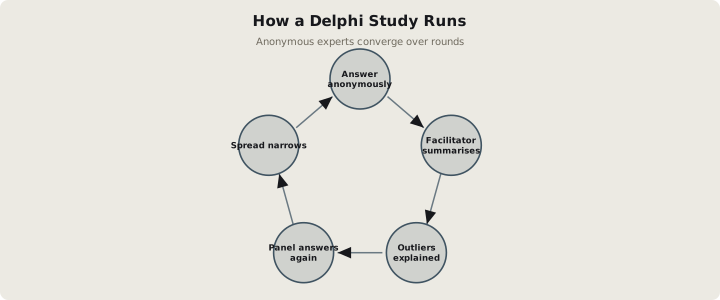
Delphi pools disagreeing experts through anonymous rounds and controlled feedback.

Check your understanding

Answer each from memory. Your results are saved in this browser and count toward your readiness — sign in (account panel above) to keep them across devices.

  1. What are the three defining design principles of a Delphi study?

  2. Why did RAND analysts such as Helmer and Dalkey turn to structured expert judgement?

  3. Which is a genuine failure mode of the Delphi technique?
12 min · Core

Framework Foresight

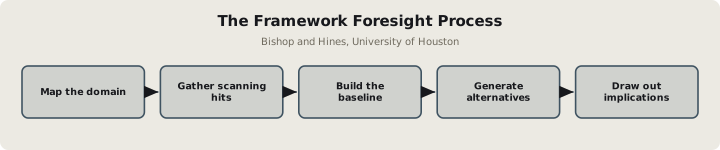
Framework Foresight is the teachable method developed by Peter Bishop and Andy Hines at the University of Houston, the leading American graduate programme in futures studies. It gives an analyst a repeatable sequence: map the domain, gather scanning hits, build a baseline forecast, then generate alternative futures and draw out their implications. It turned foresight from an art practised by gifted individuals into a discipline that can be taught and audited.

~3 min

By the end you can

  • Outline the stages of the Framework Foresight process from domain to implications.
  • Distinguish a baseline (expected) future from alternative futures.
  • Explain the role of environmental scanning and scanning hits.
  • Explain why a teachable framework matters for institutional foresight.

Foresight you can teach

For decades foresight risked being an art: a few gifted individuals produced striking scenarios, but no one could quite say how they did it, and the skill did not transfer. Peter Bishop and Andy Hines, running the futures programme at the University of Houston, set out to fix that. Their Framework ForesightThe teachable, repeatable foresight process of Peter Bishop and Andy Hines at the University of Houston: mapping a domain, gathering scanning hits, building a baseline, generating alternative futures and drawing out implications. is a deliberately explicit, repeatable process, designed so that a student or an analyst who follows the steps produces defensible work rather than relying on flair. That ambition, to make foresight a discipline rather than a gift, sits at the heart of the American institutional school.

Mapping the domain

The first move is to define and map the domain: the specific slice of the future under study, its boundaries, its key actors, and the questions that matter. A vague brief such as the future of work is sharpened into a bounded system with defined stakeholders and drivers. This discipline of scoping prevents the common failure of a foresight exercise that wanders across everything and concludes nothing.

Scanning and the baseline

With the domain mapped, the analyst gathers scanning hits: individual pieces of evidence about change, drawn from research, news, patents, fringe sources and weak signals, each logged as a discrete item. From the accumulated scan and the known drivers, the analyst builds a baseline future, the expected trajectory if present trends simply continue. The baseline is not a prediction the analyst endorses; it is a reference case, the future that would arrive if nothing surprising happened, against which alternatives can be compared.

Alternatives and implications

The heart of the method is refusing to stop at the baseline. Bishop and Hines have the analyst generate alternative futures, systematic departures from the expected case: a collapse, a transformation, a new equilibrium, a discipline that guards against the single-forecast trap. Each alternative is then pushed to its implications: what would this future mean for the stakeholders identified at the start, and what should they do now. This final step is what makes the exercise useful to a decision-maker rather than merely interesting. A forecast without implications is trivia; Framework Foresight is built to end in consequence.

A teachable sequence from a mapped domain to implications for named stakeholders.

Check your understanding

Answer each from memory. Your results are saved in this browser and count toward your readiness — sign in (account panel above) to keep them across devices.

  1. In Framework Foresight, what is a baseline future?

  2. Who developed Framework Foresight and where?

  3. Why does Framework Foresight insist on drawing out implications as its final stage?

13 min · Core

The Futures Wheel and Cross-Impact

Jerome Glenn invented the Futures Wheel in 1971 as a simple, visual way to map the consequences of a change, radiating outward through first, second and third-order effects. Paired with cross-impact analysis, which asks how events change each other's probabilities, it gives analysts a structured way to reason about interacting consequences. Glenn went on to found the Millennium Project, a global foresight network built on these tools.

~3 min

By the end you can

  • Construct a Futures Wheel through first, second and third-order consequences.
  • Explain what cross-impact analysis adds beyond a single-consequence chain.
  • Describe how the two methods guard against linear, single-effect thinking.
  • Situate Glenn's tools within the Millennium Project's global foresight work.

A wheel of consequences

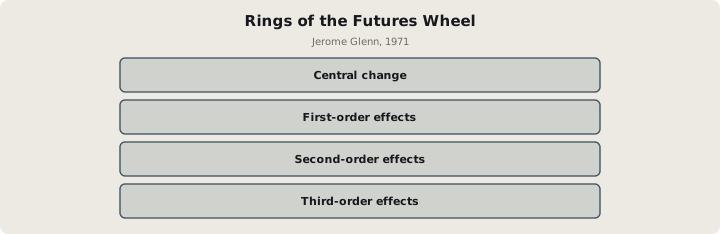
In 1971 Jerome Glenn devised the Futures WheelJerome Glenn's 1971 consequence-mapping tool. A change is written in the centre and its effects radiate outward through first, second and third-order rings, forcing an analyst past the obvious immediate result., one of the most widely used and disarmingly simple tools in the field. You write a change or event in the centre, then radiate outward the direct, first-order consequences. Around each of those you draw the second-order consequences, the effects of the effects, and then a third ring of third-order consequences. The visual structure forces a discipline that prose does not: you cannot stop at the obvious first result, because the empty outer rings demand to be filled. A single ban on petrol cars produces first-order effects on manufacturers, which produce second-order effects on electricity grids and mining, which produce third-order effects on geopolitics and labour.

Why the outer rings matter

The value of the wheel lies in the second and third rings. First-order consequences are usually the ones already discussed; the surprises, and the strategic risks, live further out. A method that makes an analyst articulate the effects of the effects catches the indirect impacts that linear thinking misses. It is also a defence against a common cognitive failure: assuming a change will have one clean result rather than a cascading web of them.

Cross-impact analysisA method that asks, for a set of possible future events, how the occurrence of each changes the probability of the others, exposing reinforcing loops and mutual exclusions that a simple consequence chain hides.

The Futures Wheel maps consequences but treats each branch in isolation. Cross-impact analysis supplies what it lacks: it asks, for a set of possible future events, how the occurrence of each one changes the probability of the others. If event A happens, does event B become more or less likely, and by how much. Laid out as a matrix, this exposes reinforcing loops and mutual exclusions that a branching diagram hides. Theodore Gordon, whom we met at RAND, was central to formalising cross-impact methods, tying this lesson back to the same probabilistic tradition.

Glenn and the Millennium Project

Glenn did not leave these as classroom exercises. He co-founded the Millennium Project, a global participatory foresight network with nodes in dozens of countries that produces the annual State of the Future reports. The project institutionalised Glenn's tools at international scale, using structured consequence mapping and expert panels to study long-range global challenges. It is a working example of the institutional ambition running through this whole module: turning individual foresight technique into durable, shared machinery. Mapping consequences first, then reasoning about how they interact, is the combined lesson these two methods teach.

A central change radiates outward; the surprises live in the outer rings.

Check your understanding

Answer each from memory. Your results are saved in this browser and count toward your readiness — sign in (account panel above) to keep them across devices.

  1. What does cross-impact analysis add beyond a Futures Wheel?

  2. Why are the second and third rings of a Futures Wheel considered the most valuable?

  3. Which global foresight body did Jerome Glenn co-found to institutionalise these tools?

12 min · Core

The Institute for the Future

The Institute for the Future, spun out of RAND in 1968 and based in Palo Alto, made a specialism of the ten-year forecast. Its practice rests on hunting signals, small present-day examples of a possible future, and on making the future tangible through artefacts from the future: mocked-up objects and headlines that let a client feel a forecast rather than merely read it. It is the institutional school at its most concrete.

~3 min

By the end you can

  • Explain the ten-year forecast horizon and why IFTF favours it.
  • Define a signal and distinguish it from a trend.
  • Describe artefacts from the future and their persuasive purpose.
  • Explain how IFTF connects abstract forecasting to concrete decision-making.

The ten-year horizon

The Institute for the Future, or IFTF, was spun out of RAND in 1968 and settled in Palo Alto, where it has advised governments and corporations ever since. Its signature is the ten-year forecast. Ten years is a deliberate choice: far enough out that present constraints loosen and genuine alternatives open, yet near enough that the analysis still bites on decisions an organisation makes today. Shorter horizons collapse into extrapolation; much longer ones drift into science fiction that no executive will act on. The decade is IFTF's sweet spot for making foresight decision-relevant.

Hunting signals

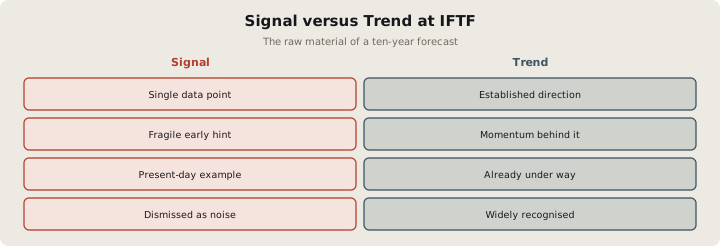
IFTF's raw material is the signal: a small, concrete, present-day example of something that could become significant, a startup, a behaviour, a device, a policy experiment. A signal is not a trend. A trend is an established direction of change with momentum behind it; a signal is a single data point, an early and often fragile hint that a new pattern might be forming. The analyst's craft is to notice signals that others dismiss as noise and to ask what world would have to be true for this small thing to become large. Collecting and clustering signals is how IFTF builds a forecast from the ground up rather than by extrapolating existing trends.

Artefacts from the future

IFTF is best known for a persuasive innovation: artefacts from the future. Rather than hand a client a report, the institute mocks up a tangible object from the forecast world, a product package, a newspaper front page, a government form, a job advertisement dated ten years hence. Holding a plausible artefact makes a forecast visceral in a way a slide never does; the client stops arguing about whether the future is possible and starts reasoning about what to do if it arrives. This is experiential futures: engaging the imagination, not just the analytical mind, so the forecast lodges and provokes action.

From forecast to decision

The common thread is IFTF's insistence that foresight must change what an organisation does. The ten-year horizon keeps the work decision-relevant, signals ground it in observable reality rather than speculation, and artefacts force engagement from leaders who would otherwise nod at a report and file it. In this the institute embodies the pragmatic, applied character of the American school: rigorous about method, but always aimed at a decision a client has to make. Foresight that does not move a decision, in the IFTF view, has not done its job.

IFTF builds forecasts from fragile signals, not by extrapolating trends.

Check your understanding

Answer each from memory. Your results are saved in this browser and count toward your readiness — sign in (account panel above) to keep them across devices.

  1. What is the difference between a signal and a trend in IFTF's practice?

  2. Why does IFTF favour a roughly ten-year forecasting horizon?

  3. What is the purpose of an artefact from the future?

14 min · Core

Tetlock and Superforecasting

Philip Tetlock's work is the empirical culmination of the American probabilistic school. His Good Judgment Project won the IARPA forecasting tournament by showing that ordinary people, given the right habits, systematically beat experts and intelligence analysts. The habits, base rates, granular probabilities, frequent updating and honest scoring against the Brier score, turn forecasting into a measurable skill. DSI's own Predictions Scorecard is a deliberate application of this tradition.

~4 min

By the end you can

  • Describe the Good Judgment Project and the IARPA tournament it won.
  • Explain the core habits of superforecasters, from base rates to updating.
  • Explain what the Brier score measures and why scoring matters.
  • Connect Tetlock's calibration discipline to DSI's Predictions Scorecard practice.

The tournament that settled an argument

Philip Tetlock had already shown, in twenty years of earlier research, that the average expert forecaster was little better than chance and often worse than a simple rule. The question that remained was whether anyone could do reliably better. Between 2011 and 2015 the American intelligence research agency IARPA ran a forecasting tournament, pitting teams against one another on hundreds of real geopolitical questions. Tetlock and Barbara Mellers ran the Good Judgment Project, whose volunteer forecasters beat the other university teams so decisively that IARPA dropped the rest, and reportedly beat professional intelligence analysts with access to classified material. The result was hard to dismiss: forecasting is a skill, and it can be measured.

The habits of a superforecaster

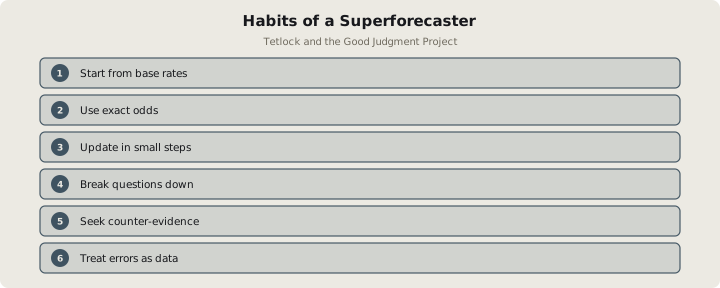
The best performers, whom Tetlock labelled superforecasters, were not geniuses or subject specialists. They shared habits. They started from base rates, asking how often things like this happen in general before adjusting for the specifics of the case, an outside view before an inside one. They expressed judgements as granular probabilities, distinguishing sixty per cent from seventy rather than hiding behind likely or possible. They updated frequently and in small increments as news arrived, neither clinging to a first guess nor lurching wildly. They broke big questions into tractable sub-questions, sought disconfirming evidence, and treated their own prior errors as data. None of this requires brilliance; it requires discipline.

The Brier scoreA measure of forecast quality that rewards being both accurate and appropriately confident. Confident predictions that fail are punished heavily; permanent fifty-fifty hedging is uninformative. Used by Tetlock to score forecasters.

What made the whole enterprise scientific was measurement. Tetlock scored forecasts with the Brier score, which rewards being both accurate and appropriately confident. Say something will happen with ninety per cent confidence and it does not, and the score punishes you hard; hedge everything at fifty per cent and you are merely uninformative. Because the Brier score is computed over many forecasts, it exposes the forecaster who sounds impressive but is poorly calibrated, meaning their stated confidence does not match their hit rate. Scoring is what turns opinion into a track record, and a track record is what lets a forecaster actually improve.

Publishing the scorecard

This is the tradition DSI deliberately joins. Most commentary on security and geopolitics issues confident claims that are never checked; the analyst pays no price for being wrong and earns no credit for being right, because no one keeps score. DSI's Predictions Scorecard applies Tetlock's discipline directly: forecasts are stated as explicit, checkable claims with probabilities attached, and then graded honestly against what actually happened. It is a calibration and accountability practice, not a marketing device. Publishing checkable forecasts and scoring them is uncomfortable precisely because it can prove the analyst wrong, and that discomfort is the point: it is the difference between commentary and a discipline that can be trusted to improve.

Disciplined habits, not genius, let volunteers beat expert forecasters.

Check your understanding

Answer each from memory. Your results are saved in this browser and count toward your readiness — sign in (account panel above) to keep them across devices.

  1. What did the Good Judgment Project demonstrate in the IARPA tournament?

  2. What does the Brier score reward and punish?

  3. How does DSI's Predictions Scorecard relate to Tetlock's work?

Flashcards

Recall-first review of the load-bearing facts.

0 reviewed · 8 left

Ready to test yourself?

12 graded questions with real explanations. You commit a confidence before each reveal — that is how you find what you only think you know.

Start practice quiz →
The American Probabilistic and Institutional School — Strategic Foresight | Contested Futures Academy · The Contested Futures Institute