The Anglo Intuitive-Logics School

The dominant Western approach to scenario planning grew out of the Cold War and matured inside a single oil company. This module traces the intuitive-logics tradition from Herman Kahn's disciplined imagination about nuclear war, through Pierre Wack's work at Shell that let the firm see the 1973 oil shock as plausible, to Kees van der Heijden's account of scenarios as a strategic conversation and Peter Schwartz's popular 2x2 method. It closes by weighing the school's strengths as a narrative craft against the blind spots that later drove analysts toward more formal methods, and shows how DSI writes intuitive-logics-style narrative futures grounded in named incidents.

  • scenario-planning
  • intuitive-logics
  • shell-scenarios
  • strategic-conversation
  • driving-forces
  • scenario-narrative
13 min · Core

Thinking the Unthinkable

Scenario thinking was born not in a business school but at RAND, where Herman Kahn built structured stories to reason about nuclear war. His insight was that some futures are too dangerous to leave unexamined, and that a disciplined narrative is a better tool for reasoning about deep uncertainty than a single forecast. This lesson establishes the founding move of the whole tradition: scenarios as disciplined imagination, not prediction.

~4 min

By the end you can

  • Explain where and why scenario thinking first emerged as a method.
  • Distinguish a scenario from a prediction or a forecast.
  • Describe what Kahn meant by 'thinking the unthinkable' and why it was controversial.
  • State why disciplined imagination suits problems of deep uncertainty.

Born at RAND, not in business

ScenarioA coherent, internally consistent story of how the future might unfold, chosen because it is instructive rather than because it is the most likely. A scenario is disciplined imagination, not a prediction. planning is now a boardroom staple, but its origin is far darker. In the 1950s the RAND Corporation, a research body created to serve the United States Air Force, faced a problem no forecast could answer: what would happen in a nuclear war, a war that had never been fought and, everyone hoped, never would be. Herman Kahn, a physicist and military strategist at RAND, argued that the only responsible way to reason about such a future was to construct detailed, internally consistent stories of how events might unfold. He borrowed the word scenario from the film industry, where it meant an outline of a screenplay. The choice was deliberate: a scenario is a narrative, a sequence of plausible happenings, not a number.

Thinking the unthinkable

Kahn's 1962 book was titled Thinking About the Unthinkable, and the phrase captured his central provocation. Most people refused to reason clearly about nuclear war because contemplating it felt monstrous. Kahn insisted that this squeamishness was itself dangerous. If leaders would not think through escalation, deterrence and the aftermath in cold detail, they would make worse decisions when it mattered. His work at RAND and later at the Hudson Institute, which he founded in 1961, treated the most horrifying futures as objects of analysis. Critics found this chilling, and Kahn is often cited as one of the models for the film character Dr Strangelove. Yet the method he pioneered outlived the controversy.

A scenario is not a prediction

The founding distinction of the whole tradition is this: a scenario does not claim that a particular future will happen. It claims only that the future could happen, and that it is worth reasoning about. Kahn did not predict a nuclear exchange; he built stories of how one might occur so that planners could examine the logic and prepare. A forecast offers a single expected outcome with a probability attached. A scenario offers a coherent account of a possible world, chosen because it is instructive, not because it is likely. Confusing the two is the most common error newcomers make, and getting the distinction right is the price of admission to the field.

Why disciplined imagination

Kahn's contribution was to make imagination rigorous. Anyone can dream up a lurid future; the discipline lies in constructing one that hangs together, where each step follows plausibly from the last and the whole remains internally consistent. This is why the tradition is sometimes called disciplined imagination. For problems of deep uncertainty, where the range of outcomes is wide and past data offers little guide, a set of well-built scenarios does something a forecast cannot: it stretches the mind to take seriously futures that a single expected value would quietly ignore. That founding move, treating the unthinkable as thinkable through structured narrative, is the seed from which everything in this module grows.
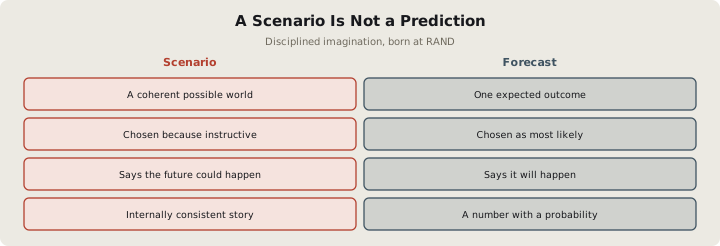
Kahn built stories of what could happen, not a single number of what will.

Check your understanding

Answer each from memory. Your results are saved in this browser and count toward your readiness — sign in (account panel above) to keep them across devices.

  1. Where and why did scenario thinking as a method first emerge?

  2. What is the founding distinction between a scenario and a prediction?

  3. What did Kahn mean by 'thinking the unthinkable', and why was it controversial?
14 min · Core

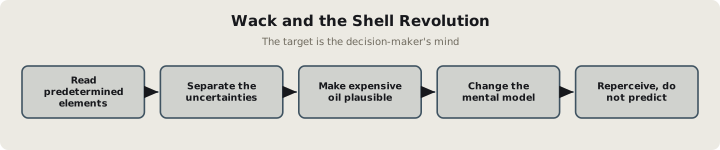
Pierre Wack and the Shell Revolution

Kahn gave the world the scenario; Pierre Wack turned it into a tool that changed how a corporation decided. Working in Shell's planning group in the early 1970s, Wack built scenarios that helped the firm's managers treat a sharp rise in oil prices as genuinely plausible before it happened. His deeper lesson was that the aim is not to forecast a number but to change the mental model of the decision-maker.

~4 min

By the end you can

  • Recount how Shell used scenarios ahead of the 1973 oil shock.
  • Explain Wack's claim that scenarios must change the decision-maker's mental model.
  • Distinguish 'first-generation' scenarios that inform from ones that change behaviour.
  • Explain why plausibility, not prediction, was the point of Wack's work.

A number the world assumed would hold

In the early 1970s the price of oil had been low and stable for so long that most in the industry treated cheap oil as a fixed fact. Pierre Wack, a French planner in the scenario team at Royal Dutch Shell, saw the assumption differently. Studying the position of the oil-producing states, the depletion of United States reserves and the political mood in the Middle East, he judged that a sharp rise in prices was not merely possible but structurally likely. His team built scenarios that laid out, step by step, how the world might arrive at expensive oil. When the 1973 embargo sent prices soaring, Shell was among the least surprised of the major companies, and it weathered the shock far better than its rivals.

The real target is the mind of the decision-maker

Wack drew a lesson from this that goes deeper than the famous forecast. In a pair of celebrated Harvard Business Review articles he argued that most scenario work fails, because it produces tidy reports that managers read, nod at and ignore. A scenario only matters, he wrote, when it changes the mental model of the person who decides, the picture of the world in their head from which they act. Shell's managers did not change their behaviour because a report told them oil might get dear; they changed because the scenarios made expensive oil feel real, forcing them to rehearse a world they had dismissed. Wack called the goal reperceiving: helping people see the same facts through a changed frame.

First-generation and beyond

Wack distinguished what he called first-generation scenarios, which merely describe possible futures and inform, from the harder kind that actually shift how managers act. The first are common and nearly useless; the second are rare and valuable. To reach the second, he separated what he called predetermined elements, the things already in motion that will shape any future, such as the reserves already discovered or the demographics already born, from the genuine uncertainties. By making the predetermined pieces vivid and undeniable, he could lead managers to conclusions they would otherwise resist, without ever claiming to predict the exact outcome.

Plausibility, not prediction

The point that anchors the whole episode is that Wack never predicted the 1973 embargo. He did not know when or how oil prices would rise. What his scenarios did was make a costly future plausible enough to prepare for while there was still time to act. This is the intuitive-logics creed in its purest form: the value of a scenario lies not in being right about a number but in loosening a fixed belief so that an organisation is ready when the world turns. Shell's advantage in 1973 came from having reperceived the terrain, not from having forecast the event.

Scenarios reperceived expensive oil as plausible, so Shell was ready in 1973.

Check your understanding

Answer each from memory. Your results are saved in this browser and count toward your readiness — sign in (account panel above) to keep them across devices.

  1. What did Shell's scenarios achieve ahead of the 1973 oil shock?

  2. According to Wack, when does a scenario actually matter?

  3. What did Wack mean by 'predetermined elements'?

13 min · Core

The Strategic Conversation

Kees van der Heijden, another of Shell's planners, gave the tradition its most influential theory. He reframed scenarios not as documents but as a device for organisational learning: their real product is a better strategic conversation among the people who run a firm. This lesson develops his idea of the 'gentle art of reperceiving' and explains why the process, not the report, carries the value.

~3 min

By the end you can

  • Explain van der Heijden's claim that the scenario's real output is a conversation.
  • Describe why scenarios are a tool for organisational learning.
  • Define the 'gentle art of reperceiving' and its purpose.
  • Explain why a shared set of scenarios beats a single official forecast for a leadership team.

From document to conversation

Kees van der Heijden, who led business environment analysis in Shell's scenario group and later wrote the field's standard text, made a claim that reshaped how practitioners understood their own craft. The output of scenario work, he argued, is not the set of stories that ends up on paper. It is the quality of the strategic conversation those stories produce among the executives who must act together. A firm's real strategy lives in the shared understanding of its leaders, and that understanding is built, tested and revised through talking. Scenarios are the material that makes such talk rigorous rather than a clash of private hunches.

Scenarios as organisational learning

Van der Heijden treated the firm as a learning organism. Most organisations, he observed, carry an unexamined official future, a single implicit picture of what lies ahead that everyone assumes and no one questions. That shared blind spot is precisely what leaves a firm exposed when the world diverges from it. By putting several plausible futures on the table at once, scenario work forces a leadership team to surface its assumptions, notice where members quietly disagree, and learn together. The learning is the point. A team that has genuinely reasoned through three or four futures thinks differently afterwards, whichever one arrives.

The gentle art of reperceiving

He named the core skill the gentle art of reperceiving, extending Wack's word. ReperceivingSeeing familiar facts through a changed frame. Van der Heijden called it the 'gentle art of reperceiving' because it cannot be forced; well-built scenarios lead people to change their own minds. is the act of seeing familiar facts in a new way, and the art is gentle because it cannot be forced. You cannot order a chief executive to change their mind; you can only construct scenarios so honest and well-built that they lead the executive to change it themselves. This is why facilitation matters so much in the tradition. The scenario planner is less a forecaster than a guide who helps a group escape its own official future without humiliating anyone or pretending to know what will happen.

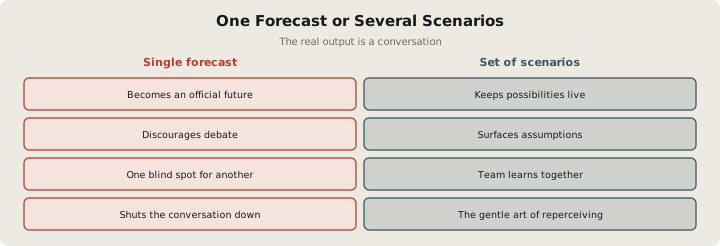
Why several futures beat one forecast

The practical upshot is a strong claim: for a leadership team facing deep uncertainty, a shared set of scenarios is more useful than a single confident forecast. A forecast, if believed, replaces one blind official future with another and discourages debate. A set of scenarios keeps several possibilities live, so the team stays alert to signals that any one of them is arriving and can adapt. Van der Heijden's legacy is this reframing: measure a scenario exercise not by whether it named the right future, but by whether it left the people who run the organisation better able to think and decide together.

A believed forecast becomes a new blind spot; scenarios keep the team learning.

Check your understanding

Answer each from memory. Your results are saved in this browser and count toward your readiness — sign in (account panel above) to keep them across devices.

  1. According to van der Heijden, what is the real output of scenario work?

  2. What is the 'official future', and why is it dangerous?

  3. Why can a shared set of scenarios beat a single confident forecast?

12 min · Core

GBN and the 2x2 Method

Peter Schwartz, who worked under Wack at Shell, carried the tradition into the wider world through the Global Business Network and his popular book The Art of the Long View. He also gave the school its most recognisable technique: the deductive 2x2 matrix, built by ranking driving forces to find the two critical uncertainties that structure four contrasting futures. This lesson explains the method and its appeal.

~4 min

By the end you can

  • Explain the role of Peter Schwartz and GBN in popularising scenario planning.
  • Define driving forces and critical uncertainties.
  • Walk through how the deductive 2x2 matrix produces four scenarios.
  • Explain why the 2x2 method became the tradition's signature technique.

From Shell to the world

Peter Schwartz learned scenario planning under Pierre Wack at Shell, then took it out of the oil industry and made it a general management practice. In 1987 he co-founded the Global Business Network, a consultancy that brought scenario work to corporations, governments and even film-makers, and in 1991 he published The Art of the Long View, which remains the most widely read introduction to the field. Schwartz did more than any single figure to move the tradition from a rarefied planning function into the vocabulary of ordinary strategists, and the version of scenario planning most people meet today is largely his.

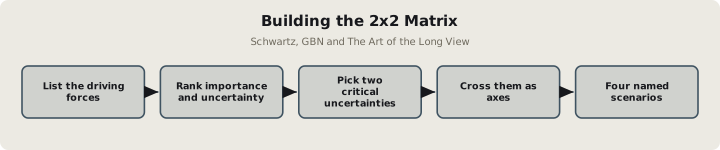
Driving forcesThe social, technological, economic, environmental and political factors that shape how a chosen question will unfold. They are the raw material sorted to find the critical uncertainties. and critical uncertainties

The method starts by listing the driving forces shaping the question at hand: the social, technological, economic, environmental and political factors that will influence how the future unfolds. These forces are then sorted along two axes. One axis is importance, how much a force would matter to the decision; the other is uncertainty, how unpredictable its direction is. The forces that score high on both, the ones that matter enormously and could genuinely go either way, are the critical uncertainties. Everything hinges on identifying them correctly, because they, not the predictable forces, are what a good scenario set must explore.

Building the matrix

Schwartz's signature move is to take the two most important critical uncertainties and cross them as the axes of a grid. Because each uncertainty has two contrasting outcomes, the grid yields four quadrants, and each quadrant becomes the seed of a distinct scenario. A team studying the future of energy might cross the pace of climate regulation, strict or lax, against the pace of clean-technology cost decline, fast or slow. The four cells give four coherent and genuinely different worlds. The team then fleshes each quadrant into a narrative with a memorable name. This is called a deductive approach because the scenarios are derived logically from the chosen axes rather than brainstormed freely.

Why the 2x2 caught on

The matrix became the tradition's calling card for good reasons. It is quick to teach, it forces a group to argue productively about what truly matters and what is truly uncertain, and it guarantees a spread of contrasting futures rather than four flavours of the same expectation. Four is also a workable number: enough to break a single official future, few enough to hold in mind. The danger, which the final lesson takes up, is that the technique can become a ritual, with teams reaching for two convenient axes and mistaking a tidy grid for genuine insight. Used well, though, the 2x2 remains the most efficient way to turn a messy list of forces into a usable set of strategic futures.

Rank driving forces, pick two critical uncertainties, and cross them into four worlds.

Check your understanding

Answer each from memory. Your results are saved in this browser and count toward your readiness — sign in (account panel above) to keep them across devices.

  1. In the 2x2 method, what are the 'critical uncertainties'?

  2. How does the deductive 2x2 method produce four scenarios?

  3. What was Peter Schwartz's role in the scenario-planning tradition?

12 min · Core

Strengths and Blind Spots of Intuitive Logics

The intuitive-logics school owes its reach to real strengths: its scenarios are qualitative, narrative and memorable, and they change how people think. But those same strengths carry blind spots. The method is subjective, leans heavily on the facilitator, and produces stories that are hard to audit or reproduce. This lesson weighs both sides and shows why other schools of foresight arose, using DSI's own narrative forecasting as a worked example.

~4 min

By the end you can

  • State the core strengths that made intuitive logics dominant.
  • Identify the school's main blind spots: subjectivity, facilitator dependence and auditability.
  • Explain why these limits motivated other schools of foresight.
  • Recognise disciplined narrative forecasting in a real analytical product such as DSI's.

Why it won

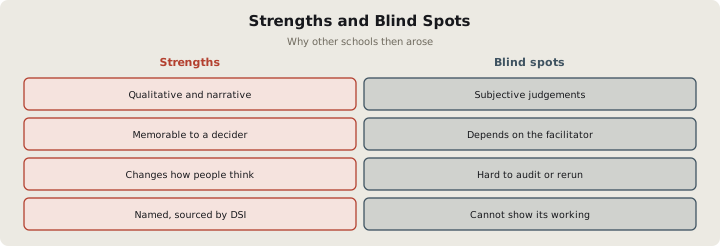
The intuitive-logics school became the dominant Western approach to scenario planning because it does something no equation can. Its futures are qualitative and narrative: they are told as stories, with characters, causes and consequences, and stories are how human beings actually reason about what might happen. A well-built scenario is memorable in a way a probability distribution never is, and because it is memorable it lodges in the mind of a decision-maker and shapes what they notice. The whole tradition, from Kahn to Schwartz, is a craft of making possible futures vivid enough to change behaviour. That is a genuine and rare strength.

The blind spots

The same qualities create the weaknesses. The method is subjective: which driving forces get chosen, which uncertainties are judged critical, and how each story is coloured all depend on the judgement of the people in the room. It is facilitator-dependent: a skilled guide produces a transforming exercise while a weak one produces four bland reports, and the difference is hard to specify in advance. And it is hard to audit. Because the scenarios rest on expert intuition rather than an explicit, reproducible model, an outsider cannot easily check the reasoning, rerun it with different inputs, or say why these four futures rather than four others. A sceptical board member who asks 'why should I believe this?' cannot be answered with a calculation.

Why other schools arose

These limits are the reason the field did not stop with intuitive logics. Later traditions grew up precisely to address them. Analysts influenced by the French prospective school, and by the work of Michel Godet, built more formal, quantified techniques that make the influence of each factor explicit and reproducible. Others turned to probabilistic and model-based methods, and to structured judgement approaches that discipline the forecasting of individual events. Each was, in part, a response to the intuitive-logics school's difficulty with subjectivity and auditability. Understanding the strengths and the blind spots together is what lets a practitioner choose the right tool rather than reaching for narrative scenarios out of habit.

Disciplined narrative in practice

Done rigorously, narrative forecasting remains powerful, and DSI's own work shows what disciplined intuitive logics looks like outside the boardroom. In its briefing The Architecture of the Watched World, DSI opened with named, verifiable incidents about the modern surveillance stack and then closed with five explicit forecasts about how that stack would develop. Those forecasts were not point predictions dressed as certainties; they were reasoned narrative futures, each grounded in concrete evidence and stated plainly so a reader could later judge whether it held. This is the intuitive-logics inheritance applied honestly: build the story from real forces, name the incidents, and make the future claims explicit enough to be checked. The strength is the vividness; the discipline, which answers the school's blind spots, is the sourcing and the willingness to be held to account.

Narrative vividness is the strength; subjectivity and weak audit are the cost.

Check your understanding

Answer each from memory. Your results are saved in this browser and count toward your readiness — sign in (account panel above) to keep them across devices.

  1. Which core strength best explains why the intuitive-logics school became dominant?

  2. Which set of blind spots most accurately describes intuitive logics?

  3. How does DSI's briefing 'The Architecture of the Watched World' illustrate disciplined intuitive logics?

Flashcards

Recall-first review of the load-bearing facts.

0 reviewed · 8 left

Ready to test yourself?

12 graded questions with real explanations. You commit a confidence before each reveal — that is how you find what you only think you know.

Start practice quiz →
The Anglo Intuitive-Logics School — Strategic Foresight | Contested Futures Academy · The Contested Futures Institute