Capstone: Run a Foresight Cycle

The whole course converges here. Framing, scanning, alternative futures, stress-testing and war-gaming, structural analysis, calibration and scoring, communication, decision and monitoring are not separate tricks but one cycle. This capstone walks that cycle end to end, runs it on a real case, holds the finished product to a decision-making-under-deep-uncertainty standard, links scenarios to actual decisions and trigger indicators, and then hands the learner their own question to run through the same loop. It is the point where the schools of foresight are made to combine rather than compete.

  • foresight-cycle
  • synthesis
  • foresight-product
  • decision-support
  • structural-analysis
  • calibration
13 min · Core

The Full Cycle, End to End

A recap of the whole arc as a single loop: frame the question, scan for signals, build alternative futures, stress-test and war-game them, assess the drivers structurally, calibrate and score the call, communicate the product, then decide and monitor. Each stage feeds the next, and the loop closes because monitoring sends you back to reframe.

~3 min

By the end you can

  • Name the stages of the foresight cycle in order and state what each produces.
  • Explain how each stage feeds the next rather than standing alone.
  • Describe why the cycle is a loop that returns to reframing.
  • Recognise that the schools of foresight are stages in one process, not rivals.

One loop, not eight tricks

Each earlier module taught a distinct capability, and it is tempting to file them as a toolbox to dip into. That is the wrong mental model. Framing, scanning, building alternatives, stress-testing, structural assessment, calibration, communication and decision are stages of a single foresight cycle. The output of one becomes the input of the next, and skipping a stage does not save time so much as move the failure downstream. A brilliant scenario built on a badly framed question answers something no one asked.

The eight stages

Start by framing: turn a vague worry into a decision-focused question with a clear time horizon and boundary. Then scan: gather signals, weak and strong, across politics, economics, technology and society, sorting driving forces from noise. From the two or three most uncertain, high-impact drivers you build alternative futures, most often as a two-by-two of plausible worlds rather than one forecast. You then stress-test and war-game each world, red-teaming your own assumptions and playing adversaries who get a vote. Next you assess structurally, asking what incentives, dependencies and power relations actually drive the outcome, in the tradition of Susan Strange and of Henry Farrell and Abraham Newman on weaponised interdependence. You calibrate and score, attaching confidence bands you are willing to be judged on, in the spirit of Philip Tetlock's work on forecasters. You communicate the result as a product a decision-maker can act on. And you decide and monitor, linking each scenario to a choice and to indicators that tell you which world is arriving.

Why it must close

The cycle is a loop because monitoring feeds back into framing. When a trigger indicator fires, or a scenario you dismissed starts to materialise, you do not cling to the old product; you reframe and run the loop again with what you now know. Foresight is not a report delivered once but a standing capability that updates. A view held to the end of a quarter regardless of new signals is not analysis, it is a bet nobody is willing to revise.

The schools stop competing

Placed in the cycle, the schools of foresight that seem to argue with each other turn out to occupy different stages. Scenario planning owns the building of alternatives. Structural and political-economy analysis owns the assessment of drivers. Analysis of competing hypotheses, from Richards Heuer's tradecraft, disciplines the stress-testing. Calibration owns the scoring. None is the whole of foresight, and a practitioner who only knows one produces a lopsided product. The capstone's real lesson is combination: the next lessons run the full loop on a live case, then hand it to you.
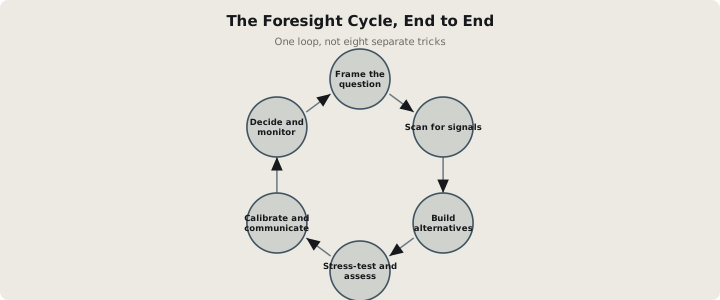
Each stage feeds the next, and monitoring returns you to reframing.

Check your understanding

Answer each from memory. Your results are saved in this browser and count toward your readiness — sign in (account panel above) to keep them across devices.

  1. Which sequence correctly orders the foresight cycle?

  2. Why is the foresight cycle described as a loop rather than a line?

  3. How do the different schools of foresight relate within the cycle?
15 min · Core

A Worked Example

The whole cycle run once, on a real DSI case: sovereign cloud. Frame the question, scan the signals, build a two-by-two of futures, apply structural analysis through the CLOUD Act and weaponised interdependence, red-team both the sovereigntist and the pragmatist narratives, and score the resulting call, showing how the schools combine into a single product.

~4 min

By the end you can

  • Frame a live geopolitical question into a decision-focused foresight brief.
  • Build a two-by-two of futures from the driving uncertainties of sovereign cloud.
  • Apply structural analysis via the CLOUD Act and weaponised interdependence.
  • Red-team both competing narratives and attach a calibrated confidence band.

Frame and scan

Take a question a European institution actually faces: will using a United States hyperscaler for sensitive workloads leave us exposed to extraterritorial control over the next five years, and should we migrate. That is decision-focused, bounded and time-bound, which a vague worry about "cloud risk" is not. Scanning surfaces the signals: the persistence of the CLOUD ActUnited States legislation allowing its authorities to compel disclosure of data held by American providers regardless of where the data is physically stored, the load-bearing structural fact in the sovereign-cloud case., which lets United States authorities compel disclosure of data held by American providers wherever it sits; the EU's push for sovereignty schemes and data boundaries; the maturing of European providers; and the sheer switching cost of a migration. Two drivers dominate as both uncertain and high-impact: how aggressively extraterritorial legal reach is exercised, and how credible a European alternative becomes.

Build the alternative futures

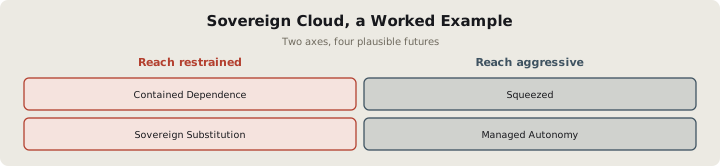
Cross those two axes into a two-by-two. In Contained Dependence, legal reach stays restrained and European alternatives stay weak, so the status quo persists and migration looks like wasted money. In Sovereign Substitution, reach is restrained but credible alternatives emerge, making a gradual migration cheap insurance. In Squeezed, reach is aggressive but alternatives remain weak, the worst world: exposed and with nowhere to go. In Managed Autonomy, reach is aggressive and alternatives are strong, so migration becomes urgent and viable. Four plausible worlds, not one forecast, and each implies a different move.

Assess the structure

Scenarios describe; structure explains. The CLOUD Act is not a detail but the load-bearing fact, and the lens that reads it is Henry Farrell and Abraham Newman's weaponised interdependence: control over a chokepoint, here the jurisdiction of the dominant cloud providers, becomes coercive power. Susan Strange's structural power sharpens it: the party that sets the terms of the network wields more leverage than any single transaction shows. This is the same logic DSI traced in "The Laundered Dependency" on rare earths, where a dependence firms cannot even verify is the true exposure. Structurally, the exposure is real in every scenario; what varies is whether it is exercised and whether escape exists.

Red-team both narratives, then score

Now stress-test both stories. The sovereigntist narrative overstates certainty: aggressive extraterritorial action carries costs for the United States too, and pure European autonomy can trade one dependence for another. The pragmatist narrative underweights tail risk: "it has never been used against us" is not "it cannot be", and switching costs rise the longer you wait. Following Richards Heuer, the honest analyst declines to endorse either self-story. The scored call, held to Philip Tetlock's discipline: a 60 to 70 per cent probability that within five years exposure stays latent rather than exercised, paired with the judgement that beginning a reversible, partial migration is the robust move because it pays off in three of the four worlds. That is the whole cycle in one case.

Crossing the driving uncertainties yields four worlds, each implying a different move.

Check your understanding

Answer each from memory. Your results are saved in this browser and count toward your readiness — sign in (account panel above) to keep them across devices.

  1. Which two uncertainties form the axes of the sovereign-cloud scenario matrix?

  2. How does weaponised interdependence read the CLOUD Act?

  3. What is the correct analytic stance toward the sovereigntist and pragmatist narratives?

14 min · Core

Communicating Foresight

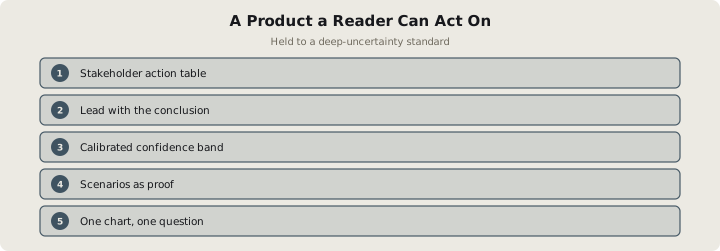
A finished foresight product is only as useful as a decision-maker's ability to act on it. This lesson holds the product to a decision-making-under-deep-uncertainty standard: a stakeholder action table that maps findings to reader types, calibrated confidence bands rather than false precision, and scenarios placed exactly where the argument needs them.

~3 min

By the end you can

  • Build a stakeholder action table that maps findings to distinct reader types.
  • Express judgements as calibrated confidence bands, avoiding false precision.
  • Place scenarios and visuals where the argument needs proof, not decoration.
  • Distinguish a product a reader can act on from an essay that merely informs.

The product is the point

Analysis that a decision-maker cannot use is not finished, however sound its reasoning. The benchmark here is the standard J.P. Morgan set with its Decision-Making under Deep Uncertainty report: lead with the conclusion, show the uncertainty honestly, and structure the whole so a busy reader extracts their action in minutes. A foresight product is judged by what a reader does after closing it, not by how thorough it felt to write.

The stakeholder action table

Different readers need different things from the same analysis, so open with a stakeholder action table that maps each finding to the reader who must act on it. In the sovereign-cloud case, the chief information security officer reads "begin a reversible partial migration of the most sensitive workloads"; procurement reads "add exit and data-location clauses to the next contract cycle"; the board reads "exposure is latent but real, budget for optionality, not panic." One analysis, several actions, each addressed to the person who owns it. This single table often does more work than the rest of the document, because it converts a shared picture into divided labour.

Calibrated bands, not false precision

A number like "there is a 63.5 per cent chance" projects a rigour the evidence cannot support and quietly destroys trust when it proves wrong. Follow Philip Tetlock's discipline and state a confidence band: "we assess it likely, roughly 60 to 70 per cent, that exposure stays latent over five years, low confidence beyond that horizon." The band signals the real state of knowledge, invites challenge, and can be scored later. Ranges and stated confidence levels are not weakness; false precision is. A reader trusts an analyst who shows the edges of their own knowledge more than one who hides them.

Scenarios where the argument needs them

Place each scenario and visual at the moment the prose needs it as proof, never as ornament. The two-by-two belongs where you introduce the four futures, not on a cover as decoration. A single chart should answer one question. If a scenario does not change a recommendation, it does not earn a place in the product. The test of every element is the same: does it help the reader decide? An essay informs; a foresight product equips a named person to move. That difference is the craft this lesson teaches, and it is where rigorous analysis either lands or is wasted.

Every element is judged by whether it helps the reader decide.

Check your understanding

Answer each from memory. Your results are saved in this browser and count toward your readiness — sign in (account panel above) to keep them across devices.

  1. What is the purpose of a stakeholder action table in a foresight product?

  2. Why is a stated confidence band preferable to a figure like '63.5 per cent'?

  3. What test decides whether a scenario or chart belongs in the product?

13 min · Core

From Foresight to Decision

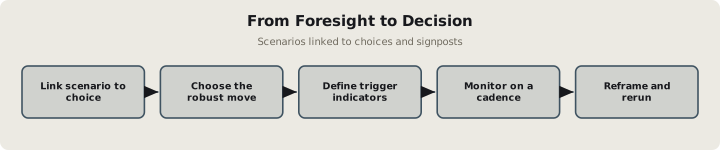
Scenarios are worthless until they are linked to decisions. This lesson connects each future to a specific choice, defines the trigger indicators and monitoring that reveal which world is arriving, and shows how the view is updated as signals come in, closing the loop back to reframing.

~3 min

By the end you can

  • Link each scenario to a concrete decision or hedge rather than a mood.
  • Define trigger indicators that reveal which future is materialising.
  • Set up monitoring that updates the view as signals arrive.
  • Explain how the decision link closes the loop back to reframing.

Scenarios that do not touch a decision are theatre

A set of vivid futures that changes no one's behaviour is an intellectual exercise, not foresight. The decision link is the discipline of asking, for each scenario, "what would we do if this were the world we are in." In the sovereign-cloud case the four futures map to four postures: do nothing, hedge with a partial migration, prepare an emergency exit, or migrate in earnest. The robust move is the one that pays off across most futures, which is why the partial, reversible migration wins: it is right in three of the four worlds and cheap in the fourth. Robustness across scenarios, not accuracy about one, is what a decision-maker under deep uncertainty is buying.

Trigger indicators tell you which world is arriving

Once decisions are attached to futures, you need to know which future is actually unfolding, and for that you define trigger indicators: specific, observable, pre-committed signposts that distinguish the scenarios. For sovereign cloud they might be a new extraterritorial data-access order against a European entity, a formal EU sovereignty certification reaching maturity, or a hyperscaler winning or losing a landmark jurisdiction case. Each is chosen because it moves you between worlds, and each is agreed in advance so that when it fires it prompts action rather than a fresh argument about whether it matters. The art is choosing indicators early enough to act on and specific enough not to fire on noise.

MonitoringThe standing process of watching trigger indicators on a set cadence, updating the assessed probabilities and recommended posture as signals arrive, and returning to framing when a dismissed scenario begins to materialise. turns a report into a capability

Monitoring is the standing process of watching those indicators and revisiting the view on a set cadence. Without it, the sharpest analysis decays into a stale document the moment the world moves. With it, the product becomes a live instrument: an indicator fires, the assessed probabilities shift, the recommended posture updates, and the decision-maker is told before the change becomes a crisis. This is where foresight earns its keep, in the update rather than the original call.

Closing the loop

Monitoring is also what closes the cycle. When enough signals accumulate, or a scenario you had rated unlikely starts to arrive, you do not patch the old product; you return to framing and run the loop again with better knowledge. Following Tetlock, the good forecaster updates in proportion to the evidence, neither clinging to a prior view nor lurching at every headline. The decision link, the triggers and the monitoring together are what make foresight a repeated cycle rather than a one-off prediction. The final lesson hands you your own question to run through it.

The robust move pays off across most futures, not just one.

Check your understanding

Answer each from memory. Your results are saved in this browser and count toward your readiness — sign in (account panel above) to keep them across devices.

  1. What makes a decision 'robust' in foresight terms?

  2. What properties should a good trigger indicator have?

  3. How does monitoring relate to the rest of the foresight cycle?

15 min · Supplement

Capstone: Your Own Foresight Cycle

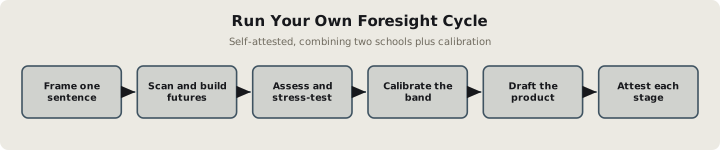
A synthesising, self-attested walkthrough. You take a question that matters to your own work and run it through the full foresight cycle, combining at least two schools plus the calibration layer, then draft a short foresight product to a decision-making-under-deep-uncertainty standard. The steps are given as prose to work through and attest, not as an automated lab.

~3 min

By the end you can

  • Frame your own decision-focused question with a horizon and boundary.
  • Run the full cycle, combining at least two schools plus calibration.
  • Draft a short foresight product with an action table and confidence bands.
  • Self-attest each stage honestly, including where your confidence is low.

Choose a question that matters to you

Pick a real question from your own domain: an analyst might ask whether a supplier country will remain a reliable chokepoint, a policy adviser whether a regulation will hold under pressure, a strategist whether a market will fragment along geopolitical lines. Frame it the way the worked example framed sovereign cloud: decision-focused, bounded, and time-bound. Write it in one sentence. If you cannot, the question is not yet ready, and no amount of clever scenario work will rescue a question no one needs answered. Attest to yourself that your framing names a decision and a horizon.

Run the cycle

Now work the loop. Scan for the driving forces and note the two most uncertain, high-impact ones. Build a two-by-two of four futures from those axes and name each world in a phrase you would remember. Assess structurally: name the real incentives, dependencies and power relations at work, using Susan Strange's structural power or Farrell and Newman's weaponised interdependence where a chokepoint is in play. Stress-test with analysis of competing hypotheses in Richards Heuer's tradition: list the hypotheses, and look for evidence that would disconfirm your favourite rather than confirm it. Combine at least two of these schools deliberately, and note which stage each served, so the combination is conscious rather than accidental.

Calibrate and draft the product

Attach a confidence band to your central judgement, in Philip Tetlock's discipline: a probability range and an honest note of where your confidence falls away. Then draft a short foresight product, one or two pages, to the standard of the communication lesson. Open with a stakeholder action table mapping your finding to the readers who must act. State the scored call as a band, not a false-precise number. Place your two-by-two where the argument needs it. Define two or three trigger indicators and the monitoring cadence that would tell you which world is arriving. Keep it short enough that a busy decision-maker reads it in one sitting.

Attest honestly

Finally, mark each stage complete only if you did it in earnest. Did you frame a real decision, not a mood. Did you build genuinely distinct futures, not one forecast in disguise. Did you look for disconfirming evidence, or only gather support for the view you started with. Did you state a band you would let yourself be scored on. The value of this capstone is not a certificate but the honesty of the self-attestation, in the spirit of the integrity test that asks how work is done when no one is checking. Run the loop, draft the product, and note the one stage you found hardest, because that is the one to practise next.

Value lies in the honesty of the attestation, in the spirit of the integrity test.

Check your understanding

Answer each from memory. Your results are saved in this browser and count toward your readiness — sign in (account panel above) to keep them across devices.

  1. What is the first sign that your chosen question is ready to run through the cycle?

  2. What does stress-testing with analysis of competing hypotheses require you to do?

  3. What does the capstone say gives the self-attestation its value?

Flashcards

Recall-first review of the load-bearing facts.

0 reviewed · 8 left

Ready to test yourself?

12 graded questions with real explanations. You commit a confidence before each reveal — that is how you find what you only think you know.

Start practice quiz →
Capstone: Run a Foresight Cycle — Strategic Foresight | Contested Futures Academy · The Contested Futures Institute