The Chinese Strategic-Foresight Tradition

China does foresight differently. Where much Western planning imagines the future as a set of discrete events to forecast, an older and continuing Chinese tradition treats the future as a propensity already latent in the present, to be sensed and shaped rather than predicted. This module traces that tradition from Sun Tzu's idea of shi, through the quantitative modelling of comprehensive national power and Qian Xuesen's meta-synthesis, to the living state doctrines of the period of strategic opportunity and the great changes unseen in a century. The aim is not to admire or to alarm, but to help an analyst read a rival's own foresight on its own terms.

  • chinese-strategy
  • shi
  • comprehensive-national-power
  • state-foresight
  • meta-synthesis
  • strategic-doctrine
13 min · Core

Sun Tzu and Shi (势)

Shi is one of the oldest ideas in Chinese strategic thought and one of the hardest to translate. The sinologist Francois Jullien renders it as propensity: the configuration of forces in a situation that makes one outcome more likely than another. To act through shi is to shape the situation so that victory follows almost of its own accord, rather than to impose a plan on a resistant world. This lesson introduces shi through Sun Tzu and the contrast between the encircling game of weiqi and the decisive game of chess.

~4 min

By the end you can

  • Define shi as propensity or the configuration of forces in a situation.
  • Explain Jullien's reading of shaping the situation so victory follows.
  • Contrast the positional logic of weiqi with the decisive logic of chess.
  • Recognise shi as a mode of foresight distinct from event prediction.

A word that resists translation

The Chinese character shi (势) has no clean English equivalent. It has been rendered as power, force, momentum, tendency, circumstance and configuration, and each catches part of it. The French sinologist Francois Jullien, in his study The Propensity of Things, settles on propensity: the inherent disposition of a situation, the way the arrangement of forces at a given moment already leans towards one outcome. A boulder at the top of a slope has shi; so does an army positioned so that the ground fights for it. To read shi is to read where a situation is already tending before anything decisive has happened.

Sun Tzu and the shaping of situations

Sun Tzu, in the text that carries his name, treats shi as the strategist's real object. The skilled commander does not seek a fair fight and win it by effort; he arranges conditions so that when battle comes it is nearly settled in advance. Sun Tzu's image is water that has been dammed and then released, or a crossbow drawn and held. The work is done upstream, in positioning, timing and the shaping of the adversary's choices. Victory, when it arrives, looks effortless precisely because the effort went into configuring the situation rather than into the clash. This is foresight as cultivation, not as forecast: the strategist does not predict the future so much as tilt the present until the future it wants becomes the likely one.

WeiqiThe board game known in the West by its Japanese name Go, in which stones are placed to encircle territory. A recurring metaphor for positional, encircling strategy and the patient accumulation of advantage over a decisive single blow. against chess

The contrast between two board games sharpens the point, and it is a contrast Chinese strategists themselves draw. In chess, force is concentrated and the aim is decisive: capture the king and the game ends. In weiqi, known in the West by its Japanese name Go, stones are placed one by one on a wide board and the aim is to encircle territory and slowly deny the opponent room. There is rarely a single decisive blow; there is the patient accumulation of position until the balance has tipped so far that the outcome is no longer in doubt. A player thinks in terms of influence across the whole board, not the capture of one piece. Where chess rewards the sharp combination, weiqi rewards the long shaping of shi.

Why this matters for foresight

An analyst trained to forecast discrete events, an election, an invasion, a crisis, can miss a strategy conducted through shi, because such a strategy shows up not as an event but as a slow change in the configuration of forces. The point is not that Chinese strategists never predict events or that Western ones never shape situations; both traditions do both. It is that the shi tradition foregrounds the shaping. Reading it on its own terms means asking not only what will happen but which way the terrain is already leaning, and who is quietly steepening the slope. That question, rather than any prediction, is the inheritance this module builds on.
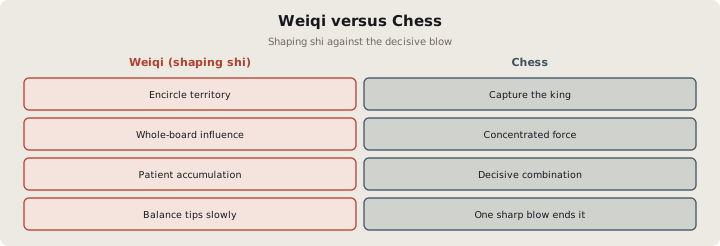
Weiqi rewards patient encirclement; chess rewards one concentrated, decisive stroke.

Check your understanding

Answer each from memory. Your results are saved in this browser and count toward your readiness — sign in (account panel above) to keep them across devices.

  1. How does Francois Jullien translate the concept of shi?

  2. In Sun Tzu's account, where does the skilled commander do the real work?

  3. What is the key strategic contrast between weiqi and chess?
13 min · Core

Comprehensive National Power (综合国力)

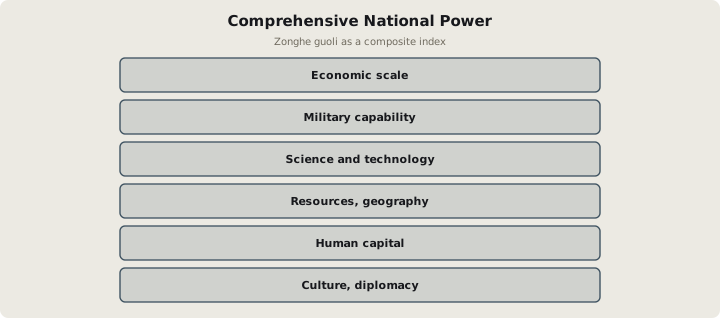
Chinese strategists have long tried to reduce the standing of a nation to a single measurable quantity. Comprehensive national power, zonghe guoli, is a school of quantitative modelling that scores a country across economy, military strength, technology, resources, culture and diplomacy, and then tracks that score over decades. Where shi is qualitative and situational, comprehensive national power is a numeric attempt at the same instinct: to read the underlying trajectory of forces rather than the surface of events.

~4 min

By the end you can

  • Define comprehensive national power as a composite, quantitative measure of a nation's standing.
  • List the main dimensions the models combine into a single index.
  • Explain how the model frames foresight as tracking a power trajectory.
  • Assess the strengths and the limits of reducing power to one number.

Power as a single number

Comprehensive national powerZonghe guoli, a Chinese school of quantitative modelling that scores a nation's total strength across economy, military, technology, resources, human capital and culture, then tracks that composite over time., in Chinese zonghe guoli, is the attempt to express the total strength of a state as one composite figure. The idea took institutional form in Chinese think tanks from the 1980s onward, at bodies such as the Chinese Academy of Social Sciences and the Academy of Military Sciences, where analysts built indices that combined many strands of national capability into a single score and then compared states against one another. The ambition is frankly reductive: to turn the sprawling question of how strong a country is into a number that can be plotted, ranked and projected forward.

What the models combine

The dimensions vary between models, but a typical index folds together economic scale and productivity, military capability, science and technology, natural resources and geography, human capital and population, and softer factors such as culture, diplomacy and national cohesion. Each strand is weighted and normalised, then aggregated. The result is a claim that, say, one state holds seventy units of comprehensive power to another's fifty, and, more importantly, that the gap is closing or widening at a measurable rate. The scholarship around these indices, surveyed by analysts such as Michael Pillsbury and others who have read the Chinese sources closely, shows a genuine and sustained effort rather than a propaganda exercise, even where the weightings are contestable.

Foresight as trajectory, not event

The strategic payoff is not the score at any single moment but its trajectory. If a rival's comprehensive national power is rising while one's own plateaus, the models say the terrain is tilting, in the language of shi, regardless of who wins any particular diplomatic round. This reframes foresight: the object of attention becomes the long curve of relative national strength, and policy is set to bend that curve. A state that thinks this way will tolerate short-term setbacks that leave the long trajectory intact and worry about developments that appear minor but change the slope. It is the numerical cousin of reading propensity.

The strengths and the traps

The approach has real virtues. It forces attention onto fundamentals such as productivity and technology that daily headlines obscure, and it imposes discipline by making assumptions explicit and comparable over time. But reducing a nation to one number carries familiar dangers. The weightings encode judgements that may be wrong; a single index can hide the very asymmetries, in alliances, in chokepoints, in resilience, that decide real contests; and a rising curve can breed the overconfidence it appears to justify. An analyst reading Chinese foresight should take the trajectory framing seriously without treating any particular score as more solid than the assumptions beneath it. The measure is a lens, not the terrain itself.

Chinese indices fold many strands of capability into one tracked score.

Check your understanding

Answer each from memory. Your results are saved in this browser and count toward your readiness — sign in (account panel above) to keep them across devices.

  1. What is comprehensive national power (zonghe guoli)?

  2. Why does the model treat the trajectory of the score as the key object of foresight?

  3. What is a central danger of reducing a nation's power to one number?

14 min · Core

Qian Xuesen and Meta-Synthesis (综合集成)

Qian Xuesen, the American-trained rocket scientist who founded China's missile and space programmes, spent his later years arguing that the methods of systems engineering could be turned onto society and the state. His answer to problems too complex for pure computation and too consequential for pure intuition was meta-synthesis, zonghe jicheng: a disciplined method for combining expert judgement, hard data and machine computation. This lesson introduces meta-synthesis and the institution built around it, the Hall for Workshop of Metasynthetic Engineering.

~4 min

By the end you can

  • Identify Qian Xuesen and his move from rocketry to systems engineering for statecraft.
  • Define meta-synthesis as combining expert judgement, data and computation.
  • Explain the role of the Hall for Workshop of Metasynthetic Engineering.
  • Relate meta-synthesis to the wider Chinese instinct to systematise foresight.

From rockets to the social system

Qian Xuesen (also written Tsien Hsue-shen) was among the twentieth century's foremost engineers. Trained at the California Institute of Technology, a co-founder of the Jet Propulsion Laboratory, he was deported to China in 1955 amid the anti-communist suspicion of the McCarthy era and went on to father China's missile, satellite and space programmes. In his later decades he turned the discipline that had built rockets, systems engineering, onto the largest system he could imagine: society and the state itself. His conviction was that a nation could be steered with the same rigour used to steer a launch vehicle, if only the right method could be found for problems where the variables are human and the data incomplete.

The method of meta-synthesis

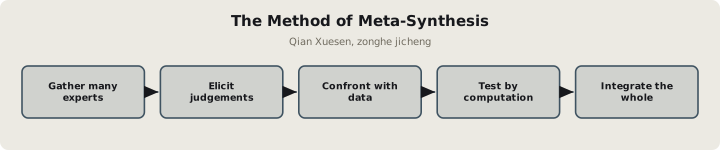
That method he called meta-synthesis, in Chinese zonghe jicheng, developed with colleagues including Yu Jingyuan and Dai Ruwei around 1990 for what they termed open complex giant systems. Its premise is that the hardest strategic problems yield neither to computation alone, because too much is qualitative and uncertain, nor to expert opinion alone, because human judgement is biased and narrow. Meta-synthesisZonghe jicheng, a method developed by Qian Xuesen and colleagues that combines expert judgement, hard data and machine computation for open complex giant systems where neither computation nor intuition alone will serve. proposes to combine them deliberately: gather many experts across disciplines, elicit their reasoned judgements, confront those judgements with hard data, and use machine computation and models to test and integrate the whole. The aim is a synthesis that is more disciplined than a committee and more humane than a formula, iterating between human insight and quantitative check.

The Hall for Workshop of Metasynthetic Engineering

Qian gave the method an institutional home in idea and design: the Hall for Workshop of Metasynthetic Engineering, sometimes rendered as the metasynthetic engineering hall. It was conceived as a physical and organisational setting where experts, data streams and computing power meet to work a complex problem together, a kind of engineered war room for strategy and policy rather than for a single battle. The design anticipated, decades early, much of what later decision-support centres and modelling cells would attempt: bringing analysts, models and live data into one room so that judgement and computation could correct each other in real time.

Foresight made into an engineering discipline

Meta-synthesis matters for this module because it shows the Chinese instinct to systematise foresight carried to its furthest point. Where comprehensive national power reduces standing to a number, meta-synthesis builds a whole apparatus for reasoning about complex futures, treating strategic foresight as an engineering discipline with methods, roles and institutions. Rush Doshi and other readers of Chinese strategy note how deeply this systems-engineering mentality runs through the party-state's approach to planning. For an analyst, the lesson is twofold. First, do not assume a rival's foresight is merely intuition or ideology; it may rest on an explicit, self-conscious method. Second, the same method has a weakness worth watching: an apparatus this elaborate can produce false confidence, mistaking the rigour of its process for the reliability of its conclusions.

Meta-synthesis combines expert judgement, data and computation, iterating between them.

Check your understanding

Answer each from memory. Your results are saved in this browser and count toward your readiness — sign in (account panel above) to keep them across devices.

  1. What was Qian Xuesen's central later-life argument?

  2. What does meta-synthesis (zonghe jicheng) combine?

  3. What was the Hall for Workshop of Metasynthetic Engineering conceived as?

13 min · Core

Planning and the Period of Strategic Opportunity

The Chinese party-state practises foresight at scale through its Five-Year Plans, a rolling exercise in setting national direction over horizons far longer than an electoral cycle. Alongside the plans sits a subtler judgement about the external environment: the period of strategic opportunity, zhanlue jiyuqi, an official assessment of whether the world will, for a stretch of years, permit a country to concentrate on building its own strength. This lesson treats both as instruments of state foresight.

~4 min

By the end you can

  • Describe the Five-Year Plan as a mechanism of long-horizon state foresight.
  • Define the period of strategic opportunity as a judgement about the external environment.
  • Explain how such an assessment shapes concrete policy choices.
  • Recognise a declared period of opportunity as a foresight claim that can be revised.

Planning across horizons

The Five-Year PlanChina's rolling national planning instrument, first launched in 1953, that sets priorities across the economy, technology and infrastructure over horizons no electoral cycle imposes, often nested inside longer visions to 2035 or mid-century. is the most visible instrument of Chinese state foresight. Since the first was launched in 1953, the plans have set national priorities across the economy, technology, infrastructure and, increasingly, science and the environment, over a horizon no electoral cycle imposes. A plan is not a mere budget; it is a coordinated statement of where the country intends to be and which capabilities it will build to get there, often nested inside longer visions reaching to 2035 or mid-century. Whatever its execution, the plan embodies a mode of thinking in which the state commits publicly to a direction and holds itself to a multi-year trajectory, the institutional expression of the trajectory-reading instinct met in earlier lessons.

The period of strategic opportunity

Less familiar to outside observers, and arguably more revealing, is the period of strategic opportunity, in Chinese zhanlue jiyuqi. This is an explicit official judgement about the external environment: an assessment that, for a defined span of years, great-power conditions will permit the country to concentrate on domestic development rather than on managing crises or confrontation. The formulation was made prominent in the early 2000s, when Chinese leaders judged that the years ahead offered such a window, and that judgement shaped a generation of policy oriented towards economic construction. Naming a period of opportunity is a foresight act in the fullest sense: a public forecast about the disposition of the world, on which enormous resource allocation then rests.

How the judgement drives policy

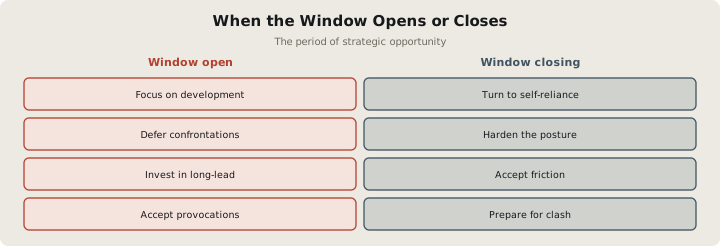
The practical force of the assessment lies in what it licenses and what it forbids. If the leadership judges that a window of opportunity is open, it can defer confrontations, invest patiently in long-lead capabilities, and accept provocations that a more threatened posture would answer, because the priority is to use the calm to build. If it judges the window closing, the calculus shifts towards hardening, self-reliance and the acceptance of friction. The same country, holding the same capabilities, will behave very differently depending on which reading of the environment its foresight has produced. The assessment is therefore not a slogan but a hinge on which grand strategy turns.

Reading it as a revisable claim

For an analyst, the value of these instruments is that they are forecasts a rival has committed to in public, and forecasts can be tracked and tested. A declared period of strategic opportunity states, in effect, that the external world will remain permissive; if events contradict that, one should expect the doctrine to be revised, and revisions signal a change in how the rival reads its own future. Watching whether Beijing still speaks of an open window, or has begun to hedge the phrase, is itself a foresight indicator. The next lesson turns to exactly such a shift, when the language moved from opportunity to a world of great changes.

A reading of the external environment turns strategy toward building or hardening.

Check your understanding

Answer each from memory. Your results are saved in this browser and count toward your readiness — sign in (account panel above) to keep them across devices.

  1. What is the period of strategic opportunity (zhanlue jiyuqi)?

  2. How does judging that a window of opportunity is open shape policy?

  3. Why is a declared period of strategic opportunity useful to an outside analyst?

14 min · Core

Great Changes Unseen in a Century (百年未有之大变局)

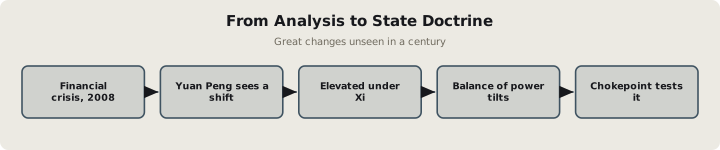
In 2009, in the aftermath of the global financial crisis, the Chinese analyst Yuan Peng argued that the world was entering an epochal shift in the balance of power. The phrase he helped popularise, great changes unseen in a century, was later elevated under Xi Jinping from 2017 to 2018 into a headline judgement of Chinese grand strategy. This lesson treats the phrase as a live state foresight doctrine and uses it to practise reading a rival's own assessment of the future.

~4 min

By the end you can

  • Trace the phrase from Yuan Peng in 2009 to its codification under Xi Jinping.
  • Explain what the doctrine asserts about the current epoch and the balance of power.
  • Read a rival's foresight doctrine as evidence of how it sees the world, not as neutral fact.
  • Connect the doctrine to the weaponised-interdependence and chokepoint lens from DSI analysis.

The origin of a phrase

In 2009, writing in the wake of the global financial crisis that had shaken Western economies, the Chinese America-watcher Yuan Peng argued that the world stood at the start of a rare structural transition. The crisis, in this reading, was not a passing shock but a marker that the long dominance of the West had entered relative decline while others, China foremost, were rising. The formulation that crystallised this view, great changes unseen in a century, in Chinese bainian weiyou zhi da bianju, captured the claim in a single memorable clause: the present is not ordinary turbulence but a once-in-a-hundred-years reordering.

From analysis to doctrine

What began as analysis became doctrine. From around 2017 and 2018 the phrase was elevated under Xi Jinping into an authoritative judgement guiding Chinese grand strategy, repeated in leadership speeches and party documents as the settled assessment of the era. This elevation matters. When a state raises an analyst's forecast to the level of official doctrine, it is publicly committing to a reading of the future and organising policy around it. The doctrine implies that the balance of power is shifting in China's favour, that the shift is structural rather than temporary, and that the task is to navigate the transition to advantage while managing its risks. Rush Doshi, in The Long Game, reads such formulations as windows onto how Beijing perceives the trajectory of the contest, and treats the shift in language after 2008 and again after 2016 as evidence of changing strategic confidence.

Reading a rival's foresight

The analytic discipline this module teaches comes to a head here. A doctrine like great changes unseen in a century should be read not as a true description of the world but as evidence of how a rival sees the world, which is a different and often more useful thing. Whether or not the West is in structural decline, the fact that Chinese strategy is organised around the belief that it is will shape choices about risk, timing and assertiveness. To read the doctrine well is to hold two questions apart: is the assessment correct, and, whatever the answer, what follows from a great power acting as though it were. Confusing the two, either dismissing the doctrine because one disputes it or accepting the worldview because one takes the doctrine seriously, is the characteristic error.

The chokepoint that tests the doctrine

The doctrine also invites a structural test, and here DSI's own work is instructive. In The Laundered Dependency, DSI examined how China's control of rare-earth refining and its export-licence regime function as a panopticon: because the licence forces end-user disclosure, the Chinese state can see the true dependency of foreign firms better than those firms' own investors or governments can. Western companies that believed themselves China-independent were, on inspection, structurally reliant through refining chokepoints they had not traced. Read through the weaponised-interdependence lens that Henry Farrell and Abraham Newman describe, this is precisely the kind of leverage a rising power would cultivate if it believed the century was turning. The doctrine and the chokepoint fit together: one is the declared foresight, the other the material shaping of shi beneath it. An analyst who reads only the speeches misses the refinery; one who reads only the refinery misses why it is being built. The tradition this module has traced insists on reading both at once, and on doing so without cheer or alarm, describing the play rather than taking a side in it.

A crisis reading became doctrine, then met its test in refining chokepoints.

Check your understanding

Answer each from memory. Your results are saved in this browser and count toward your readiness — sign in (account panel above) to keep them across devices.

  1. Who first popularised the phrase 'great changes unseen in a century', and when?

  2. How should an analyst read a rival's foresight doctrine such as this one?

  3. How does DSI's 'The Laundered Dependency' connect to this doctrine?

Flashcards

Recall-first review of the load-bearing facts.

0 reviewed · 8 left

Ready to test yourself?

12 graded questions with real explanations. You commit a confidence before each reveal — that is how you find what you only think you know.

Start practice quiz →
The Chinese Strategic-Foresight Tradition — Strategic Foresight | Contested Futures Academy · The Contested Futures Institute