Choosing the Right Tool

Foresight has no shortage of methods: scenario axes, morphological analysis, cross-impact matrices, Delphi panels, trend extrapolation, backcasting and more. The immature analyst adopts one and defends it against all comers. The mature analyst treats the method as a choice, matched to the decision at hand, the time horizon and the kind of uncertainty in play. This module makes tool selection itself the object of study. It draws on Matthew Spaniol's work formalising foresight method choice, Rene Rohrbeck's corporate-foresight maturity model, and DSI's own method-family as a worked selection stack, and it names the failure modes that turn foresight into theatre.

  • tool-selection
  • mixed-methods
  • foresight-capability
  • implementation
  • method-fit
  • foresight-maturity
12 min · Core

There Is No Single Best Method

Every foresight school and every tool has a domain of fit and a domain where it misleads. Intuitive-logics scenarios, French structural analysis, probabilistic trend work and Delphi consultation each answer a different question well and a different question badly. Foresight maturity is not loyalty to one tradition but the judgement to match method to problem.

~4 min

By the end you can

  • Explain why no foresight method is universally superior across all problems.
  • Characterise the domain of fit for the major foresight schools.
  • Recognise dogmatic single-method loyalty as a sign of low maturity.
  • Frame method selection as the central skill rather than method mastery alone.

The method is a choice, not a creed

Walk into any foresight practice and you will meet people who identify with a method the way others identify with a football club. One swears by the two-axis scenario matrix, another by cross-impact modelling, a third by Delphi panels. Each can point to a triumph. What none can honestly claim is universal superiority, because every method encodes assumptions about the problem it is aimed at. A tool that shines on a deeply uncertain, qualitative question will produce false precision on a well-measured one, and a tool built for quantitative extrapolation will flatten exactly the discontinuities that matter most in a political rupture. The first mark of maturity is to treat the method as a decision you make, not a creed you hold.

Where the schools fit

The major traditions each own a domain. The Anglo-American intuitive-logics school, associated with Pierre Wack and the Shell planning team and later codified by writers such as Kees van der Heijden, builds a small set of internally coherent narratives around critical uncertainties. It is strong where the drivers are qualitative and contested and weak where a decision-maker wants a number. The French prospective tradition, shaped by Michel Godet, runs structural analysis: it maps the variables in a system and their mutual influence to find which few actually drive the rest. It is rigorous about structure and demanding to run. Delphi, developed at RAND, harvests and converges expert judgement under anonymity, useful when the knowledge is dispersed across specialists and thin in the literature. Probabilistic and trend methods answer how much and how fast where the past is a fair guide to the near future.

Why loyalty misleads

The danger is not any one method but the reflex to reach for the same one regardless of the question. A team that only does two-axis matrices will force a richly structured system into two dimensions and lose the interactions that decide the outcome. A team that only does structural analysis will spend weeks quantifying influence on a question whose real uncertainty is a single political decision no matrix will surface. The tool shapes what you can see, so a fixed tool fixes your blind spot in place. Anointing one method as best is therefore not rigour but its opposite: it substitutes a habit for the act of judgement that foresight is supposed to supply.

Selection is the skill

The practical consequence is that the scarce, valuable skill is not mastery of any single technique but the judgement to fit technique to problem. A capable analyst can name what a question is really asking, what kind of uncertainty it carries, and which tool answers that. The rest of this module builds that judgement: how to read a decision and match a tool to it, how to combine traditions when one is not enough, how to spot the failures that make foresight ceremonial, and how to turn a one-off project into a standing capability. None of it works without first accepting that there is no single best method, only a best method for this problem, now.
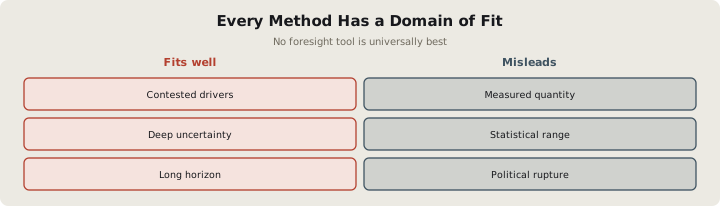
A tool suited to one kind of question produces false precision on another.

Check your understanding

Answer each from memory. Your results are saved in this browser and count toward your readiness — sign in (account panel above) to keep them across devices.

  1. Why is there no single best foresight method?

  2. Which best describes the domain of fit of the French structural-analysis tradition associated with Michel Godet?

  3. What does anointing one method as universally best actually reveal?
14 min · Core

Matching Tool to Decision

If method is a choice, on what grounds do you choose? This lesson sets out the selection variables that matter: the type of decision the work must inform, the time horizon in play, and the kind of uncertainty involved. It draws on Matthew Spaniol's research at Roskilde University, which formalises foresight tool selection as a problem in its own right rather than leaving it to taste.

~4 min

By the end you can

  • Identify the main variables that should drive foresight tool selection.
  • Distinguish kinds of uncertainty and match each to an appropriate method.
  • Explain how Matthew Spaniol formalises tool selection as a research problem.
  • Choose a defensible method for a given decision, horizon and uncertainty.

Choose on the decision, not the fashion

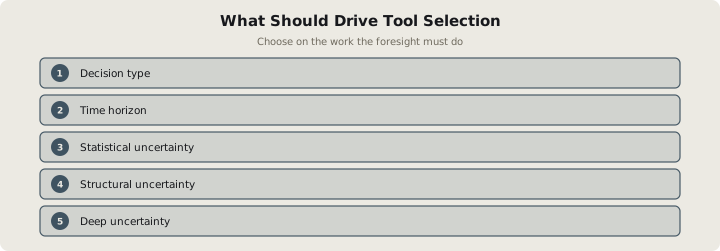
Once you accept that no method is universally best, the question becomes concrete: what should the choice depend on? The honest answer is the work the foresight must do. Three variables carry most of the weight. The first is the decision type: is the output meant to test the resilience of an existing strategy, to generate options that do not yet exist, to prioritise investment, or simply to widen the range of futures a leadership team takes seriously? A method that stress-tests a plan is not the one that invents new ones. The second is the time horizon. Over three years, structured extrapolation and expert judgement can carry a great deal; over twenty, the structural and narrative methods earn their place because the past stops being a reliable guide.

The kind of uncertainty decides the tool

The third and most neglected variable is the kind of uncertainty. It is a category error to treat all uncertainty as one thing. Some is statistical: a quantity that varies within a knowable range, where probabilistic and trend methods are exactly right. Some is structural: we do not know which relationships in the system will dominate, which is the home ground of cross-impact and morphological analysis. Some is deep or fundamental: the drivers themselves are contested and the future may not resemble the past at all, which is where intuitive-logics scenarios come into their own because they do not require a probability that cannot honestly be assigned. Matching the method to the kind of uncertainty is the single most consequential move in the whole selection, and the one novices most often get wrong by reaching for numbers where none can be justified.

Spaniol makes selection a discipline

This is where Matthew Spaniol's research at Roskilde University matters. Spaniol, working with colleagues including Nicholas Rowland, has argued that the field spends enormous effort perfecting individual methods and almost none on the prior question of which method to use. His contribution is to treat tool selection as a formal problem: to define scenarios and foresight outputs precisely, to clarify the conditions under which a given approach is appropriate, and so to move method choice from private taste to something a practitioner can reason about and defend. The point is not that Spaniol supplies a lookup table that removes judgement. It is that he legitimises the selection question, insisting the discipline owes an account of why this tool and not another was chosen for this task.

Reasoning the choice out loud

In practice this means the selection should be argued, not assumed. Before the method is chosen, a mature team writes down what decision the work serves, over what horizon, and what kind of uncertainty dominates, and only then names the tool and says why it fits. A regulator asking a bank to explore climate transition over thirty years faces deep uncertainty about policy and technology, so probability-weighted narratives make sense and a single extrapolated line does not. A procurement team choosing a supplier over an eighteen-month horizon faces mostly structural and statistical uncertainty, so a lighter, faster method serves better. Making that reasoning explicit is what separates a defensible foresight exercise from one that simply reached for whatever the team knew how to do.

Spaniol makes selection a discipline you must reason about and defend.

Check your understanding

Answer each from memory. Your results are saved in this browser and count toward your readiness — sign in (account panel above) to keep them across devices.

  1. Which set of variables should most drive the choice of a foresight method?

  2. Deep or fundamental uncertainty, where the drivers are contested and the future may not resemble the past, best suits which method?

  3. What does Matthew Spaniol's Roskilde research contribute to foresight practice?

14 min · Core

Combining Schools

The strongest foresight rarely comes from one tradition run purely. It comes from triangulation: a narrative intuitive-logics scenario checked against French structural analysis and disciplined by intelligence-grade calibration. Each tradition covers the others' blind spots. This lesson shows how a mixed method beats any single school, using DSI's own practice of pairing a narrative brief with structural analysis and a calibrated verdict.

~4 min

By the end you can

  • Explain why combining schools can outperform any single tradition.
  • Describe how narrative, structural and calibration methods cover each other's blind spots.
  • Define triangulation as used in a mixed foresight method.
  • Illustrate a mixed method with DSI's narrative-plus-structure-plus-calibration practice.

Each tradition is blind somewhere

Once you see that every method fits some questions and misleads on others, the next move is obvious: use more than one. Each of the major traditions has a characteristic blind spot. A narrative intuitive-logics scenario is vivid and internally coherent, but nothing in the method forces the storyteller to check whether the drivers in the story actually influence one another the way the plot assumes. French structural analysis is disciplined about exactly that, mapping which variables drive which, but it can produce an elegant influence map with no human sense of how the future would actually feel or unfold. And neither, on its own, disciplines the analyst's confidence: a compelling scenario and a rigorous matrix can both be delivered with a false certainty that the evidence does not support.

TriangulationAttacking a question with several independent methods and trusting a conclusion more where they converge and less where they diverge, on the logic that different methods have different blind spots. covers the gaps

Triangulation is the practice of attacking a question with more than one independent method and trusting the answer more where they converge, and less where they diverge, than any single method would warrant. Its logic is that different methods have different blind spots, so a conclusion that survives all of them is stronger than one that survives only the method most likely to flatter it. Applied to foresight, a scenario written in the intuitive-logics style can be checked against a structural analysis of the same system: if the narrative's plot depends on a driver that the structural map shows to be weakly connected, the story is suspect and must be revised. The structural map, in turn, gains meaning from the narrative, which shows what its abstract influence relationships would look like as lived events.

CalibrationThe intelligence-tradecraft practice of attaching explicit confidence levels to judgements, distinguishing observation from inference, and searching deliberately for disconfirming evidence, drawing on the work of Richards Heuer. disciplines confidence

The third leg is calibration, borrowed from intelligence analytic tradecraft. Where scenario and structure describe what could happen, calibration asks how sure are we, and on what evidence. Practices drawn from the work of Richards Heuer and from standards such as the US intelligence community's analytic tradecraft attach explicit confidence levels to judgements, distinguish what is observed from what is inferred, and force a deliberate search for the evidence that would prove the assessment wrong. This is what keeps a mixed method honest. A scenario that has been stress-tested against a structural map and then delivered with a stated, defensible confidence level is a far stronger product than any of the three techniques could yield alone.

The mixed method in practice

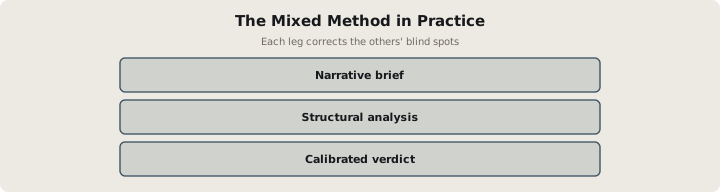
DSI's own work is built this way, and it is a useful worked example. A typical assessment pairs a narrative brief, which tells the intuitive-logics story of how a situation could unfold, with a structural analysis of the drivers and their weaponised interdependencies, and closes with a calibrated verdict that states the assessment and its confidence in the language of analytic tradecraft. The narrative supplies the human sense of the future, the structure disciplines the plot against how the system really connects, and the calibration disciplines the confidence. No single school delivers all three, which is the whole point. The mixed method is not a compromise between traditions; it is a way of making each tradition correct the others, and it consistently beats the purest application of any one of them.

Triangulation trusts a conclusion more where independent methods converge.

Check your understanding

Answer each from memory. Your results are saved in this browser and count toward your readiness — sign in (account panel above) to keep them across devices.

  1. What is triangulation in a mixed foresight method?

  2. What does the calibration leg, drawn from intelligence tradecraft, add that narrative and structural methods do not?

  3. How does DSI's mixed method combine the three traditions in a single assessment?

13 min · Core

Avoiding Foresight Theatre

Foresight fails most often not because the method was wrong but because the exercise was ceremonial. Scenarios with no link to any decision, workshops that quietly confirm the leadership's existing view, elaborate outputs that no one ever acts on, and numbers dressed up to look more certain than they are: these are the recurring failures. This lesson names them so they can be recognised and refused.

~4 min

By the end you can

  • Recognise the common failure modes that reduce foresight to theatre.
  • Explain why a missing decision link is the most damaging failure.
  • Identify how confirmation of the house view corrupts a foresight exercise.
  • Distinguish honest uncertainty from false precision in foresight outputs.

The ceremony that changes nothing

The most common failure in foresight is not a badly built scenario. It is a well-built scenario that changes nothing, because the exercise was performed for its own sake. Foresight theatreForesight work that has the appearance of rigour and none of the effect: polished outputs produced and admired but linked to no decision. The diagnostic is that no one can name a choice made differently because of it. is the term for work that has the appearance of rigour and none of the effect: the polished deck, the away-day workshop, the four quadrants with memorable names, all produced and admired and then filed. The tell is that if you asked what decision was made differently because of the work, no one could answer. The output existed to be seen, not to be used, and the effort that went into the method was, in the end, ornamental.

The missing decision link

The gravest of the failures is the missing decision link. A scenario set that is not tied to a specific choice the organisation actually faces has nowhere to land. Good practice runs the other way: you start from a live decision, an investment, a strategy under pressure, a capability being planned, and you build only the foresight that decision needs. Pierre Wack, whose scenario work at Shell is the field's founding success, was insistent on this. His scenarios were not admired as stories; they changed how managers perceived their world and therefore what they decided when the oil shock came. Foresight that cannot name the decision it informs has already failed, however elegant the method.

Confirming the house view

The second failure is subtler because it can coexist with real effort. A workshop convened to explore the future can quietly become a workshop convened to confirm what leadership already believes. Uncomfortable scenarios get softened, the challenging driver is ruled out of scope, and the exercise returns, with the authority of a structured method, precisely the view it began with. This is confirmation of the house view, and it is corrosive because it launders an existing prejudice as foresight. The defence is deliberate: assign someone to argue the scenario leadership least wants to hear, seek the evidence that would break the favoured story, and treat a foresight exercise that comfortably confirms everything as a warning sign rather than a success.

Follow-through and false precision

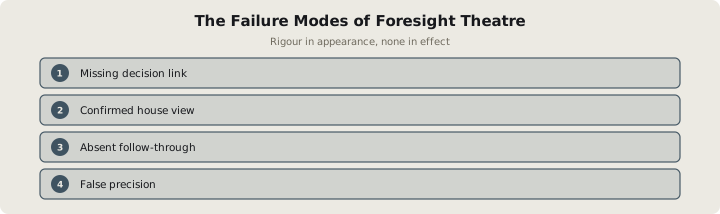
Two further failures round out the pattern. One is the absence of follow-through: an exercise that ends at the presentation, with no owner, no trigger points to watch, and no mechanism to revisit the judgement as the world moves. Foresight is not an event but a rhythm, and an exercise with no afterlife is theatre by another route. The other is false precision: dressing a deeply uncertain judgement in decimal points and single-number forecasts to make it look more authoritative than the evidence allows. Honest foresight states ranges and confidence levels and says plainly where it does not know; false precision hides the uncertainty that is the whole reason for doing the work. Naming these four failures, the missing decision link, the confirmed house view, the absent follow-through and the false precision, is the first step to refusing them.

The tell: no one can name a decision made differently because of the work.

Check your understanding

Answer each from memory. Your results are saved in this browser and count toward your readiness — sign in (account panel above) to keep them across devices.

  1. What is the clearest tell that a foresight exercise has become theatre?

  2. How does confirmation of the house view corrupt a foresight exercise?

  3. Which output reflects honest treatment of deep uncertainty rather than false precision?

13 min · Core

Embedding Foresight in an Organisation

A single brilliant foresight project is fragile; a standing capability with a rhythm is durable. This lesson moves from the one-off exercise to the organisational question: how does foresight become a repeatable function that feeds decisions on a cadence rather than a heroic occasional event? It uses Rene Rohrbeck's corporate-foresight maturity model to describe the path from ad hoc to embedded.

~4 min

By the end you can

  • Contrast a one-off foresight project with a standing foresight capability.
  • Describe the dimensions of Rene Rohrbeck's corporate-foresight maturity model.
  • Explain why cadence and ownership matter more than any single output.
  • Outline how an organisation moves from ad hoc foresight toward an embedded function.

From heroic project to standing function

A single outstanding foresight exercise, led by a talented individual for one high-stakes decision, is worth having, but it is fragile. When that person moves on, the capability leaves with them, and the organisation is back to reacting. The mature end state is different: foresight is a standing function with an owner, a cadence and a route into real decisions, so that scanning the horizon and testing strategy against alternative futures happen as a matter of routine rather than as an occasional heroic effort. The shift from project to capability is the difference between a company that once did good foresight and one that reliably does.

Rohrbeck's maturity model

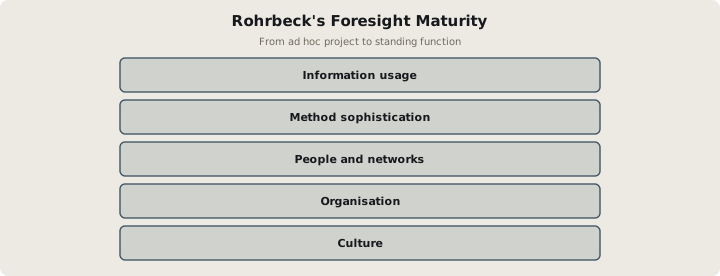
Rene Rohrbeck's corporate-foresight maturity model gives a language for that journey. Developed through his research on how large firms organise foresight, and set out with collaborators including Menes Etingue Kum, the model assesses an organisation across several dimensions rather than as a single score. It looks at the information usage that feeds foresight, the method sophistication in play, the people and networks who supply and receive signals, the organisation of the foresight activity itself, and the culture that determines whether uncomfortable findings are welcomed or buried. A firm can be strong on method and weak on culture, or rich in signals but unable to route them into decisions. Assessing each dimension separately shows exactly where a capability is thin, which is more useful than a single maturity number.

Why cadence and ownership beat any output

The model's deeper lesson is that the durable value of foresight lies less in any individual output than in the cadence and ownership that make outputs recur and land. A quarterly rhythm that reliably surfaces changes in the environment and feeds them into planning will, over years, outperform a single dazzling scenario set that had no successor. Ownership matters for the same reason: a named function accountable for foresight ensures the horizon keeps being watched and that trigger points identified in one exercise are actually monitored. Rohrbeck's research links stronger, better-embedded foresight to firms being better prepared for disruption, which is the whole justification for the investment. The point is not to run one perfect study but to build the standing capacity to keep running good-enough ones.

Moving up the ladder

Practically, an organisation climbs from ad hoc toward embedded in recognisable steps. It starts by tying foresight to live decisions so the work is used, which defeats the theatre failure of the previous lesson. It broadens the methods in play, so it is not the prisoner of a single tool. It builds the networks that supply signals from outside its own walls. It gives the function an owner and a rhythm so foresight recurs. And, hardest of all, it grows a culture that can hear a future it dislikes without punishing the messenger, because a capability that only survives if it flatters leadership is not a capability at all. The tool-selection judgement this module has built, matching method to decision, combining schools, and refusing theatre, is what a mature foresight function does routinely. Embedding it is how an organisation stops depending on a single gifted analyst and starts owning the capacity itself.

Assessed dimension by dimension, showing exactly where a capability is thin.

Check your understanding

Answer each from memory. Your results are saved in this browser and count toward your readiness — sign in (account panel above) to keep them across devices.

  1. Why is a single brilliant foresight project, led by one talented individual, considered fragile?

  2. What does Rene Rohrbeck's maturity model assess an organisation across?

  3. According to the maturity view, where does the durable value of foresight mainly lie?

Flashcards

Recall-first review of the load-bearing facts.

0 reviewed · 8 left

Ready to test yourself?

12 graded questions with real explanations. You commit a confidence before each reveal — that is how you find what you only think you know.

Start practice quiz →
Choosing the Right Tool — Strategic Foresight | Contested Futures Academy · The Contested Futures Institute