Time Is Not Universal
Every method of thinking about the future rests on a prior assumption about the shape of time. Western modernity tends to picture time as a line that advances; many other traditions picture it as a wheel that returns. This lesson shows that the image is not decoration but foundation: the shape of time a strategist carries silently decides which questions get asked and which futures remain unseen.
By the end you can
- Distinguish linear-progress and cyclical images of time as competing foundations.
- Explain how an image of time quietly selects a forecasting method.
- Recognise that no single conception of time is neutral or universal.
- Identify the blind spots each image of time tends to create.
The assumption beneath the method
Ask a room of analysts to picture the future and most will draw an arrow: a line running from a fixed past, through the present, toward a horizon that is different and, usually, further along. That arrow feels so natural it seems like a fact about the world rather than a choice. It is a choice. Long before anyone selects a scenario grid, a trend model or a war game, they have already assumed something about the shape of time itself, and that assumption does quiet, decisive work.
Two shapes of time
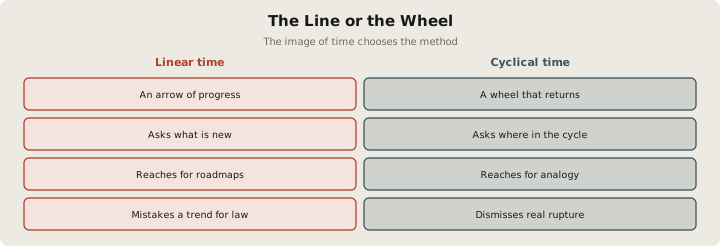
Broadly, two images compete. The first is linear time, the arrow of progress that runs through Western modernity: the future is a place we have not yet reached, and history moves, however unevenly, forward. The second is cyclical time, in which the important pattern is return. Seasons turn, dynasties rise and fall, generations repeat the shape of those before them. Under a cyclical image the sharpest question is not what is new but where are we in the cycle. Neither picture is a mistake. Each is a different bet on which pattern in events matters most.
How the image chooses the method
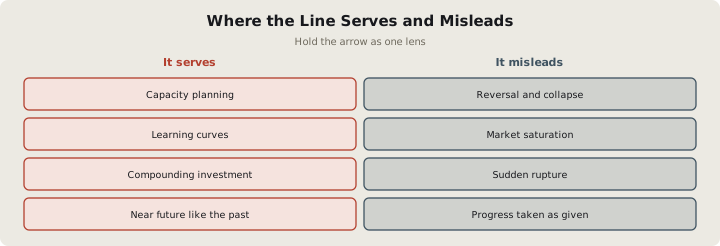
The image of time is not idle. It selects the method almost before the strategist notices. If you hold the arrow, you naturally reach for trend extrapolation, growth curves and roadmaps, because a line invites you to extend it. If you hold the wheel, you reach instead for analogy, for the study of prior turnings, for asking which earlier moment the present rhymes with. The same brief handed to a linear thinker and a cyclical thinker will produce two different toolkits, two different sets of evidence, and two different futures, and often neither analyst will see that the divergence began with an unspoken assumption.
The blind spot each image carries
Because the image is silent, its blind spots are too. The linear thinker, trained to extend the line, is prone to mistake a trend for a law and to miss the turning that a cyclical thinker would have expected. The cyclical thinker, alert to return, can dismiss a genuine rupture as merely another turn of a familiar wheel. The point is not to crown one image as correct. It is to make the assumption visible, so that a strategist can ask, deliberately, whether this future is better read as a line or a wheel. Treating one's own conception of time as universal is itself the first and most expensive analytic error, and the rest of this module works through the major images the world actually holds.
Check your understanding
Answer each from memory. Your results are saved in this browser and count toward your readiness — sign in (account panel above) to keep them across devices.
What does this lesson claim silently decides which forecasting method feels natural?
Under a cyclical image of time, what is the sharpest question to ask?
What is the characteristic blind spot of the linear-progress image?