The French La Prospective School

La prospective is the French tradition of thinking about the future, distinct in temperament and method from Anglo-American forecasting. Where forecasting projects trends, prospective insists the future is not written: it is built by the will and conflict of actors. This module walks its lineage from the philosophers Gaston Berger and Bertrand de Jouvenel to the toolbox Michel Godet built at CNAM, morphological analysis, MICMAC structural analysis and the Mactor game of actors, and it reads DSI's own 'Laundered Dependency' analysis through that actor-centred lens. It closes by contrasting this formal, auditable, systems-based school with the narrative 'intuitive logics' scenario tradition, and asks when each is the right instrument.

  • la-prospective
  • morphological-analysis
  • actor-analysis
  • structural-analysis
  • scenario-methods
  • volontarisme
13 min · Core

The Future as a Field of Freedom and Power

La prospective begins with a claim about the nature of the future itself: it does not exist yet to be discovered, so it cannot be forecast the way a coming eclipse can. Gaston Berger framed prospective as an attitude that looks far ahead and treats the future as open, and Bertrand de Jouvenel argued that because the future is a field of freedom, it is also a field of power, shaped by the wills of those who act. This lesson establishes the volontariste stance that separates the school from trend projection.

~4 min

By the end you can

  • Explain why la prospective treats the future as built rather than awaited.
  • Attribute the founding stance to Gaston Berger and Bertrand de Jouvenel.
  • Define the volontariste attitude and contrast it with passive forecasting.
  • Describe why treating the future as a field of freedom makes it a field of power.

A future that does not yet exist

Most people meet the future as something to be predicted, the way an astronomer predicts an eclipse. The French school of la prospective rejects that picture at the root. An eclipse is already determined by the mechanics of the solar system, so it can be calculated. The human future is not. It has not happened, no facts about it exist yet, and therefore it cannot be discovered like a hidden object. What can be studied are the many futures that remain possible, and the forces and choices that will decide which of them arrives. This is a different intellectual act from forecasting, and the school insists on the distinction.

Berger and the long view

The philosopher Gaston Berger coined prospective in the 1950s and gave it its temperament. For Berger prospective was less a technique than an attitude: to look far into the distance, to see the whole rather than the fragment, to consider humanity rather than a single interest, and to take risks in thought. He wanted decision-makers to lift their eyes from the immediate and accept that acting today shapes a distance they cannot yet see clearly. The point was not to be right about a date but to be prepared for a field of possibility.

De Jouvenel: freedom becomes power

The economist and political thinker Bertrand de Jouvenel gave the school its sharpest idea. He coined the term futuribles for the futures that are genuinely possible, those that could grow from the present without breaking its logic. His deeper move was this: because the future does not yet exist, it is a domain of freedom, and precisely because it is open, it is a field of power. The future is not neutral ground waiting to be observed. It is contested terrain that actors try to bend toward their own ends. Whoever acts with intent is voting on which futurible becomes real.

The volontariste stance

From this comes the school's defining posture, often called volontarisme, the conviction that will matters. A forecaster asks what will probably happen if present trends continue and then waits. A practitioner of prospective asks which futures are possible, which is desirable, and what an actor must do now to steer toward it. Anticipation exists to serve action, not to replace it. The German industrialist planning a plant and the minister drafting an energy law are not spectators of the future; they are among its authors. To treat them as forecasters watching a fixed outcome is to misread what they are actually doing.

Why the stance changes the work

This reframing is not merely philosophical decoration. It decides what the rest of the toolbox is for. If the future is built by the interplay of forces and the wills of actors, then a serious method must map those forces, expose how they drive one another, and read the strategic game between the players. That is exactly what Godet's instruments, morphological analysis, MICMACCross-impact matrix multiplication applied to a classification: a structural-analysis tool that scores each variable's influence on every other, multiplies the matrix to reveal indirect influence, and maps variables by influence against dependence. and MactorThe method of actors, objectives and power relations. It identifies the actors contending over a system's driving variables, maps their objectives, alliances and conflicts, and weighs leverage against intensity of interest to reveal the balance of power., were built to do. The philosophy of Berger and de Jouvenel is the reason those tools take the shape they do.
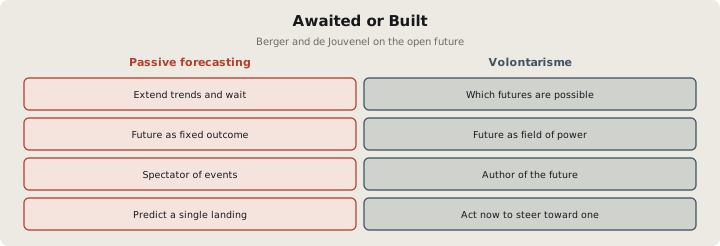
Prospective treats the future as a field of freedom, and so a field of power.

Check your understanding

Answer each from memory. Your results are saved in this browser and count toward your readiness — sign in (account panel above) to keep them across devices.

  1. Why does la prospective reject forecasting the human future the way one forecasts an eclipse?

  2. What was Bertrand de Jouvenel's central contribution to the school?

  3. Which best describes the volontariste stance?
14 min · Core

Morphological Analysis

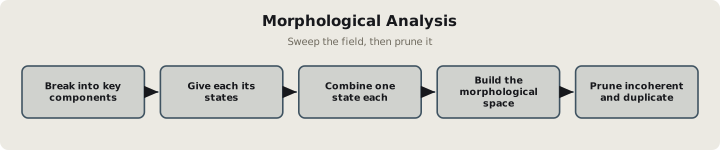
Morphological analysis is the prospective method for sweeping the entire field of possibilities rather than jumping to a favourite story. The system is broken into a handful of key components, each component is given its plausible states, and scenarios are built by selecting one state per component. The full grid of combinations is the morphological space, and the craft lies in pruning the impossible and incoherent combinations to leave a manageable set of genuinely distinct futures. Michel Godet made this a staple of the CNAM toolbox.

~4 min

By the end you can

  • Describe how a system is decomposed into components and states.
  • Explain how the morphological space of scenarios is constructed by combination.
  • Explain why pruning incoherent combinations is the analyst's main task.
  • Contrast systematic field-sweeping with jumping straight to a preferred scenario.

Sweeping the field, not guessing the answer

The commonest failure in thinking about the future is to leap to one vivid story and defend it. Morphological analysisA method for sweeping the field of possible futures by breaking a system into key components, giving each its plausible states, and forming scenarios from combinations of those states. Adapted for prospective by Michel Godet from Fritz Zwicky's work. is built to prevent that leap. Its promise is coverage: before choosing which future to worry about, map the whole field of what is possible. The technique has roots in the work of the astrophysicist Fritz Zwicky, who used it to enumerate configurations of physical systems, and Michel Godet adapted it at the Conservatoire national des arts et métiers as a core prospective instrument for social and strategic systems.

Components and their states

The method starts by breaking the system under study into a small number of components, the dimensions that really matter. For the future of European energy those components might be the pace of demand, the fuel mix, the degree of political integration, and the state of key supply relationships. Each component is then given its plausible states. Demand might be rising sharply, flat, or falling; political integration might be deepening, holding, or fracturing. The discipline of naming components and their states forces the analyst to be explicit about the variables that drive the system, rather than smuggling assumptions into a single narrative.

Building the morphological space

A scenario is then simply one state chosen from each component: rising demand, a gas-heavy mix, fracturing integration, a strained supply relationship. The full set of all such combinations is the morphological space, and it grows fast. Four components with three states each already yield eighty-one combinations. This explosion is a feature, not a nuisance: it guarantees the analyst has considered configurations that intuition would never have surfaced, including the uncomfortable ones a preferred story quietly excludes.

Pruning is the real craft

Eighty-one raw scenarios are useless, so the substance of the method is reduction. Many combinations are internally incoherent, deep political integration alongside a total collapse of supply cooperation may simply not hang together, and are struck out. Others are so similar they collapse into one. What remains is a small set of genuinely distinct, internally consistent futures worth exploring in depth. The value is not in the arithmetic but in the disciplined exclusion: every scenario that survives has been checked for internal logic, and every one that was cut can be justified. That auditability is exactly what the intuitive, story-first approach cannot offer.

Why the sweep matters strategically

For a strategist the payoff is protection against the blind spot. An organisation that plans around its single expected future is undefended against the combination it never named. Morphological analysis makes the field visible first and the choice of focus deliberate second. It pairs naturally with the tools that follow: once the space of futures is drawn, structural analysis asks which components truly drive the system, and actor analysis asks who is fighting to push those components toward one state or another.

Map every combination of component states, then prune to distinct, coherent futures.

Check your understanding

Answer each from memory. Your results are saved in this browser and count toward your readiness — sign in (account panel above) to keep them across devices.

  1. How is a scenario constructed in morphological analysis?

  2. Why does the morphological space grow so quickly?

  3. What is the analyst's main task once the morphological space is built?

13 min · Core

MICMAC: Structural Analysis

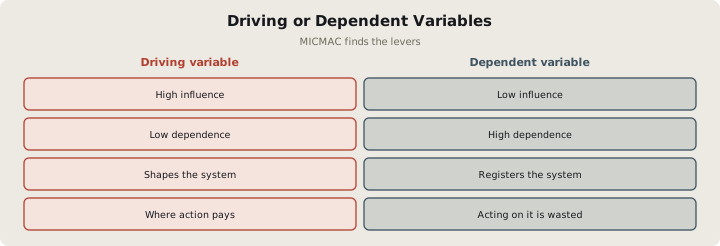
MICMAC is the prospective tool for finding the levers in a complex system. The analyst lists the variables that matter, then judges, in a matrix, whether each variable influences each other one. Multiplying that matrix out reveals indirect and hidden influence, and every variable is plotted by how much it drives the system against how much the system drives it. The result separates the true driving variables, worth acting on, from the dependent variables that merely register what others decide.

~4 min

By the end you can

  • Explain how a direct-influence matrix between variables is built.
  • Describe what MICMAC's matrix multiplication reveals beyond direct links.
  • Interpret the influence-dependence map and its four regions.
  • Explain why identifying driving versus dependent variables changes strategy.

Finding the levers

Morphological analysisA method for sweeping the field of possible futures by breaking a system into key components, giving each its plausible states, and forming scenarios from combinations of those states. Adapted for prospective by Michel Godet from Fritz Zwicky's work. maps what is possible; MICMACCross-impact matrix multiplication applied to a classification: a structural-analysis tool that scores each variable's influence on every other, multiplies the matrix to reveal indirect influence, and maps variables by influence against dependence. asks what actually moves the system. Its name comes from the French for cross-impact matrix multiplication applied to a classification, and it belongs to the same CNAM toolbox that Michel Godet assembled. The purpose is blunt and useful: in a tangle of interacting factors, tell me which few really drive the rest, because those are where action pays, and which merely follow, because acting on them is wasted effort.

Building the matrix

The method begins by listing the variables that describe the system, perhaps thirty or forty for a serious study, drawn from technology, economics, regulation, society and geopolitics. The analysts then fill a square matrix. For each pair they ask a single disciplined question: does variable A directly influence variable B, and if so how strongly. The exercise is qualitative but structured, and the argument that surrounds each judgement is often more valuable than the score itself, because it forces a group to make its mental model of the system explicit and contestable.

Multiplying out the hidden influence

The insight that gives MICMAC its name is that direct influence is not the whole story. A variable may barely touch another directly yet dominate it through a chain of intermediaries. Multiplying the matrix by itself, and again, traces these indirect paths and lets hidden, second- and third-order influence surface. A variable that looked minor in the raw matrix can prove to be a quiet master of the system once its indirect reach is counted. This is the step that separates MICMAC from a simple list of obvious connections.

Reading the map

Each variable ends with two scores: its total influence on others and its total dependence on others. Plotting influence against dependence yields a map with four telling regions. High-influence, low-dependence variables are the driving variables, the levers that shape everything downstream. Low-influence, high-dependence variables are the dependent variables, outcomes that reflect the system rather than steer it. Variables high on both are relay or unstable variables, powerful but volatile, and those low on both are largely autonomous and can be set aside. The map turns a wall of factors into a hierarchy of leverage.

Why leverage changes strategy

The strategic value is that it redirects effort. Organisations habitually fixate on the dependent variables, the visible outcomes that alarm them, while ignoring the driving variables that quietly determine those outcomes. A firm agonising over a price it cannot control is watching a dependent variable; the driving variable might be a supply relationship or a regulatory decision upstream. MICMAC forces the question of where the true levers sit, and in doing so sets up the next tool: once you know which variables drive the system, you can ask which actors control those variables, and how they contend for them.

Matrix multiplication exposes hidden influence and separates levers from outcomes.

Check your understanding

Answer each from memory. Your results are saved in this browser and count toward your readiness — sign in (account panel above) to keep them across devices.

  1. What does MICMAC's matrix multiplication reveal that the raw direct-influence matrix does not?

  2. On the influence-dependence map, what characterises a driving variable?

  3. Why does distinguishing driving from dependent variables change strategy?

14 min · Core

Mactor: The Game of Actors

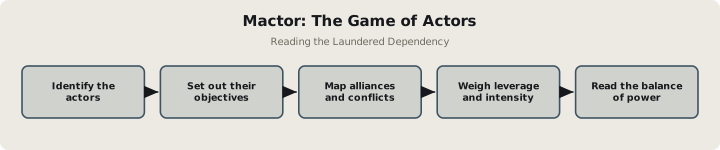
Mactor is the prospective method that treats the future as a strategic game between players. Once the driving variables are known, the analyst identifies the actors who contend over them, sets out each actor's objectives, and maps who is allied with and opposed to whom on each stake. The tool weighs how much leverage each actor holds and how strongly it cares about each objective, turning a fog of interests into a readable balance of power. DSI's 'Laundered Dependency' analysis reads naturally as a Mactor-style game.

~5 min

By the end you can

  • Explain what Mactor adds once the driving variables are identified.
  • Describe how actors' objectives, alliances and conflicts are mapped.
  • Explain how leverage and intensity of interest are weighed together.
  • Read DSI's 'Laundered Dependency' case as an actor game with objectives and leverage.

The future as a contest between players

Variables do not move themselves. Behind every driving variable stands an actor with an interest in pushing it one way or another. MactorThe method of actors, objectives and power relations. It identifies the actors contending over a system's driving variables, maps their objectives, alliances and conflicts, and weighs leverage against intensity of interest to reveal the balance of power., short for method of actors, objectives and power relations, is the prospective tool that brings those players to the centre. It returns the analysis to de Jouvenel's insight that the future is a field of power: to anticipate it, read the strategic game between the actors contending over the stakes that matter. Godet built Mactor to make that reading systematic rather than impressionistic.

Objectives, alliances, conflicts

The method proceeds in steps. First, identify the actors who influence the driving variables. Second, set out each actor's objectives, what it is trying to achieve on each stake. Third, map the pattern of agreement and disagreement: on any given objective, which actors are allied because their aims converge, and which are in conflict because their aims collide. The same two actors may be allies on one stake and adversaries on another, and Mactor is built to hold that complexity rather than flatten it into a single friend-or-foe line.

Weighing power and interest

A list of objectives is not yet an analysis, because not every actor can enforce its wishes and not every actor cares equally. Mactor therefore weighs two things together. The first is leverage: how much power each actor holds over the others, its ability to help or hurt them. The second is intensity: how strongly each actor is mobilised on a given objective, because an actor may hold great power yet be indifferent to a stake, or hold little power yet fight to the end for one it prizes. Combining leverage with intensity turns a fog of positions into a readable balance of power that shows where alliances are stable, where conflict is likely, and which actor sets the terms.

Reading the Laundered Dependency as a Mactor game

DSI's analysis The Laundered Dependency reads naturally as this kind of actor game, which is why it serves as a worked example here. Set out the players and their objectives. The firms that claim independence from Chinese supply want to be believed, to keep customers and government contracts, and to avoid disclosing an origin they often cannot actually trace. Investors and the firms' home government want an honest account of the true dependency so their capital and their defence supply chains are not quietly exposed. And the Chinese export-licence regime, by forcing end-user disclosure as a condition of export, ends up holding better information about the real chain of dependency than the firms' own investors or governments do. Now read the leverage between them: the firms have an interest in opacity, the licence regime has visibility it can grant or withhold, and investors and the home state depend on information they do not control. The stakes conflict, the leverage is unevenly held, and the party that on paper is the adversary turns out to hold the clearest view of the truth. That is a Mactor reading, and it shows how an actor-analysis lens exposes a structure that a trend forecast would miss entirely. The framing is DSI's own analysis; the method for reading it is the French school's.

Why the actor lens is decisive

For a strategist the lesson is that outcomes are decided by the interplay of interested players, not by an impersonal trend. Naming the actors, their objectives and their leverage turns anticipation into something one can act on: form the alliance that shifts the balance, deny an adversary the leverage it relies on, or expose the information asymmetry that a rival is quietly exploiting.

Identify actors, map objectives, and weigh leverage against intensity of interest.

Check your understanding

Answer each from memory. Your results are saved in this browser and count toward your readiness — sign in (account panel above) to keep them across devices.

  1. What does Mactor add once the driving variables of a system are known?

  2. Why does Mactor weigh leverage and intensity of interest together rather than power alone?

  3. In a Mactor reading of DSI's 'Laundered Dependency', which actor ends up holding the clearest view of the true chain of dependency?

12 min · Core

La Prospective vs Intuitive Logics

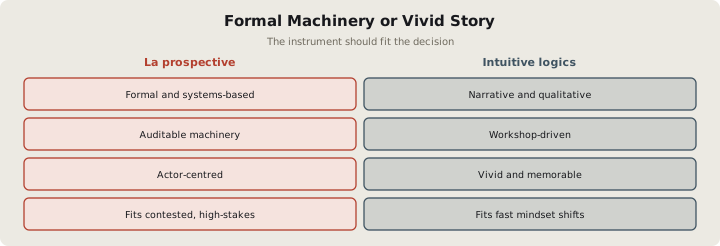
Two great scenario traditions dominate strategic foresight. La prospective, the French school, is formal, systems-based, actor-centred and auditable: every scenario traces back to explicit variables, matrices and actor games. The 'intuitive logics' school, associated with Anglo-American practice and Shell's planning, is narrative, qualitative and workshop-driven, prizing the vivid, memorable story that reframes how leaders see. Neither is superior in all cases; the mature practitioner knows the temperament and the terrain each one fits.

~4 min

By the end you can

  • Characterise the French prospective school as formal, systems-based and auditable.
  • Characterise the intuitive-logics school as narrative and qualitative.
  • Compare the two on transparency, actor focus and the demands each makes.
  • Judge which approach fits a given decision context.

Two traditions, one purpose

Strategic foresight is dominated by two families of scenario practice, and they have distinct temperaments. The French la prospective school, built out by Godet on the philosophy of Berger and de Jouvenel, is one. The intuitive logics school, associated with Anglo-American practice and made famous by the scenario planning of Pierre Wack and his successors at Shell, is the other. Both exist to help leaders act well under deep uncertainty, but they get there by opposite routes, and confusing them leads to using the wrong instrument for the job.

The formal, auditable route

Prospective is formal and systems-based. It insists on making the machinery explicit: the components and states of a morphological analysis, the influence-dependence matrix of MICMACCross-impact matrix multiplication applied to a classification: a structural-analysis tool that scores each variable's influence on every other, multiplies the matrix to reveal indirect influence, and maps variables by influence against dependence., the objectives and leverage of a MactorThe method of actors, objectives and power relations. It identifies the actors contending over a system's driving variables, maps their objectives, alliances and conflicts, and weighs leverage against intensity of interest to reveal the balance of power. game. Because every scenario traces back to stated variables and judgements, the reasoning is auditable. A sceptic can challenge a specific matrix entry or an actor's assumed objective, and the analysis can answer. This transparency is its great strength in contested, high-stakes settings where a conclusion must survive interrogation, and it is why the school suits regulators, defence planners and anyone who must defend a forecast rather than merely assert it.

The narrative, intuitive route

The intuitive-logics school works the other way. It gathers a mix of expert judgement in structured workshops and builds a small number of vivid, internally consistent stories about how the future might unfold. Its power is psychological: a well-crafted narrative can break a leadership team's fixed assumptions and let them see a possibility they had refused to consider, which is exactly what Wack's scenarios did for Shell before the oil shocks. The method is lighter, faster and more flexible than the French toolbox, and it excels at shifting mindsets. Its weakness is the mirror of prospective's strength: the reasoning lives partly in the facilitators' judgement and is harder to audit or to contest line by line.

Choosing the instrument

Neither school wins in the abstract; the terrain decides. When the stakes are contested and the conclusion must be defended before auditors, a board or a regulator, the formal, actor-centred prospective toolbox earns its cost, because it can show its work and name the players. When the goal is to loosen a leadership team's grip on a single assumed future, quickly and memorably, the narrative intuitive-logics approach often does more with less. Many mature practices combine them: use morphological analysis and MICMAC to define a rigorous scenario space, then dramatise the surviving scenarios as compelling stories so decision-makers actually feel the stakes. The error to avoid is dogmatism, treating one tradition as the whole of foresight. The instrument should fit the decision, the audience and the time available, and knowing which fits is itself the mark of a serious practitioner.

Prospective is auditable and actor-centred; intuitive logics is fast and memorable.

Check your understanding

Answer each from memory. Your results are saved in this browser and count toward your readiness — sign in (account panel above) to keep them across devices.

  1. What most distinguishes the French prospective school from the intuitive-logics school?

  2. What is the characteristic strength of the intuitive-logics school?

  3. Which decision context most favours the formal prospective toolbox over the intuitive-logics approach?

Flashcards

Recall-first review of the load-bearing facts.

0 reviewed · 8 left

Ready to test yourself?

12 graded questions with real explanations. You commit a confidence before each reveal — that is how you find what you only think you know.

Start practice quiz →
The French La Prospective School — Strategic Foresight | Contested Futures Academy · The Contested Futures Institute