Net Assessment and War-Gaming

Foresight is not only about scanning the horizon; it is about diagnosing a contest and stress-testing your own view of it. This module treats four adversarial disciplines as a family: net assessment, which frames the long-term competition rather than predicting its winner; red-teaming, which challenges the house view before an adversary does; war-gaming, which surfaces the second-order moves a static forecast misses; and prediction markets, which price dispersed belief into a probability. It draws on Andrew Marshall's Office of Net Assessment, Micah Zenko's study of red teams, the classical war-gaming tradition, and market experiments such as the Iowa Electronic Markets, and closes by turning simulation insight into robust, antifragile strategy.

  • net-assessment
  • red-teaming
  • war-gaming
  • prediction-markets
  • adversarial-analysis
  • decision-under-uncertainty
13 min · Core

The Net Assessment Tradition

Net assessment is the discipline of diagnosing a long-term competition between rivals, rather than forecasting an outcome or counting each side's arsenal in isolation. Shaped by Andrew Marshall at the US Office of Net Assessment, its distinctive move is to frame the right question about a standing contest, comparing us against them across many dimensions and over years, so that a strategist can act on relative advantage instead of a single prediction.

~3 min

By the end you can

  • Define net assessment as the diagnosis of a long-term competition rather than a forecast.
  • Explain why comparing rivals net, side against side, differs from counting one side's forces.
  • Describe Andrew Marshall's contribution and the role of the Office of Net Assessment.
  • Recognise framing the right question as the core act of net assessment.

Diagnosis, not prophecy

Most people expect a foresight unit to predict what will happen. Net assessmentThe diagnosis of a long-term competition between rivals, comparing both sides across many dimensions and over time to reveal relative advantage, rather than predicting an outcome or counting one side's forces. refuses that job. Its purpose is to diagnose a standing competition between two rivals over the long run, comparing the two sides as a system rather than forecasting who wins on a given day. The question it answers is not what will the outcome be but who holds the advantage in this contest, on what dimensions, and which way is it trending. That reframing is the whole discipline. A good net assessment leaves a decision-maker understanding the shape of a rivalry, not clutching a single number they will be tempted to treat as fact.

Net, meaning side against side

The word net is doing real work. A common analytic failure is to study one's own forces in isolation, or to tally an opponent's tanks and missiles as if a bigger pile settled the matter. Net assessment insists on the comparison: your strengths against their strengths, your vulnerabilities against their vulnerabilities, across military, economic, technological, demographic and organisational dimensions at once. A rival with more submarines but a brittle supply chain and an ageing population may be losing the competition even while it looks ahead on a bar chart. Counting one side answers the wrong question; comparing both, over time, answers the right one.

Marshall and the Office of Net AssessmentThe small, deliberately independent US Department of Defense shop led by Andrew Marshall from 1973 to 2015, tasked with thinking in decades about long-term military competitions.

The tradition is inseparable from Andrew Marshall, who led the US Office of Net Assessment from 1973 until 2015. Marshall built a small, deliberately independent shop whose job was to think in decades, not budget cycles, and to ask questions the rest of the Pentagon was too busy to ask. Its assessments of the long US and Soviet competition helped shift attention from counting warheads toward exploiting Soviet weaknesses, a competitive strategy that sought to impose disproportionate cost on the rival. Marshall's method was patient, sceptical, and comfortable with ambiguity, and he trained a generation of analysts who carried the habit outward.

The right question is the deliverable

Marshall's famous discipline was to spend most of the effort framing the question, because a competition analysed under the wrong question produces confident, useless answers. Asking how do we win the arms race invites a counting contest; asking where is the rival structurally weak and how do we make that weakness expensive to sustain reorients the whole enterprise. This is the enduring lesson. Before you assess, you interrogate the frame, and much of net assessment's value is in the questions it declines to answer as posed. That instinct, to distrust the obvious framing and diagnose the contest instead, is the foundation the rest of this module builds on.
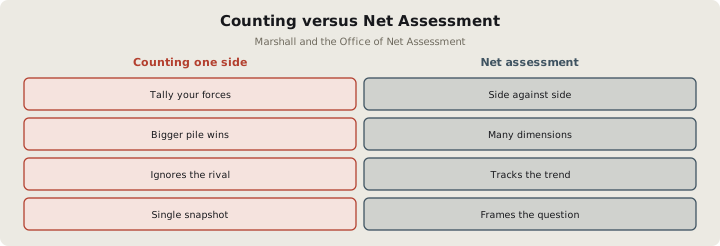
Net assessment compares both rivals over time, not just one side's forces.

Check your understanding

Answer each from memory. Your results are saved in this browser and count toward your readiness — sign in (account panel above) to keep them across devices.

  1. What does net assessment primarily aim to do?

  2. Why does the word 'net' matter in net assessment?

  3. What did Andrew Marshall treat as the most important part of the work?
14 min · Core

Red-Teaming and Alternative Analysis

Red-teaming is the deliberate practice of challenging the prevailing view: playing devil's advocate, standing up a red cell to attack a plan, or forcing an analysis of alternatives against the house consensus. Drawing on Micah Zenko's study of red teams, this lesson shows why the discipline works, why it usually fails when it is tokenistic, and how DSI's neutrality doctrine and its Alarm Test turn the same adversarial habit inward on one's own conclusions.

~4 min

By the end you can

  • Distinguish devil's advocacy, red cells and alternative analysis as forms of red-teaming.
  • Explain, using Micah Zenko's lessons, why red teams add value against a strong house view.
  • Identify how red teams fail when they are tokenistic or captured.
  • Apply the adversarial habit reflexively, to test one's own alarms and narratives.

Attacking the house view on purpose

Red-teaming is the discipline of challenging a plan or judgement from the inside, before a real adversary or reality does it for you. It comes in several forms. A single devil's advocate is tasked to argue the opposite of the consensus. A red cell is a standing team that plays the adversary and probes a plan for the seams a hopeful author cannot see. Alternative analysisA structured technique that develops a competing hypothesis against the house line, so a decision is tested against more than the consensus interpretation. forces a structured competing hypothesis against the house line. All three share one aim: to break the comfortable agreement that forms inside any group that has been staring at the same problem for too long.

Why it works

Micah Zenko, in his study of red teams across the military, intelligence and private sectors, found that their value comes from a simple asymmetry. An organisation invested in a plan cannot easily see its own blind spots, because the same assumptions that built the plan also frame how members judge it. A red team is licensed to hold different assumptions, so it notices what the house has stopped questioning. Zenko documents cases where a red cell tunnelling under a supposedly secure facility, or challenging a confident intelligence estimate, exposed a flaw that months of internal review had missed. The mechanism is not brilliance; it is standpoint. Someone paid to disbelieve sees differently.

Why it usually fails

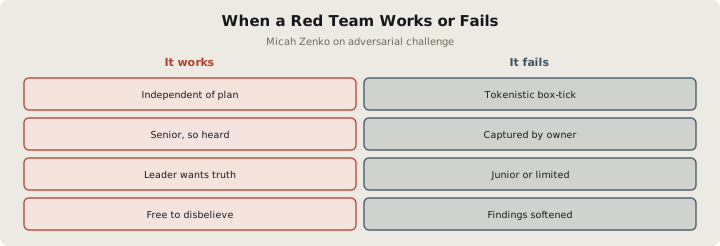
Zenko's harder lesson is that most red teams fail, and they fail predictably. When red-teaming is tokenistic, a box ticked so leaders can say the plan was challenged, the team is ignored the moment it says something inconvenient. When the red team reports to the very person whose plan it critiques, it is captured, and it softens its findings to keep the relationship. When its members are junior or its access is limited, it cannot reach the assumptions that matter. The pattern is consistent: red teams succeed only when they are independent, senior enough to be heard, and genuinely wanted by a leader willing to be told they are wrong. Absent that, the ritual produces false comfort, which is worse than no challenge at all.

Turning the habit inward

The most disciplined analysts red-team themselves. DSI's standing neutrality doctrine is exactly this reflex made into a rule: on a contested conflict, puncture both sides' self-stories and explain outcomes by structure rather than morality. Its Iran-war coverage red-teamed both narratives at once, declining both the salvation story and the resistance story. The Alarm Test extends the habit to DSI's own trade: it turns Richards Heuer's analysis of competing hypotheses and Karl Popper's falsification back on the security industry's own alarms, asking which warnings survive a genuine attempt to knock them down. That is red-teaming pointed at oneself, and it is the hardest and most valuable version, because the assumptions a red team must break are your own.

Red teams add value only when independent, senior and genuinely wanted.

Check your understanding

Answer each from memory. Your results are saved in this browser and count toward your readiness — sign in (account panel above) to keep them across devices.

  1. According to Micah Zenko, why can a red team see flaws the host organisation misses?

  2. Which condition most reliably makes a red team fail?

  3. How does DSI's Alarm Test apply the red-teaming habit?

14 min · Core

Business and Political War-Gaming

A war game is a structured simulation in which teams play rival actors, make moves in turns, and have those moves adjudicated so that the interaction, not any single forecast, produces the insight. This lesson covers how to assign teams, structure moves and adjudication in business and political settings, and why the discipline's real payoff is surfacing the second-order reactions a static analysis never sees.

~4 min

By the end you can

  • Define a war game and distinguish it from a static forecast or scenario write-up.
  • Explain how teams, moves and adjudication are structured in a business or political game.
  • Show why war games surface second-order reactions that other methods miss.
  • Identify what a game reveals about an adversary's likely response, not just one's own plan.

What a war game is

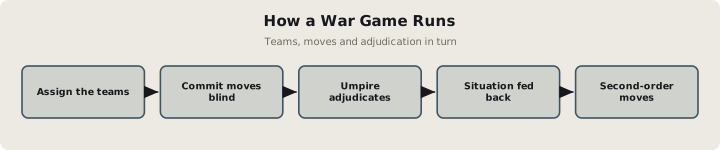
A war game is a simulation of a competition played by people. Teams are assigned to represent the rival actors, each team makes moves in sequence, and an umpire adjudicates the results, feeding the new situation back so the next round responds to what just happened. The classical military tradition, from the nineteenth-century Prussian Kriegsspiel to the interwar games at the US Naval War College, established the form: it is the interaction between thinking opponents, not a scripted timeline, that generates the learning. A game is therefore the opposite of a static forecast. It does not tell you what will happen; it lets you watch a contest unfold and discover which of your assumptions survive contact with an opponent who is trying to win.

Structuring the game

The design decisions carry the value. First, teams: a blue team plays your organisation, a red team plays the competitor or adversary, and often a green or white team plays third parties such as regulators, customers or allied states whose reactions matter. Casting a credible red team is the hard part, because a red team that plays the adversary as you wish they would behave teaches nothing. Second, moves: each team commits to a decision each turn, in writing, without seeing the others' choices, which forces genuine anticipation. Third, adjudication: an umpire or a panel decides the outcome of the clashing moves, using rules, judgement, or both, and this is where honesty lives. Weak adjudication that lets the home team win quietly turns the game into theatre.

Business and political variants

The method transfers cleanly. In a business war game, a firm assigns teams to its main competitors and plays out a price cut, a product launch or an acquisition, to see how rivals would respond before committing real money. In a political game, teams represent states or factions in a crisis, testing how sanctions, mobilisation or a diplomatic overture would actually land. The value in both is the same: you learn the shape of the response, and you learn it cheaply. A launch that looks brilliant on a slide can collapse the moment a competitor team, playing to win, cuts its own price in retaliation.

The prize: second-order reactions

The reason to run a game rather than write an analysis is that static methods stop at the first move. They tell you what you will do and, at best, guess the immediate reaction. A game keeps going: your move provokes their counter, which provokes a third party, which changes the ground under your original plan. These second-order reactions, the response to the response, are where strategies actually fail, and they are almost impossible to see from a desk because they require an adversary genuinely trying to defeat you. This is why war-gaming pairs so naturally with red-teaming. A well-cast red team inside a game is a red team in motion, and the moves it makes are the second-order future your forecast omitted.

The interaction of thinking teams, not a script, surfaces second-order reactions.

Check your understanding

Answer each from memory. Your results are saved in this browser and count toward your readiness — sign in (account panel above) to keep them across devices.

  1. What distinguishes a war game from a static forecast?

  2. Why is casting a credible red team the hard part of designing a game?

  3. What is the chief prize of running a war game over writing an analysis?

12 min · Core

Prediction Markets

A prediction market lets participants trade contracts that pay out on a future event, so the price becomes a live probability estimate that aggregates dispersed private knowledge. This lesson explains why markets can outperform experts, using the Iowa Electronic Markets as the classic case, and sets against that their real limits: manipulation, thin trading, and questions that resist a clean settlement.

~4 min

By the end you can

  • Explain how a contract price in a prediction market functions as a probability estimate.
  • Describe why markets can aggregate dispersed knowledge better than a single expert.
  • Identify manipulation and thin-market conditions as limits on market accuracy.
  • Judge when a question is suitable for a prediction market and when it is not.

Price as probability

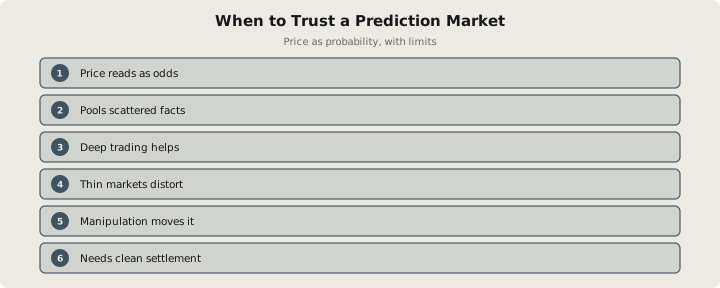
A prediction market is a market in contracts that pay a fixed amount if a stated event occurs and nothing if it does not. A contract on candidate X wins that trades at sixty cents on the dollar implies the market's collective judgement that X has roughly a sixty per cent chance. The price moves as participants buy and sell on new information, so it is a continuously updated probability rather than a one-off poll. The appeal is that people bet with their own money, which rewards accuracy and punishes wishful thinking. A trader who believes the crowd is wrong has both the means and the incentive to correct the price, and in doing so, reveals what they know.

Why the crowd can beat the expert

The deeper logic is the aggregation of dispersed knowledge. No single analyst holds all the relevant information about a complex event; it is scattered across many minds, each with a fragment. A market is a mechanism for pooling those fragments into one number, weighting each by the confidence its holder is willing to back with money. The Iowa Electronic Markets, run by the University of Iowa since 1988, is the standing demonstration: its election markets have often tracked outcomes as closely as, and sometimes more closely than, opinion polls, despite thin volumes and small stakes. The lesson is not that crowds are wise by nature but that a well-designed market extracts and combines private knowledge that no survey reaches.

The limits are real

The method fails in specific, predictable ways, and a serious analyst names them. Manipulation: a participant with an agenda can push a price to create a false signal, especially if the market is small enough that a single large trade moves it. Thin markets: when few people trade, or when only a narrow, unrepresentative group participates, the price reflects that small group rather than any real aggregate, and the wisdom of crowds collapses into the opinion of a handful. Settlement: a market needs a question with a clear, verifiable resolution and a date. Vague questions, or events that never cleanly resolve, cannot support a market, which is why markets handle elections well and handle 'will there be a major war this decade' badly.

Using markets honestly

A prediction market is a tool, not an oracle, and it belongs alongside the others in this module rather than above them. It answers narrow, resolvable questions with a disciplined probability, and it does so cheaply and continuously. It cannot frame the competition the way net assessment does, cannot challenge assumptions the way a red team does, and cannot reveal a second-order reaction the way a war game does. Its right use is as one calibrated input, treated with respect for its limits: read the depth of trading before you trust the price, ask who could gain from moving it, and confirm the question can actually settle. Used that way, a market sharpens a judgement; mistaken for prophecy, it misleads with a number that merely looks precise.

A market price is a probability only when trading is deep and the question can settle.

Check your understanding

Answer each from memory. Your results are saved in this browser and count toward your readiness — sign in (account panel above) to keep them across devices.

  1. What does the price of a prediction-market contract represent?

  2. Why can a well-designed prediction market outperform a single expert?

  3. Which situation most undermines a prediction market's accuracy?

13 min · Core

From Game to Decision

A simulation is worthless if it ends as an interesting afternoon. This lesson closes the module by turning insight from net assessment, red teams, war games and markets into decisions that hold up: robust strategies that perform across many futures and antifragile ones that gain from disorder. It also names the implementation pitfalls that quietly waste the effort, from theatre to confirmation to the game that flatters the plan it was meant to test.

~4 min

By the end you can

  • Distinguish a robust strategy from an antifragile one and say when each is the goal.
  • Translate a specific game or assessment insight into a concrete decision or hedge.
  • Identify the common implementation pitfalls that make simulation effort worthless.
  • Combine the module's four disciplines into one decision process.

The point was always the decision

Every discipline in this module earns its cost only at the moment it changes a decision. A net assessment that reframes a contest, a red team that breaks an assumption, a game that exposes a second-order reaction, a market that prices an event, all of it is preamble until someone acts differently because of it. The failure mode to guard against is the well-run exercise whose findings are admired, filed, and ignored. So the discipline of this final lesson is translation: taking what the simulation revealed and converting it into a choice, a hedge, or a changed plan that a decision-maker actually owns.

Robust and antifragile strategies

Two qualities make a decision worth the analysis. A robust strategy is one that performs acceptably across many of the futures the games and assessments generated, rather than winning gloriously in the one future you hoped for and collapsing in the rest. You find it by asking, of each option, how it fares in the worst red-team move and the least favourable market price, not just the base case. An antifragile strategy, in Nassim Taleb's sense, goes further: it is structured so that volatility and surprise help it rather than harm it, through options that cost little and pay off hugely if a shock lands. Where robustness survives disorder, antifragility feeds on it. The right aim depends on the stakes: robustness when you must not lose, antifragility when you can afford small bleeding losses in exchange for large asymmetric gains.

Turning insight into a choice

Translation is concrete work. Suppose a business war game shows that your product launch triggers a price war you cannot win. The decision is not to abandon the launch but to change it: enter a segment the incumbent will not defend, or hold a cash reserve as a hedge against the retaliation the red team demonstrated. Suppose a net assessment shows your rival's advantage rests on a single fragile supply line. The decision is to design a strategy that raises the cost of sustaining that line, the competitive-strategies logic Marshall pursued against the Soviet Union. In each case the game or assessment does not make the decision; it reveals the terrain on which a specific, defensible decision can be made.

Pitfalls that waste the effort

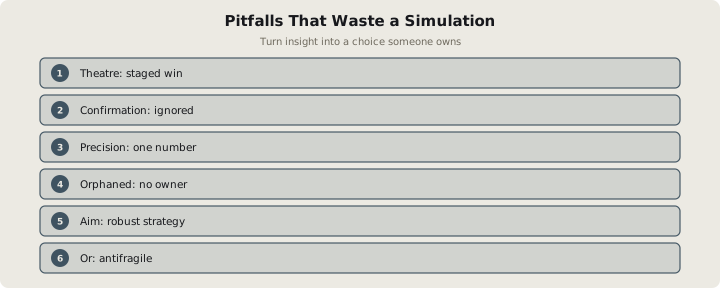
The method fails in familiar ways, and naming them is a defence. Theatre: a game staged to endorse a decision already taken, where the adjudication quietly lets the home team win. Confirmation: a red team appointed and then ignored the moment it says something unwelcome, the tokenism from the red-teaming lesson. Precision illusion: treating a market price or a single game outcome as a forecast rather than one calibrated input, forgetting that the value is the reasoning, not the number. Orphaned insight: a finding no decision-maker owns, so it changes nothing. Against all four, the guard is the same discipline this whole module teaches, the reflex to red-team your own process: ask who wanted this game to reach its conclusion, whether the red team was genuinely free, and whether anyone will actually act. The four methods are strongest together, net assessment framing the contest, red teams breaking the frame, war games running it forward, and markets pricing the pieces, but only if the exercise ends where it should, in a decision someone is willing to defend.

A game earns its cost only if it ends in a robust or antifragile decision.

Check your understanding

Answer each from memory. Your results are saved in this browser and count toward your readiness — sign in (account panel above) to keep them across devices.

  1. What is the difference between a robust and an antifragile strategy?

  2. A war game shows your launch would trigger an unwinnable price war. What is the disciplined response?

  3. Which is an implementation pitfall that makes simulation effort worthless?

Flashcards

Recall-first review of the load-bearing facts.

0 reviewed · 8 left

Ready to test yourself?

12 graded questions with real explanations. You commit a confidence before each reveal — that is how you find what you only think you know.

Start practice quiz →
Net Assessment and War-Gaming — Strategic Foresight | Contested Futures Academy · The Contested Futures Institute