Sensing and Framing

Foresight begins long before anyone forecasts anything. It begins with two disciplines that decide whether the whole cycle is worth running: how the question is framed, and how the environment is sensed. This module treats framing as the act that sets the decision, the time horizon and the system boundary; and sensing as the structured scanning that turns a noisy environment into ordered signals. It draws on STEEP scanning, Graham Molitor's emerging-issues analysis and Bill Sharpe's Three Horizons, alongside how DSI Advisory catches weak signals early. The aim is not a technique to memorise but a judgement to develop: what to look at, and why.

  • horizon-scanning
  • weak-signals
  • three-horizons
  • trend-analysis
  • framing
  • environmental-scanning
13 min · Core

Framing the Foresight Question

A foresight study is only as good as the question it answers. Before any scanning, an analyst must fix three things: the decision the work serves, the time horizon it reaches to, and the boundary of the system under study. A badly framed question does not produce a weak forecast; it produces a confident answer to the wrong problem, and wastes the entire cycle.

~3 min

By the end you can

  • Explain why framing precedes scanning and sets the terms of the whole cycle.
  • Distinguish the decision, the time horizon and the system boundary as the three framing choices.
  • Recognise the common failures of a badly framed foresight question.
  • Frame a question so that its outputs are decision-relevant rather than merely interesting.

Framing comes first

Analysts new to foresight reach for the tools: scanning, scenarios, forecasts. The experienced ones spend their first effort somewhere less glamorous, on the question itself. Framing is the act of deciding what the study is actually about, and it governs everything downstream. Scan without a frame and you drown in signals with no way to judge relevance. The discipline is to resist the pull toward activity and instead ask what decision this work exists to serve. Everything that follows inherits the quality, or the sloppiness, of that first choice.

Three choices that set the study

Good framing fixes three things. The first is the decision: who will act on this, and on what. Foresight that serves no decision is entertainment. The second is the time horizon: are we reasoning about eighteen months or fifteen years? The horizon changes which forces matter, because what is fixed over two years, such as installed infrastructure, is fluid over fifteen. The third is the system boundary: what is inside the study and what is treated as external context. Draw the boundary too tight and you miss the force that actually moves the system; draw it too wide and you cannot say anything specific. These three choices, decision, horizon and boundary, are the frame.

How a bad frame fails

A poorly framed question fails in recognisable ways. It answers a question no decision-maker asked, so the work is admired and shelved. It fixes a horizon that hides the relevant dynamics, forecasting next quarter when the client's exposure is a decade out. Or it draws a boundary that amputates the cause: a study of a firm's supply risk that stops at its direct suppliers will never see the upstream refinery where the real dependency sits. In each case the analysis can be rigorous and still worthless, because rigour applied to the wrong frame compounds the error rather than correcting it.

Framing in practice

DSI's Full Threat Surface discipline is, at root, a framing move: it insists the boundary be drawn wide enough to include the whole surface an adversary could reach, not just the assets a client happens to watch. That is a deliberate choice about the system boundary made before any scanning begins. The test of a good frame is simple and demanding: can you state, in one sentence, the decision this study serves, the horizon it reaches, and what lies inside its boundary? If you cannot, you are not ready to scan. Framing is where a foresight analyst earns their keep, because a well-set question makes the rest of the cycle tractable and a badly set one makes it futile.
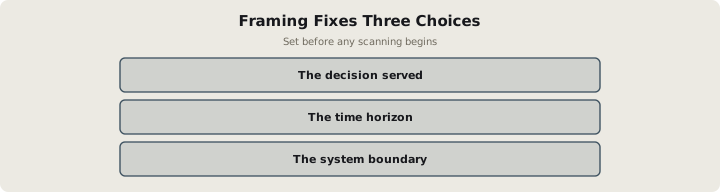
Framing sets who acts, how far ahead and what lies inside the study before scanning starts.

Check your understanding

Answer each from memory. Your results are saved in this browser and count toward your readiness — sign in (account panel above) to keep them across devices.

  1. Why must framing come before scanning in a foresight cycle?

  2. Which three choices does framing fix?

  3. A supply-risk study that stops at a firm's direct suppliers and misses the upstream refinery has failed at which framing choice?
14 min · Core

Horizon Scanning

Once the question is framed, sensing begins. Horizon scanning is the structured, ongoing search of the wider environment for signs of change. STEEP or PESTLE frameworks partition that environment so no domain is quietly ignored, and a disciplined source diet and logging of scanning hits turn scattered reading into a reproducible practice rather than a hunch.

~3 min

By the end you can

  • Define horizon scanning and distinguish it from ad hoc reading.
  • Use STEEP or PESTLE to partition the environment so no domain is neglected.
  • Explain the role of source diversity and logged scanning hits in a credible scan.
  • Relate structured scanning to DSI's Full Threat Surface discipline.

What scanning is

Horizon scanningThe systematic, continuous and recorded search of the wider environment for early signs of change relevant to a framed question. Structured to counter confirmation bias, unlike ad hoc reading. is the systematic search of the environment for early signs of change that could matter to the framed question. The word systematic is doing the work. Everyone reads; scanning differs because it is structured, continuous and recorded. An analyst who merely follows the outlets they already like will keep confirming what they already believe. Scanning is designed to counter that pull, to make the search cover ground the analyst would not naturally visit, and to keep a trail so the practice can be reviewed and improved rather than trusted on faith.

Partitioning the environment: STEEPA scanning partition that divides the environment into Social, Technological, Economic, Environmental and Political domains, forcing coverage so no area is quietly ignored. PESTLE is a sibling that adds Legal.

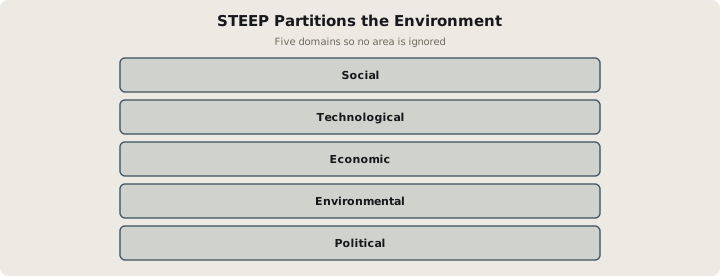
The most common way to keep a scan honest is a partition framework. STEEP divides the environment into Social, Technological, Economic, Environmental and Political domains; the sibling PESTLE adds Legal and separates the categories slightly differently. The value is not the acronym but the discipline it enforces: for each domain, the analyst must ask what is changing here. This surfaces blind spots. A team obsessed with technology is forced to look at the political and legal domains it would otherwise skip, and it is frequently there, not in the technology, that the decisive change is forming.

Sources and scanning hits

A scan is only as good as its inputs. A credible source diet is deliberately diverse: mainstream reporting for consensus, specialist and trade press for depth, primary documents such as patents, filings, tenders and standards for early movement, and voices from outside the analyst's own culture and language to counter home bias. When something notable turns up, it is captured as a scanning hit, a short logged record of the signal, its source and why it might matter. Over time these hits accumulate into a searchable base that reveals patterns no single reading would, and that lets a team show its work rather than assert a conclusion.

Scanning with a purpose

Structured scanning connects directly to how DSI works. The Full Threat Surface discipline is a scanning frame in the same spirit as STEEP: it insists the analyst survey the entire surface an adversary could reach, so no domain of exposure goes unwatched simply because it is unfamiliar. The lesson is that scanning is not passive reading but an act of coverage, deliberately structured so that the important signal is not missed for the mundane reason that no one was looking in its direction. A scan without a partition and without logged hits is just reading with ambition; a scan with them is an instrument.

STEEP forces coverage of every domain, surfacing blind spots a specialist team would skip.

Check your understanding

Answer each from memory. Your results are saved in this browser and count toward your readiness — sign in (account panel above) to keep them across devices.

  1. What distinguishes horizon scanning from ordinary reading?

  2. What is the purpose of a partition framework such as STEEP or PESTLE?

  3. What is a scanning hit?

14 min · Core

Weak Signals and Wildcards

The prize in scanning is the signal that arrives before consensus forms. Graham Molitor's model of emerging-issues analysis maps how an issue climbs an S-curve from obscure origin to mainstream concern, and shows why the earliest, weakest signals carry the most strategic value. Alongside them sit wildcards: low-probability, high-impact events that no trend line predicts but that a serious foresight practice must still confront.

~3 min

By the end you can

  • Describe Molitor's S-curve of issue emergence and where weak signals sit on it.
  • Explain why the earliest signals are both the most valuable and the hardest to trust.
  • Distinguish a weak signal from a wildcard and say how each is handled.
  • Illustrate early weak-signal detection with a concrete DSI example.

Molitor's S-curve

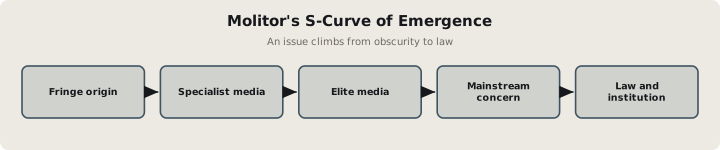
The American forecaster Graham Molitor spent his career studying how public issues emerge, and distilled it into a pattern: an issue climbs an S-curve over time. It begins almost invisibly, in a fringe journal, an activist pamphlet, a court case, a single event. For a long stretch almost no one notices. Then, if conditions are right, it accelerates through specialist and elite media into mainstream concern, and finally into law and institution. Molitor's insight for the analyst is directional: the leverage is greatest at the bottom of the curve, where the issue is still cheap to influence and few competitors are watching, and least at the top, where everyone already knows.

Weak signals

A weak signal is an early indicator sitting near the foot of that curve: fragmentary, ambiguous, easy to dismiss as noise. Its value is precisely its earliness, and its difficulty is precisely the same thing. Because it is weak, it cannot be confirmed by the usual test of corroboration; if many sources already agree, the signal is no longer weak and the advantage is gone. This is the analyst's dilemma. Wait for confirmation and you forfeit the lead; act on every faint signal and you chase ghosts. The discipline is to hold weak signals as live hypotheses, watching whether they strengthen, rather than either dismissing or over-committing to them.

Wildcards

Weak signals are the leading edge of trends that are already forming. Wildcards are different: low-probability, high-impact events that no trend line anticipates, such as a sudden state collapse, a pandemic, a critical infrastructure failure. They cannot be forecast, but they can be prepared for. A serious foresight practice does not pretend to predict wildcards; it stress-tests the client's plans against a deliberately chosen set of them, asking what would break and what could not be recovered. The point is resilience, not prophecy.

Catching the signal early

DSI's own record shows the payoff. The chain of reasoning behind the analysis later published as The Laundered Dependency began as a weak signal: fragmentary reporting on scandium and rare-earth sourcing that most observers read as a minor commodity story. Read against the framed question of hidden strategic dependency, it was the foot of an S-curve, and following it early produced a thesis well ahead of consensus. The same held for the sovereign-cloud signal behind the SEAL-0 work, where early reading of the United States CLOUD Act's reach anticipated a concern that only later became mainstream. Neither was a confident prediction at the time; both were weak signals held as hypotheses and watched until they strengthened.

Leverage is greatest at the foot of the curve, where the issue is cheap to influence.

Check your understanding

Answer each from memory. Your results are saved in this browser and count toward your readiness — sign in (account panel above) to keep them across devices.

  1. According to Molitor's S-curve, where is an analyst's leverage over an emerging issue greatest?

  2. Why is a weak signal both valuable and hard to trust?

  3. How does a serious foresight practice handle a wildcard?

12 min · Core

Trends and Megatrends

Between the faint weak signal and the settled fact sits the trend: a direction of change with enough evidence behind it to be named. Megatrends are the largest and slowest of these, shaping decades. Trend and trend-impact analysis give an analyst a way to reason about them, but the central discipline of this lesson is a warning: a trend is a tendency, not a destiny, and treating it as inevitable is one of foresight's most common and costly errors.

~3 min

By the end you can

  • Distinguish a trend from a weak signal and from a megatrend.
  • Explain what trend-impact analysis adds to naming a trend.
  • Recognise the trap of treating a trend as destiny and name its failure modes.
  • Reason about how trends can bend, stall or reverse rather than run straight.

From signal to trend to megatrend

A trend is a direction of change supported by enough evidence to be named with confidence: an ageing population, rising urbanisation, falling costs of a technology. It sits between the weak signal, which is a candidate not yet confirmed, and the settled fact, which no longer surprises anyone. A megatrend is a trend of the largest kind, slow, global and deep, shaping the terrain over decades rather than years. Demographic ageing across the developed world is a megatrend; the shift of economic weight toward Asia is another. Their scale makes them feel like fixed features of the landscape, and that feeling is exactly where the danger begins.

TrendA direction of change supported by enough evidence to be named with confidence, sitting between an unconfirmed weak signal and a settled fact. A tendency, not a destiny.-impact analysis: The discipline of working through a trend's second-order consequences: what it changes, for whom and how fast, moving past the headline direction into decision-relevant effects.">Trend-impact analysisThe discipline of working through a trend's second-order consequences: what it changes, for whom and how fast, moving past the headline direction into decision-relevant effects.

Naming a trend is not the same as understanding what it does. Trend-impact analysis asks the further question: if this trend continues, what does it change, for whom, and how fast? It works through the second-order consequences that the trend itself does not announce. An ageing population is a trend; its impact runs into labour markets, pension systems, healthcare demand, political coalitions and the housing stock, each on its own timeline. The discipline forces the analyst past the headline direction into the specific, decision-relevant consequences, which is where a client's exposure and opportunity actually sit.

The trap of trend as destiny

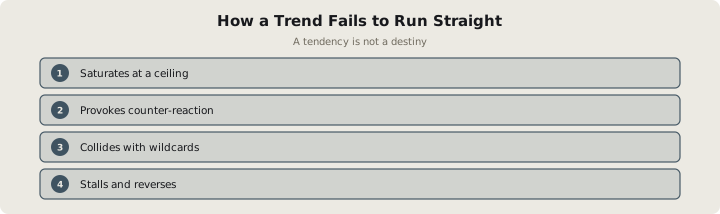
The gravest error in trend work is to mistake a tendency for a certainty and simply project the line forward. Trends bend, stall and reverse. They saturate, as adoption reaches a ceiling. They provoke counter-reactions, as a rising force calls its own opposition into being. They collide with other trends and with wildcards, which break their trajectory outright. History is littered with confident extrapolations, straight lines drawn from a few years of data, that a discontinuity then falsified. The analyst who treats a megatrend as destiny stops watching for the very forces that will bend it, and is therefore most exposed at the moment the line breaks.

Holding trends lightly

The mature stance is to take trends seriously as evidence of direction while refusing to treat them as fate. A trend tells you which way the current is running now, not that it cannot change. This is why trend analysis feeds into scenario work rather than replacing it: scenarios are, in part, a structured way to ask how a trend might bend. For the framed question, the useful output is not a single extrapolated number but an understanding of the trend's drivers, its likely ceilings, and the counter-forces that could reverse it, so a decision-maker is not blindsided when the line, as lines do, eventually turns.

Treating a trend as destiny stops the analyst watching for the forces that break the line.

Check your understanding

Answer each from memory. Your results are saved in this browser and count toward your readiness — sign in (account panel above) to keep them across devices.

  1. How does a trend differ from a weak signal and a megatrend?

  2. What does trend-impact analysis add to simply naming a trend?

  3. What is the central trap in trend work this lesson warns against?

13 min · Core

The Three Horizons Framework

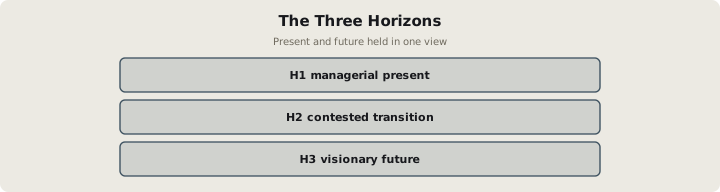
The Three Horizons framework, developed by Bill Sharpe with the International Futures Forum, gives a foresight team a way to hold the present and the future in one view. H1 is the managerial present, the dominant system in decline. H3 is the visionary future, the emerging pattern still marginal today. H2 is the entrepreneurial transition zone where the two contest, and it is where most of the interesting, and most contested, foresight work lives.

~3 min

By the end you can

  • Describe the three horizons and what each represents.
  • Explain why H2 is the contested, entrepreneurial zone of transition.
  • Use the framework to place weak signals, trends and the dominant system in one view.
  • Attribute the framework to Bill Sharpe and the International Futures Forum.

Three horizons at once

The Three HorizonsA framework by Bill Sharpe and the International Futures Forum holding three views at once: H1 the managerial present in decline, H3 the visionary emerging future, and H2 the contested, entrepreneurial transition zone between them. framework was developed by Bill Sharpe and colleagues at the International Futures Forum as a way to think about change without collapsing into either short-term management or unmoored speculation. Its power is that it holds three things in a single picture. Rather than asking flatly what the future will be, it asks how the present system gives way to a future one, and where along that passage a given signal, trend or actor belongs. It turns the sensing and framing work of this module into a shared map a team can reason over together.

H1: the managerial present

Horizon 1 is the world as it currently is: the dominant system, the prevailing business model, the established institutions. It is the horizon of management, of keeping the current machine running well. Crucially, H1 is described as in relative decline, not because it is failing today but because the conditions that made it fit are slowly changing beneath it. Much organisational energy is spent defending H1, which is rational in the short term and dangerous if it becomes the only horizon a leadership can see.

H3: the visionary future

Horizon 3 is the emerging future: the fundamentally different pattern that is marginal and easy to dismiss today but that could become dominant. This is where the weak signals of an earlier lesson live, the pockets of practice that hint at a different settled state. H3 is the horizon of vision and of long-term possibility. On its own it is easy to caricature as fantasy, which is exactly why the framework refuses to let it stand alone and insists on connecting it back through the middle horizon.

H2: the entrepreneurial transition zone

Horizon 2 is the contested middle, the zone of transition where the declining first horizon and the emerging third contend. It is the entrepreneurial space: innovations, disruptions and experiments that could either be captured to prop up the old system or become the bridge that carries the new one into dominance. The same H2 innovation can serve either horizon, which is what makes this zone both the most interesting and the most ambiguous to read. For the foresight analyst, H2 is usually where the decision-relevant action is, because it is where the future is actually being fought over rather than merely managed or imagined. Placing a client's own moves on this map, which horizon they defend and which they are building toward, is often the single most clarifying output of a sensing and framing exercise.

H1 declines, H3 emerges, and H2 is the contested zone where the future is fought over.

Check your understanding

Answer each from memory. Your results are saved in this browser and count toward your readiness — sign in (account panel above) to keep them across devices.

  1. In the Three Horizons framework, what does H1 represent?

  2. Why is Horizon 2 called the entrepreneurial zone of transition?

  3. Who developed the Three Horizons framework?

Flashcards

Recall-first review of the load-bearing facts.

0 reviewed · 8 left

Ready to test yourself?

12 graded questions with real explanations. You commit a confidence before each reveal — that is how you find what you only think you know.

Start practice quiz →
Sensing and Framing — Strategic Foresight | Contested Futures Academy · The Contested Futures Institute