Structural Power
Susan Strange argued that the power that matters most is not the visible power to win a given contest but the structural power to set the terms on which every contest is fought. She located it in four structures: security, production, finance and knowledge. Reading these is the difference between watching the pieces and seeing the board, and it is the foundation on which DSI's book The Wrong Map is built.
By the end you can
- Distinguish relational power from structural power.
- Name Strange's four structures and what each governs.
- Explain why structural power is often invisible to those who hold and lack it.
- Apply the board-not-pieces lens to a contemporary case.
Two kinds of power
Most analysis of international affairs tracks what Susan Strange called relational power: the power of one actor to make another do what it would not otherwise do. Who won the round, who blinked, who signed. Strange, writing in States and Markets in 1988, argued that this is the shallow layer. Beneath it sits structural power: the power to shape the frameworks within which states, firms and people must operate, to decide the range of choices open to everyone else. The holder of structural power rarely has to issue a command. It has already arranged the field so that others, pursuing their own interests, move where it wants them to move.
The four structures
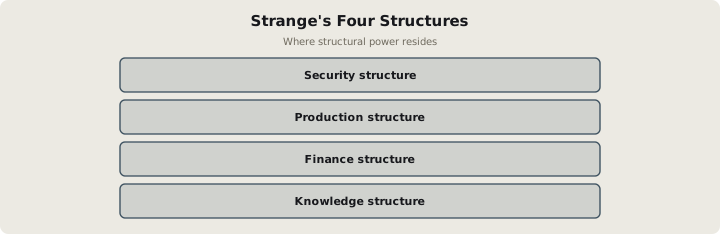
Strange located structural power in four overlapping structures. The security structure is the arrangement of who protects whom from violence, and on what terms. The production structure is the arrangement of what is made, where and by whom. The finance structure is the arrangement of credit and money, who can create it and who depends on it. The knowledge structure is the arrangement of what is known, believed and communicated, and who controls the channels. Whoever shapes these four does not need to win individual arguments. They have written the grammar in which the arguments are conducted.
Why it hides
Structural powerSusan Strange's term for the power to shape the frameworks and range of choices within which states, firms and people must operate, as distinct from the relational power to win a specific contest. Located in the security, production, finance and knowledge structures. tends to be invisible precisely because it is ambient. A firm that must price its exports in a particular currency, insure through a particular market and use a particular payments rail rarely experiences these as exercises of power. They feel like the weather, simply how the world is. That invisibility is the point. Relational powerThe power of one actor to make another do what it would not otherwise do in a given contest. The visible, shallow layer of power, beneath which structural power sets the terms of every contest. announces itself in a sanction or a strike; structural power is felt as the absence of alternatives. An analyst who tracks only the visible clashes will consistently misjudge who is actually strong, because the strongest positions produce the fewest visible fights.
Seeing the board
This is the discipline DSI's book The Wrong Map takes from Strange and makes its organising idea: read the structures, not the incidents. When an energy dispute erupts, the relational question is who prevailed this winter. The structural question is who controls the pipelines, the refining capacity, the insurance and the settlement currency, because that arrangement will still be there long after this winter's headlines fade. Consider a state that loses a trade skirmish yet sits astride the payment system through which its rival must clear every transaction. On the scoreboard of incidents it lost; on the board itself it is untouchable. Foresight begins when you stop counting the moves and start reading the board they are played on.
Check your understanding
Answer each from memory. Your results are saved in this browser and count toward your readiness — sign in (account panel above) to keep them across devices.
What best distinguishes structural power from relational power?
Which set correctly names Susan Strange's four structures?
Why does structural power tend to be invisible?