Why Foresight, and What It Is Not

Strategic foresight is often confused with prediction, and that confusion wastes the whole discipline. This module sets the foundation: the future is plural, not singular; foresight studies plausible futures rather than forecasting one; and its value is measured not by whether it calls the outcome but by whether it changes decisions today. It draws the line between forecasting, exploratory scenarios and normative backcasting, examines why capable organisations stay blind to change they could see, and closes with the foresight cycle that the rest of the course follows.

  • strategic-foresight
  • futures-studies
  • scenario-thinking
  • decision-under-uncertainty
  • horizon-scanning
  • structured-analysis
12 min · Core

The Future Is Plural

The single most important shift in strategic foresight is grammatical. There is no such thing as 'the future', only images of futures held in the present. Because the future has not happened, there is no data about it, so foresight cannot be about prediction. It studies a range of plausible futures instead, and that plural framing changes everything a strategist does next.

~4 min

By the end you can

  • Explain Jim Dator's claim that 'the future' does not exist, only images of it do.
  • State why there can be no data about the future and what follows from that.
  • Distinguish a plausible future from a probable or preferred one.
  • Describe how plural framing changes the questions a strategist asks.

A grammatical correction

The futurist Jim Dator, who founded the futures programme at the University of Hawaii, built his teaching on a deceptively simple line: the future does not exist. What exists are images of futures, held by people in the present, shaping how they act now. When a board says it is planning for 'the future', it is really acting on one image of it, usually an unspoken one. Naming that image, and admitting it is only one of several, is where foresight begins. This is not word play. If you believe there is a single fixed future out there to be discovered, you will look for the tool that reveals it. There is no such tool, and looking for one is the first mistake.

There is no data about the future

The reason is plain once stated. Data comes from things that have happened. The future has not happened, so there is no data about it, only data about the past and present that we extend forward with assumptions. Every forecast is an argument dressed as a measurement. This is why Dator insisted foresight is not prediction. A weather service predicting rain tomorrow is extending stable physical patterns over hours; a strategist reasoning about supply chains, regimes or technologies over a decade has no such stable patterns and no such data. Pretending otherwise produces false precision, the most dangerous product in the field.

Plausible, not probable

If we cannot know the future, what do we study? Plausible futuresFutures that could credibly happen given forces already in motion. Plausibility is a lower, more honest bar than probability; foresight deliberately widens the set of futures it takes seriously.: the ones that could credibly happen given what we understand about forces already in motion. Plausibility is a lower and more honest bar than probability. A probable future is a bet on a single number; a plausible future is a scenario worth taking seriously because a coherent chain of events could produce it. Foresight deliberately widens the set. It asks not 'what will happen' but 'what could happen that we would be foolish to ignore'. Dator even offered a provocation: any useful image of the future should at first appear ridiculous, because a future that looks obviously sensible today is usually just the present with the dates changed.

How plural framing changes the work

Once you accept that the future is plural, your questions change. Instead of asking an analyst to tell you what happens, you ask what forces are in play, which of them we least understand, and how differently the world could unfold depending on how they resolve. DSI's own horizon-scanning frame, 'The Full Threat Surface', works this way: it maps the range of ways pressure could arrive rather than betting on the single most likely one. A strategist who has internalised plurality stops seeking the one right answer and starts building a portfolio of futures robust enough to prepare against. That mental move, from singular to plural, is the whole foundation this course is built on.
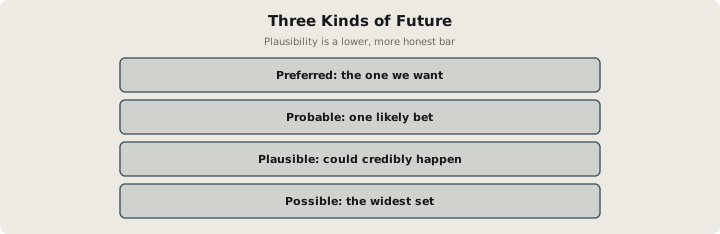
Foresight studies the plausible, not the single probable or preferred outcome.

Check your understanding

Answer each from memory. Your results are saved in this browser and count toward your readiness — sign in (account panel above) to keep them across devices.

  1. What did Jim Dator mean by saying 'the future' does not exist?

  2. Why does Dator insist that foresight is not prediction?

  3. How does a plausible future differ from a probable one?
13 min · Core

Foresight vs Prediction vs Planning

Three activities are constantly muddled: forecasting the single likely future, exploring several plausible futures, and working backwards from a chosen future. Each has its place, but using the wrong one for the wrong question is a recurring failure. This lesson draws the distinctions cleanly and explains why being roughly right early beats being precisely wrong.

~3 min

By the end you can

  • Contrast forecasting, exploratory scenarios and normative backcasting.
  • Match each method to the kind of question it answers well.
  • Explain why 'roughly right early' beats 'precisely wrong'.
  • Recognise when trend extrapolation quietly breaks down.

Three different jobs

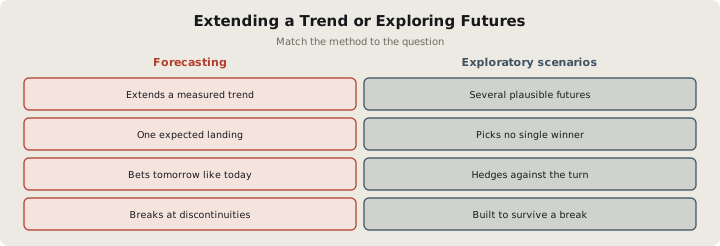
Foresight, prediction and planning are not rivals; they are different jobs that get confused because they all point forward. ForecastingExtending a measured trend forward to estimate where present patterns would land. Powerful over short horizons in stable systems; it fails silently at the discontinuities foresight most needs to anticipate. takes a measurable trend and extends it: sales, population, chip density. It answers 'if present patterns hold, roughly where do we land?' It is powerful when the underlying system is stable and short-horizon. Exploratory scenarios ask a different question: given deep uncertainty, what are several distinct, plausible ways the world could unfold? They do not pick a winner; they stretch the imagination across a range. Normative backcasting reverses direction entirely: it starts from a chosen, preferred future and works backwards to ask what would have to happen for that future to arrive. Each is a legitimate tool. The error is reaching for the forecast when the honest answer is a scenario set.

When extrapolation breaks

Trend extrapolation fails silently at exactly the moments that matter most: the discontinuities. A line drawn through past data assumes the forces that produced it stay constant. They rarely do across a decade. The value of exploratory scenarios is that they are built to survive a broken trend, because they were never a single line to begin with. This is the heart of the distinction. A forecast is a bet that tomorrow resembles yesterday; a scenario set is a hedge against the times it does not.

Roughly right, early

The founding case of the discipline shows why this matters. In the early 1970s, Pierre Wack and his team at Royal Dutch Shell used scenario planning rather than forecasting. Most oil forecasts extended the stable, cheap-oil trend of the post-war decades. Wack's scenarios instead took seriously a plausible future in which producing states asserted control and the oil price jumped. Shell did not predict the 1973 embargo; no one held its date. But because managers had already rehearsed a world of expensive, contested oil, Shell responded faster than rivals still clutching a forecast that the shock had just destroyed. Being roughly right early, and prepared, beat being precisely wrong.

Choosing the right tool

The practical discipline is to match method to question. If you need next quarter's demand in a stable market, forecast. If you are exposed to forces you do not control over years, build exploratory scenarios. If you have a goal and need a route, backcast from it. DSI's briefing practice mixes these deliberately: it will extend a trend where the ground is firm, then switch to plural scenarios the moment the ground turns to structural uncertainty. Naming which job you are doing stops the most common mistake in the field, dressing a scenario question up as a forecast and demanding a single number no one can honestly give.

Forecasting extends one line; scenarios stretch across several plausible futures.

Check your understanding

Answer each from memory. Your results are saved in this browser and count toward your readiness — sign in (account panel above) to keep them across devices.

  1. Which best describes normative backcasting?

  2. Why did Shell handle the 1973 oil shock better than its rivals?

  3. Why does trend extrapolation fail at the moments that matter most?

13 min · Core

Foresight as Decision Advantage

Foresight is not a forecasting scoreboard. It earns its keep only when it changes a decision made today. This lesson reframes the test of good foresight away from 'did it call the outcome' and towards 'did it improve what we chose while it was still cheap to choose differently'. That is DSI's stance: see change before it reaches the horizon.

~3 min

By the end you can

  • State the true test of foresight: whether it changes a present decision.
  • Explain why judging foresight by prediction accuracy misses the point.
  • Connect earlier awareness to cheaper, wider options.
  • Describe DSI's stance of seeing change before it reaches the horizon.

The wrong scoreboard

Ask most people how to judge a piece of foresight and they will say: was it right? That is the wrong scoreboard. Because there is no data about the future, no honest foresight claims certainty, and grading it like a weather forecast guarantees disappointment. The right question is different: did it change a decision that a leader made today, while changing course was still cheap? Foresight that produces a beautiful report and no altered choice has failed, however elegant. Foresight that shifted one investment, one hedge or one hiring plan earned its keep, even if the scenario it prepared against never fully arrived.

Why accuracy is the wrong test

Grading by accuracy quietly pushes practitioners towards timid, near-certain calls, the futures least worth studying because everyone already sees them. The valuable work sits in the plausible-but-unpriced region, where the organisation is exposed and unprepared. A scenario there may 'miss' in that its precise events do not occur, yet still be the most useful thing you did all year if it forced you to build an option you would otherwise have lacked. Shell's oil scenarios again make the point: their worth was never the calendar accuracy of the shock but the readiness they installed beforehand.

Earlier awareness, wider options

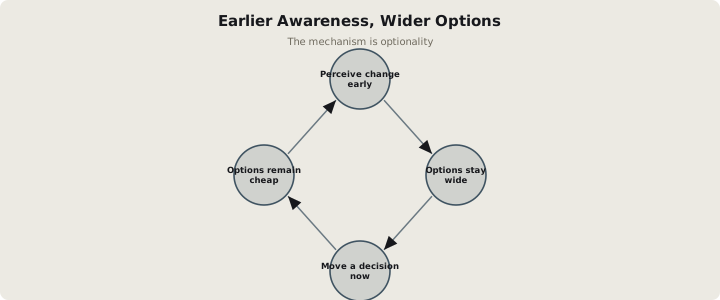
The mechanism is optionality. The earlier you perceive a possible change, the more and cheaper your options to respond. Once a change reaches the horizon and everyone can see it, the good moves are expensive or gone, priced in by competitors and constrained by events. This is why foresight pays: it does not tell you the future, it buys you time and room to manoeuvre inside it. A decision made two years early against a plausible disruption can be a modest hedge; the same decision made in the middle of the disruption can be a costly scramble, if it is available at all.

DSI's stance

This is the posture DSI takes in its own work: see change before it reaches the horizon. The purpose of a briefing is not to impress with a bold call but to move a reader's decision earlier and improve it, while options are still wide and cheap. Every scenario, every scan, every stress-test in this course serves that end. If a foresight exercise cannot finish the sentence 'because of this, we should decide X differently now', it has not yet done its job. Judge your own foresight by decisions changed, not by outcomes called.

Perceiving change early keeps options wide and cheap before rivals price them in.

Check your understanding

Answer each from memory. Your results are saved in this browser and count toward your readiness — sign in (account panel above) to keep them across devices.

  1. By what test does foresight actually earn its keep?

  2. Why does grading foresight on prediction accuracy backfire?

  3. What is DSI's stance on the purpose of foresight?

14 min · Core

Why Organisations Are Blind to the Future

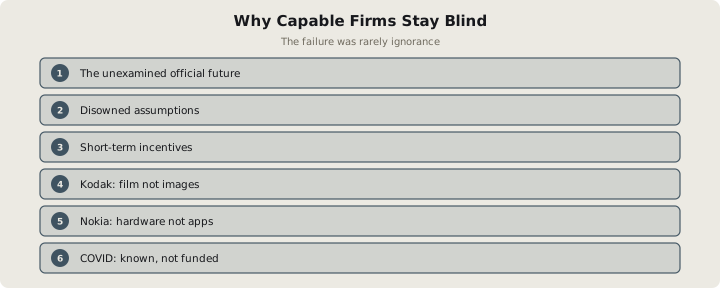
Capable organisations with good people and good data still miss changes they could have seen. The reasons are structural, not stupidity: an official future no one questions, assumptions that are held but disowned, and incentives that reward the short term. Kodak, Nokia and the COVID-19 pandemic show the pattern, and each shows that the failure was rarely ignorance of the possibility.

~4 min

By the end you can

  • Define the 'official future' and explain how it blinds an organisation.
  • Identify disowned assumptions and why they escape challenge.
  • Explain how short-termism suppresses acting on foresight.
  • Use Kodak, Nokia and COVID-19 to show the failure was rarely ignorance.

The official future

Every organisation carries an official future: the single, mostly unspoken image of how tomorrow will look that all its plans quietly assume. It is comfortable because it flatters current strategy and demands no change. Its danger is that it goes unexamined. When the official future is 'people will always print photographs' or 'phones are about hardware', every plausible alternative is filtered out before it can be discussed. Foresight's first act is to drag the official future into the open and name it as one image among several, so it can be challenged rather than obeyed.

Disowned assumptions

Beneath the official future sit assumptions the organisation holds but will not own. Kodak is the classic case. Its own engineer, Steven Sasson, built a working digital camera in 1975. Kodak understood the technology early, arguably better than anyone. What it could not do was act against the disowned assumption that its business was film and chemistry rather than images. The knowledge was present; the assumption blocking it was never surfaced and tested. Nokia tells a parallel story. It dominated mobile phones and had capable engineers who saw the smartphone coming, but an internal culture and structure kept it anchored to hardware and its own software while the platform war moved to apps and ecosystems. In both cases the fatal assumption was held tightly and examined never.

Short-termism

Even when an organisation surfaces a threat, incentives can stop it acting. Quarterly targets, annual bonuses and the pull of the current profitable line all reward defending today over preparing for a costly, uncertain tomorrow. A manager who diverts resources to a scenario that has not yet arrived pays a certain cost now for an uncertain benefit later, and the reward system rarely thanks them. This is why foresight so often dies not at the perceiving stage but at the acting stage. The change was seen; the structure would not let anyone move on it.

The pandemic that was foreseen

COVID-19 is the sharpest example because it was not an unforeseeable event. A severe respiratory pandemic sat near the top of national risk registers for years; exercises had modelled it, and reports had warned of it. The scenario existed. What was missing was action on it, stockpiles, surge capacity, tested plans, sustained across the quiet years when nothing seemed to be happening. The failure was not a failure to imagine; it was a failure to hold a known plausible future in view and fund against it when it was still cheap. That is the recurring shape of organisational blindness: rarely ignorance of the possibility, almost always a failure to name the official future, test the disowned assumption, and act despite short-term cost.

Structural blindness, not stupidity, kept Kodak, Nokia and pandemic planners frozen.

Check your understanding

Answer each from memory. Your results are saved in this browser and count toward your readiness — sign in (account panel above) to keep them across devices.

  1. What is an organisation's 'official future'?

  2. What best explains Kodak's failure to move on digital photography?

  3. Why is COVID-19 described as a foresight failure of action rather than imagination?

13 min · Core

The Foresight Cycle

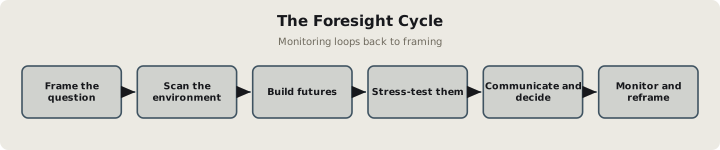
Foresight is a disciplined cycle, not a moment of inspiration. This lesson lays out the arc the rest of the course follows: frame the question, scan the environment, build alternative futures, stress-test them, assess implications, communicate, decide, and monitor. Each stage feeds the next, and monitoring loops back to reframing as the world moves.

~3 min

By the end you can

  • Name the stages of the foresight cycle in order.
  • Explain why framing the question comes before any scanning.
  • Describe how the cycle loops rather than ending at a decision.
  • Locate where communication and decision sit and why they matter.

A cycle, not a spark

Good foresight is not a flash of genius; it is a repeatable cycle. Naming its stages gives a team a shared map of where they are and what comes next. The arc runs: frame the question, scan the environment, build alternative futures, stress-test them, assess the implications, communicate the result, decide, and monitor. Each stage depends on the one before, and the last loops back to the first. The rest of this course is a walk through these stages in depth; this lesson gives you the whole shape first so each later module has a place to sit.

Framing before scanning

The cycle begins with framing because a badly framed question wastes everything after it. Framing sets the decision at stake, the time horizon, and the boundary of what is in scope. 'What happens to energy?' is unframeable; 'over the next ten years, what plausible shifts in energy supply would force us to rethink where we build?' can be worked. Only once the question is sharp does scanning make sense: the systematic search for signals of change, weak and strong, across politics, economics, society, technology and environment. Scan before you frame and you drown in noise; frame first and the scan has a target.

Building and stressing futures

Scanning feeds the building of alternative futures, distinct, internally coherent scenarios that stretch across the key uncertainties, the plural futures of the first lesson made concrete. These are then stress-tested: challenged for coherence, for hidden assumptions, and for the ways they could be wrong. This is where DSI's discipline of turning the alarm on your own analysis lives, refusing to let a comfortable scenario pass unchallenged. A scenario set that has not been stress-tested is a set of stories; one that has been is an instrument.

From assessment to monitoring

Next comes assessment: working out what each future would mean for the decision at stake, what is robust across all of them, and what is fragile. Then the two stages where foresight either lives or dies. Communication carries the finding to the people who decide, in a form they can act on, because analysis that no decision-maker absorbs changes nothing. Decision is the point of the whole exercise, the moment a present choice is made differently because of the work. Finally monitoring watches the signals that would tell you which future is arriving, and feeds that back into a fresh framing. The world keeps moving, so the cycle never truly closes; it turns. That looping arc is the spine of everything ahead.

Each stage feeds the next, and monitoring loops back so the cycle turns.

Check your understanding

Answer each from memory. Your results are saved in this browser and count toward your readiness — sign in (account panel above) to keep them across devices.

  1. Why does framing the question come before scanning in the cycle?

  2. What does the monitoring stage of the foresight cycle do?

  3. Why are communication and decision described as the stages where foresight lives or dies?

Flashcards

Recall-first review of the load-bearing facts.

0 reviewed · 8 left

Ready to test yourself?

12 graded questions with real explanations. You commit a confidence before each reveal — that is how you find what you only think you know.

Start practice quiz →
Why Foresight, and What It Is Not — Strategic Foresight | Contested Futures Academy · The Contested Futures Institute