From Data to Decisions

A trusted sustainability-data infrastructure is expensive to build, so the sensible question is what it earns once it exists. This module answers that question. It shows how the same trusted data that satisfies a compliance return becomes a source of strategy and foresight: a lens on transition risk, a map of where resources and money are being wasted, and a language that persuades a board and its investors. The through-line is the DSI lens, that trustworthy data is not a cost of compliance but a decision advantage, and that building the infrastructure is worth it only because of what it unlocks.

  • strategic-intelligence
  • decision-making
  • transition-risk
  • board-communication
  • resource-efficiency
  • investor-relations
12 min · Core

Beyond the Report

Once a business has built trustworthy sustainability data, it faces a choice: use the infrastructure only to file a compliance return, or reuse the same data to run the business better. This lesson makes the case that the report is the floor, not the ceiling, and that the marginal cost of turning trusted data into decisions is small compared with what it took to build.

~4 min

By the end you can

  • Explain why filing the report is the floor rather than the ceiling of what the data can do.
  • Describe how a trusted infrastructure can be reused for management, not only disclosure.
  • Recognise the low marginal cost of turning already-trusted data into decisions.
  • Identify the mindset shift from 'report and forget' to 'measure and manage'.

The report is the floor, not the ceiling

A business that has done the hard work of building trustworthy sustainability data has, in effect, laid a road. The temptation is to drive down it once a year, to the regulator's door, and then park. That is a waste. Filing the report is the minimum the data can do, the floor of its value. The same figures that satisfy an auditor can tell an operations director where energy is bleeding away, tell a procurement lead which suppliers carry hidden carbon cost, and tell a chief executive whether a target is on track. The compliance return is the by-product of a well-run business, not the reason to collect the data at all.

Reusing the infrastructure

The point of infrastructure is that it is built once and used many times. A firm does not build a finance system only to produce the statutory accounts; it uses the same ledger every day to decide what to buy, whom to pay and where it is losing money. Sustainability data, once it is trustworthy and flowing, deserves the same treatment. The energy figures gathered for disclosure can feed a monthly review of the worst-performing sites. The supplier emissions data collected for the value-chain report can inform which contracts to renew. The infrastructure is the same; only the use changes, from a backward-looking return to a forward-looking instrument.

Why the marginal cost is small

The reason this reuse is such a strong bet is arithmetic. The expensive part is already paid for. Capturing data once at source, making it traceable, and getting it to a standard an auditor accepts, that is where the money and effort go. Once that trusted layer exists, pointing it at a management decision costs very little more. A firm that has spent heavily to make its numbers defensible and then uses them only to fill a form is like a company that builds a factory and runs it one day a year. The decision advantage is sitting there, already funded, waiting to be switched on.

From report-and-forget to measure-and-manage

The shift this module asks for is one of habit. In the report-and-forget world, sustainability data is touched once, in a panic, before a deadline. In the measure-and-manage world, the same data is part of the ordinary operating rhythm: reviewed monthly, watched for drift, used to settle arguments with evidence. Consider a food producer that once assembled its emissions figure only for the annual report. When it began reviewing the same figure each month by site, it caught a refrigeration fault that had quietly raised energy use for a year. The data did not change. What changed was that the firm decided to look at it. The rest of this module is about what a business sees when it does.
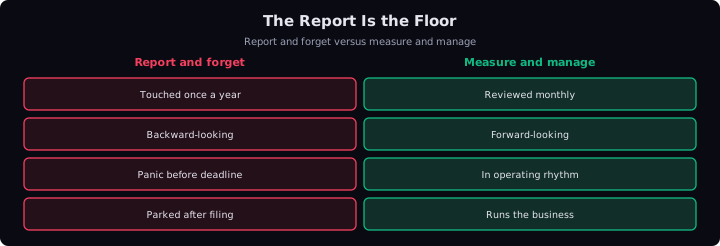
Filing the report is the minimum the trusted data can do, not the limit of its value.

Check your understanding

Answer each from memory. Your results are saved in this browser and count toward your readiness — sign in (account panel above) to keep them across devices.

  1. Why is filing the compliance report described as the floor rather than the ceiling of the data's value?

  2. Why is the marginal cost of turning trusted data into decisions typically small?

  3. What is the core mindset shift this lesson asks for?
14 min · Core

Sustainability Data as Intelligence

This is the module's central idea, the DSI lens. Trusted sustainability data is not just a record of the past; it is intelligence, in the sense a strategist means it: evidence that reduces uncertainty about what to do next. This lesson shows how the same figures that describe what happened can be read forward to reveal where a business is exposed, where it should invest, and where rivals will struggle.

~3 min

By the end you can

  • Define intelligence as evidence that reduces uncertainty about a decision.
  • Explain how backward-looking data can be read forward as foresight.
  • Describe how trusted data becomes a decision advantage over rivals.
  • Distinguish a mere record from actionable intelligence.

What intelligence means here

To a strategist, intelligence is not raw data and not a report. It is evidence that reduces uncertainty about a decision you are about to make. A weather forecast is intelligence if you are deciding whether to sail; the same forecast is trivia if you are staying indoors. Sustainability data becomes intelligence the moment it is aimed at a real choice: whether to sign a supplier, where to invest, which product line to defend. The DSI lens holds that this, not the compliance return, is what the data is finally for. Trusted numbers turn a guess into a judgement.

Reading backward data forward

Every sustainability figure describes something that already happened, an amount of energy used, a tonne of carbon emitted. Yet a good analyst reads it forward. A supplier whose emissions per unit have crept up for three years is not just a historical fact; it is a warning that its costs, and therefore its prices, will rise as carbon is taxed more heavily. A product line with the highest energy intensity in the portfolio is not merely last year's laggard; it is the one most exposed to the next energy-price shock. The data is a rear-view mirror only if you refuse to infer where the road bends. Read with a question in mind, the past becomes a forecast.

The decision advantage

Here is why this matters commercially. Two competitors face the same rising carbon costs and the same demanding customers. One can see, precisely and trustably, which of its sites and suppliers drive its footprint; the other has vague estimates it cannot defend. The first firm can act early and specifically, renegotiate the right contract, refit the right site, and quote a credible number to a customer who now insists on one. The second reacts late and blunt. Trusted data is a decision advantage, an edge in seeing and moving that compounds over time. Better sight leads to better moves, which fund better sight still.

Record versus intelligence

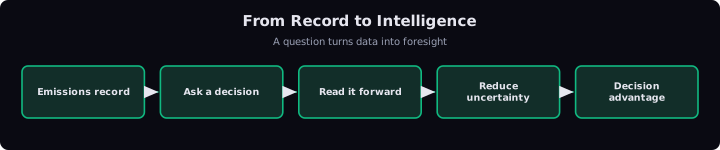
The line between a record and intelligence is not the data; it is the question. A spreadsheet of emissions is a record. The same spreadsheet, interrogated with 'which three suppliers would most reduce our exposure if we replaced them', is intelligence. Consider a chemicals firm that held detailed energy data for years and treated it as an archive. When a new analyst asked which processes would become uneconomic if power prices doubled, the same archive named the answer in an afternoon. Nothing new was collected. A question turned a record into foresight. Building trustworthy data is worth the cost precisely because it can be asked such questions and answer them defensibly.

The line between a record and intelligence is the question it is interrogated with.

Check your understanding

Answer each from memory. Your results are saved in this browser and count toward your readiness — sign in (account panel above) to keep them across devices.

  1. In the strategic sense used here, what is intelligence?

  2. How does a good analyst read a backward-looking sustainability figure forward?

  3. What distinguishes a mere record from actionable intelligence?

14 min · Core

Risk and Opportunity

Trusted sustainability data lets a business read two things it could otherwise only guess at: the risks bearing down on it as the economy decarbonises, and the opportunities to save money and win markets. This lesson covers transition risk, resource efficiency, and the market and investor advantage that flow from being able to see and prove both.

~4 min

By the end you can

  • Define transition risk and explain how the data makes it visible.
  • Show how the same data reveals resource-efficiency savings.
  • Explain how trusted data creates market and investor advantage.
  • Recognise that risk and opportunity are two readings of the same figures.

Transition riskThe danger to a business from the economy's shift to low carbon: rising carbon taxes, high-emitting inputs becoming expensive or restricted, and customers turning away from products they see as dirty., made visible

Transition risk is the danger a business faces not from the weather but from the shift to a low-carbon economy: carbon taxes rising, high-emitting inputs becoming expensive or restricted, customers walking away from products they see as dirty. It is largely invisible without data. A firm cannot manage a risk it cannot measure. With trusted figures, the risk sharpens into specifics: this material will cost more when the carbon price rises, that supplier is concentrated in a region tightening its rules, this product's footprint will price it out of a key market. Consider a car-parts maker that discovered a third of its emissions came from a single aluminium supplier. Vague dread became a manageable, named exposure the moment the data was trustworthy enough to believe.

The same data, read as opportunity

The figures that expose risk also expose savings. This is resource efficiency: the plain fact that energy, water and materials cost money, and that waste is money leaving the building. A brewery that measures water use across its plants can find the site using twice the industry norm and fix it, cutting both its footprint and its bills. A logistics firm that maps fuel use by route can reroute the worst offenders. None of this is charity; it is cost control that happens to lower emissions. The best sustainability decisions are usually the ones that would make sense even if no one cared about carbon, which is why trusted data pays for itself in operations before it ever touches a report.

Market and investor advantage

Beyond internal savings, the data opens doors. Large customers increasingly demand a credible footprint before they will buy, so a firm that can prove its numbers wins tenders a rival with hand-waving estimates loses. Banks and investors read the same signals: a company that can show it understands and is reducing its transition risk is a safer bet, and safer bets attract cheaper capital. A mid-sized supplier that could produce audited, product-level carbon figures found itself preferred by a large manufacturer precisely because its rivals could not. The trusted data was the qualification for the contract. Advantage flows to whoever can prove, not merely assert.

Two readings of one dataset

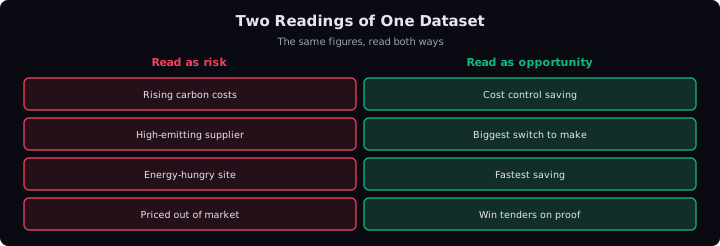
The clean insight is that risk and opportunity are not two datasets but two readings of one. The supplier that is a transition risk is also, seen differently, the biggest opportunity to cut cost and footprint by switching. The energy-hungry site that is a liability is also the fastest saving available. A leader with trusted data does not choose between defending against risk and chasing opportunity; the same figures, interrogated well, point to both at once. That dual return is the practical reason the infrastructure is worth building.

A high-emitting supplier is both a transition risk and the biggest chance to cut cost.

Check your understanding

Answer each from memory. Your results are saved in this browser and count toward your readiness — sign in (account panel above) to keep them across devices.

  1. What is transition risk?

  2. Which is a clear example of resource efficiency revealed by sustainability data?

  3. Why are risk and opportunity described as two readings of one dataset?

13 min · Core

Talking to the Board

The best sustainability analysis is worthless if it cannot cross the gap to the people who allocate money. Boards and investors think in a particular language, of risk, return, capital and competitive position. This lesson is about translation: turning tonnes of carbon and megawatt-hours into the terms that get an initiative funded, without distorting the truth.

~4 min

By the end you can

  • Explain why sustainability data must be translated into business and investor language.
  • Describe how to frame a sustainability initiative in terms of risk and return.
  • Recognise common translation failures that lose funding.
  • Explain how trusted data underpins credibility with a board.

Why translation decides everything

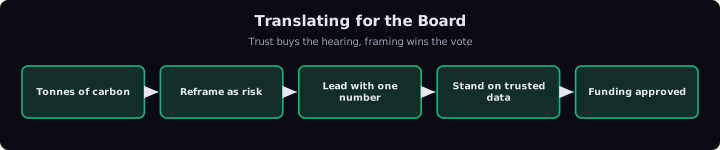
A board does not fund tonnes of carbon. It funds reduced risk, higher return, protected revenue and stronger competitive position. A sustainability lead who arrives with a slide of emissions by category, however accurate, is speaking a language the room does not buy in. The same facts, reframed, can win the money: not 'our Scope 3 emissions are 40,000 tonnes' but 'a third of our footprint sits with one supplier whose costs will rise under the carbon price, and here is what switching saves us over five years'. The data does not change. The framing decides whether it is heard. TranslationThe discipline of restating true sustainability facts in the language a board or investor uses, so a sound initiative competes on equal footing with every other capital decision. It is not spin. is not spin; it is the discipline of saying the true thing in the terms the decision-maker uses.

Framing as risk and return

The two words a board reliably understands are risk and return. Almost any sound sustainability initiative can be honestly cast in one or both. A refit that cuts energy is a return: it pays back in lower bills. Reducing reliance on a high-carbon supplier is risk management: it removes an exposure to future carbon costs and supply restrictions. Winning the ability to quote a credible footprint is competitive position: it qualifies the firm for contracts rivals cannot reach. When the sustainability case is dressed in the same clothes as every other capital decision the board weighs, it competes on equal footing instead of being filed under 'nice to have'.

How translation fails

Funding is lost in predictable ways. The first is drowning the room in detail, presenting the full dataset when the board needs the one number that changes the decision. The second is leading with virtue rather than value, arguing that a project is the right thing to do when the board is asking what it earns or protects. The third, and most damaging, is presenting figures the board cannot trust, at which point the whole case collapses regardless of its merit. A chief financial officer who spots one indefensible number will doubt them all. Good translation is short, framed as value, and standing on data that survives challenge.

Trust is the foundation of the pitch

This is where the whole course comes together. A board will only act on numbers it believes, and it believes numbers it can see are traceable, audited and defensible, exactly the trusted infrastructure the earlier module argued for. A brilliantly framed business case built on shaky data is worse than useless, because when the shakiness shows, it costs the presenter their credibility on everything else. Consider a sustainability director whose funding request was approved not because the analysis was cleverer than last year's but because, for the first time, every figure could be traced to source when the finance director probed. Trust bought the hearing; translation won the vote. The two together are how sustainability data finally moves money.

A board funds reduced risk and return, not tonnes, and only if the figures hold up.

Check your understanding

Answer each from memory. Your results are saved in this browser and count toward your readiness — sign in (account panel above) to keep them across devices.

  1. Why must sustainability data be translated before it goes to a board?

  2. Which is a sound way to frame a sustainability initiative for a board?

  3. What is the most damaging translation failure when pitching to a board?

13 min · Core

The Strategic Payoff

This lesson closes the module and the course's argument by answering the question that justifies everything: why build a trusted sustainability-data infrastructure at all? The payoff is not one benefit but a compounding set, cheaper capital, won contracts, lower costs, faster and better decisions, and resilience as rules tighten. Trust is the foundation the whole edifice stands on.

~4 min

By the end you can

  • Summarise the compounding competitive benefits a trusted data infrastructure unlocks.
  • Explain why these benefits reinforce one another over time.
  • Connect the payoff back to trust as the enabling foundation.
  • Articulate the business case for building the infrastructure in one clear statement.

Not one payoff but many

It is fair to ask why a business should spend heavily to make its sustainability data trustworthy. The answer is that the return is not a single benefit but a bundle that arrives together. Lower operating costs, because the data finds waste. Won contracts, because customers demand proof a rival cannot give. Cheaper capital, because lenders and investors reward a firm that can show it manages its transition risk. Faster, better decisions, because the numbers can be believed and acted on without hesitation. And resilience, because when rules tighten again, as they will, the firm already has the infrastructure while competitors scramble. Any one of these might justify the spend; together they make it obvious.

Why the benefits compound

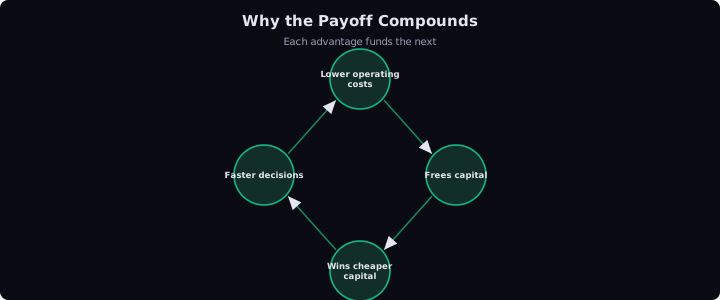
These returns do more than add up; they reinforce one another. Lower costs free capital to invest in still better data. A won contract deepens the customer relationship that surfaces the next opportunity. Cheaper capital lowers the hurdle for the next efficiency project. Being trusted by an auditor this year makes next year's assurance smoother and cheaper. The firm that starts early therefore does not merely lead by a fixed margin; the gap widens, because each advantage funds the next. This is the difference between a cost that is spent once and an asset that appreciates. Trusted data behaves like the latter.

Trust holds it all up

Every benefit in that bundle rests on one foundation, and it is the foundation this course has argued for throughout: trust. The contract is won only if the footprint can be proved. The capital is cheaper only if the risk figures are believed. The decision is faster only if no one has to stop and doubt the number. Strip trust out and the whole structure falls; the data reverts to a compliance cost that earns nothing and, when it fails an audit, becomes a liability. This is why the earlier module insisted that trust, not mere existence or tidy organisation, is the binding constraint. The strategic payoff is precisely what trust unlocks.

The case in one line

So the business case reduces to a single sentence a leader can carry into any room. Building a trusted sustainability-data infrastructure is not a compliance expense; it is an investment in a decision advantage that lowers cost, wins business, cheapens capital and compounds over time, and it works only because the data can be trusted. That is the whole argument of the course. The regulation forced the first act. The strategy justified the second. But it is trust, in the third act, that turns an obligation the business resented into an asset it would not give up. That is the reason to build it, and the reason to build it well.

The benefits reinforce one another, so the early mover's lead widens over time.

Check your understanding

Answer each from memory. Your results are saved in this browser and count toward your readiness — sign in (account panel above) to keep them across devices.

  1. Which best describes the strategic payoff of a trusted sustainability-data infrastructure?

  2. Why do the benefits of trusted data compound rather than merely add up?

  3. What single foundation does the entire strategic payoff rest on?

Flashcards

Recall-first review of the load-bearing facts.

0 reviewed · 8 left

Ready to test yourself?

12 graded questions with real explanations. You commit a confidence before each reveal — that is how you find what you only think you know.

Start practice quiz →
From Data to Decisions — Sustainability Data as Infrastructure | Contested Futures Academy · The Contested Futures Institute