Provenance and Verifiability

Sustainability data is now examined by external auditors much as financial accounts are, and a number that cannot be traced back to its origin cannot be defended. This module builds the shared language of trust: what external assurance demands, how a figure travels from a meter reading or an invoice into the report, why every hand-off along that chain is a place trust can be lost, and what an assurer actually looks for. It closes by treating verifiability not as a compliance cost but as a strategic asset a business can design in from the start.

  • data-provenance
  • assurance
  • auditability
  • data-lineage
  • chain-of-custody
  • verifiability
12 min · Core

The Assurance Turn

Sustainability figures are no longer taken on trust. Under European rules they are examined by external auditors and given a formal opinion, exactly as financial accounts have been for a century. This lesson explains what that shift means, the difference between limited and reasonable assurance, and why being assured changes what the underlying data must be able to prove.

~4 min

By the end you can

  • Explain what external assurance of sustainability data means and why it now applies.
  • Distinguish limited assurance from reasonable assurance.
  • Describe what assurance demands of the underlying data, not just the report.
  • Recognise assurance as the moment trust stops being optional.

Sustainability data grows up

For most of its life, a sustainability figure was published and believed. No independent party checked it, and readers took the company at its word. That era is closing. Under the European Union's reporting rules, the sustainability information a company discloses must now be examined by an external auditor, who forms an opinion on whether it can be relied upon. This is the same discipline that has governed financial accounts for over a hundred years, applied for the first time to carbon, energy, water and workforce numbers. The change has a name worth learning: it is the assurance turn, the point at which sustainability data must survive an outsider's challenge.

Limited and reasonable assurance

AssuranceIndependent examination of reported figures by an external auditor, who gives a formal opinion on whether the data can be relied upon, applied to sustainability data much as it has long been to financial accounts. comes in two strengths, and the difference matters for what a business must prepare. Under limited assurance, the auditor performs a lighter review and concludes, in effect, that nothing has come to their attention suggesting the figures are wrong. It is a cautious, negative form of comfort. Under reasonable assurance, the auditor does far more testing and gives a positive opinion that the figures are, in all material respects, correct. Reasonable assuranceA more rigorous form of audit involving substantial testing, in which the assurer gives a positive opinion that the figures are, in all material respects, correct. The higher bar, closer to a full financial audit. is the higher bar, closer to a full financial audit, and European rules are set to move companies from the first toward the second over time. A firm that can only just clear the lighter bar today will struggle when the higher one arrives.

What the auditor is really asking

The crucial point for a non-specialist is what assurance demands of the data beneath the report. An auditor does not simply read the number; they ask the company to prove it. Show me the meter readings behind this energy figure. Show me the invoices behind this fuel total. Show me how you turned those raw records into the single number on the page. A figure that is present but cannot be substantiated is, to an auditor, no better than a guess. Assurance therefore reaches past the report and into the plumbing: the records, the calculations and the trail that connects them.

Why this changes everything

Before assurance, a business could get away with a number it could not fully explain. After assurance, it cannot. The consequence is that trust moves from a nice-to-have to the binding requirement, because a figure that cannot be proven will be qualified or rejected, and a qualified sustainability opinion is a public signal that a company's numbers are shaky. Consider a manufacturer whose emissions figure looks reasonable but rests on estimates no one recorded the basis for: under limited assurance it might slip through; under reasonable assurance it will not. The rest of this module follows the trail the auditor follows, because being ready for assurance means building the data so that trail exists.
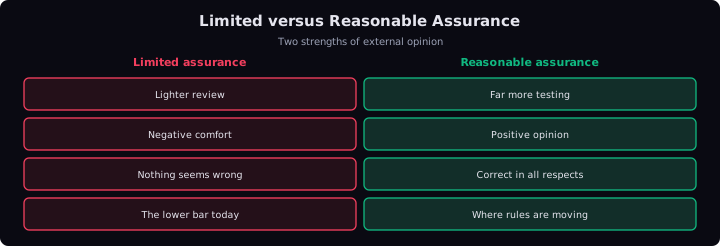
European rules push companies from limited toward reasonable assurance over time.

Check your understanding

Answer each from memory. Your results are saved in this browser and count toward your readiness — sign in (account panel above) to keep them across devices.

  1. What does the 'assurance turn' mean for sustainability data?

  2. How does reasonable assurance differ from limited assurance?

  3. What does assurance most demand of the data beneath the report?
13 min · Core

Where Did This Number Come From?

Behind every figure in a sustainability report is a chain that starts with something real: a meter reading, a fuel invoice, a supplier's certificate. Provenance is the record of that chain. This lesson traces how a raw record becomes a reported number and shows why a firm that cannot answer where a number came from cannot defend it.

~4 min

By the end you can

  • Define provenance as the recorded origin of a reported figure.
  • Trace the chain from a raw record to a number in the report.
  • Explain why a missing origin makes a figure indefensible.
  • Recognise provenance as a business question, not only a technical one.

Every number starts somewhere real

A carbon figure on a report page can feel abstract, but it always begins with something concrete in the world. A gas meter turned. A tanker delivered a measured volume of fuel. An electricity supplier issued a bill for a known number of units. A logistics partner recorded the tonnes carried and the distance driven. These raw records are the ground truth. ProvenanceThe recorded origin of a reported figure: the chain of original evidence, such as a meter reading or an invoice, that a number can be traced back to. is simply the recorded answer to a plain question: where did this number come from, and can we point to the original evidence for it?

From reading to reported figure

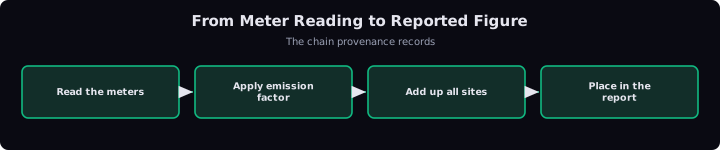
The journey from a raw record to a reported figure has several steps, and provenance is the thread that runs through all of them. Take a factory's energy emissions. First the meters are read, giving units of electricity and gas. Then those units are multiplied by an emission factor, a published conversion rate that turns energy into carbon. Then the results for every site are added up. Then the total is placed in the report. Each step transforms the number, and each step should leave a record of what went in, what came out and which factor was used. When that record exists end to end, a company can trace the final figure all the way back to the meter. When it does not, the figure floats free of its origins.

The estimate that no one recorded

Provenance breaks most often not through dishonesty but through convenience. A site's meter was faulty one quarter, so someone estimated the usage from last year and typed it straight into the spreadsheet, noting the basis nowhere. A supplier never replied, so an analyst used an industry average as a placeholder and forgot to flag it. Months later, an auditor asks how that figure was derived, and no one can say. The number may even be roughly right, but without a recorded origin it cannot be defended, and an auditor treats an undefended figure as an unproven one.

A business question, not just an IT one

It is tempting to file provenance under technology, but it is really a leadership question. If a chief financial officer is asked to sign a report, provenance is what lets them answer honestly rather than hopefully. If a bank asks for the basis of an emissions claim in a loan agreement, provenance is what protects the company from a later accusation of overstating. The discipline is close to how finance already treats money: no accountant would post a figure to the ledger without knowing which transaction it came from. Sustainability data is now held to the same standard, and the first question any leader should be able to answer about any headline number is the simplest one: where did this come from?

Each step transforms the number and should leave a record of what went in and out.

Check your understanding

Answer each from memory. Your results are saved in this browser and count toward your readiness — sign in (account panel above) to keep them across devices.

  1. What does provenance mean for a sustainability figure?

  2. In turning meter readings into a reported carbon figure, what does an emission factor do?

  3. Why can a figure that is roughly correct still be indefensible to an auditor?

13 min · Core

Chain of Custody

Data rarely stays in one place. It moves from a meter to a spreadsheet, from a supplier to an inbox, from one system to another, and it is transformed at each stop. Chain of custody is the record of that journey. This lesson explains data lineage across systems and hands, and why every hop is a place where trust can quietly leak away.

~4 min

By the end you can

  • Define chain of custody and data lineage in plain terms.
  • Identify the hops a figure makes across systems, transformations and hands.
  • Explain why each hop is a place trust can be lost.
  • Recognise unbroken lineage as what makes a figure trustworthy end to end.

The journey a number takes

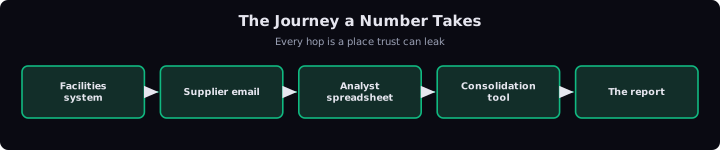
Borrowed from law and logistics, chain of custody means an unbroken record of who held something, when, and what they did with it. Applied to data, it becomes data lineage: the traceable path a figure follows from its origin, through every system and every pair of hands, to the number printed in the report. A single emissions figure might pass through a facilities system, a supplier's email, an analyst's spreadsheet, a consolidation tool and finally the report. Chain of custodyAn unbroken record of who held a figure, when, and what they did with it, borrowed from law and logistics and applied to data as it moves between systems and hands. is the answer to the question, can we retrace that whole journey, step by step, without a gap.

Every hop transforms the number

The journey is not passive. At each hop the number is handled, and handling changes it. A reading is copied from a meter into a spreadsheet, and a digit can be mistyped. Units are converted, and the wrong factor can be applied. Figures from many sites are added together, and a site can be double-counted or dropped. A supplier sends a total, and no one records whether it covered the whole year or only three quarters. None of these is fraud; each is an ordinary handling error. But each transformation is a moment where the figure can drift from the truth without anyone noticing, precisely because the change happened in a hand-off rather than in plain view.

Where trust leaks

The danger of a long chain is that trust leaks at the joints. A number can be perfect at the meter and perfect in the report and still be wrong, because something happened in between that no one can see. Picture a figure that is emailed as a screenshot, retyped into a spreadsheet, then pasted into a template: three hand-offs, each unrecorded, any of which could have introduced an error no one can now find. When an auditor asks to walk the chain and hits a hop with no record, the whole figure becomes suspect, not just that step. A single broken link discredits the entire chain, because the auditor can no longer be sure what happened at the gap.

Why unbroken lineage is the goal

This is why lineage, not just origin, is what makes a figure trustworthy. Knowing where a number started is necessary but not enough; you must also be able to show every transformation it underwent on the way to the report. A firm with unbroken lineage can answer any challenge by walking the auditor from the meter to the page, showing each step and each factor. A firm without it is left saying we are fairly sure, which is exactly the position assurance was invented to expose. The practical lesson for leaders is to count the hops in their most important figures and ask, at each one, whether a record survives. Every unrecorded hand-off is a place the business is quietly exposed.

One hop with no record makes the whole figure suspect, not just that step.

Check your understanding

Answer each from memory. Your results are saved in this browser and count toward your readiness — sign in (account panel above) to keep them across devices.

  1. What does chain of custody, or data lineage, describe?

  2. Why is each hop in the data's journey a risk to trust?

  3. An auditor walking a figure's chain hits one hop with no record. What is the effect?

14 min · Core

Evidence and Auditability

Being ready for an audit is not a heroic scramble the week before; it is a state a business can design into its ordinary work. This lesson describes what an assurer actually looks for, distinguishes evidence from the number itself, and contrasts the yearly panic of the unprepared with the calm of a firm that is audit-ready by design.

~4 min

By the end you can

  • Describe the kinds of evidence an assurer looks for behind a figure.
  • Distinguish a number from the evidence that substantiates it.
  • Contrast the annual audit scramble with being audit-ready by design.
  • Explain how ordinary controls make evidence available without a scramble.

What an assurer actually looks for

An assurer is not trying to admire the number; they are trying to test it. To do that they ask for evidence: the underlying records and the documented steps that connect them to the figure. That means source documents such as invoices and meter readings, the calculation showing how raw data became the reported total, the emission factors used and where they came from, and a note of who prepared the figure and who reviewed it. They also look for controls, the routine checks a company runs on itself, such as reconciling energy bills against meter data, or flagging a site whose usage jumps suspiciously. The pattern is consistent: the assurer wants to see not just the destination but the road, and the guardrails along it.

The number is not the evidence

A distinction that trips up many teams is that the number and the evidence for it are two different things. A tidy figure in a polished report proves nothing on its own; it is a claim. The evidence is what turns the claim into something an outsider can rely on. Two companies can report the identical emissions figure, and one can produce a clean folder of invoices, calculations and sign-offs while the other can produce only the number and a shrug. To an auditor these are worlds apart, even though the reported figures match. Leaders who confuse having the number with being able to prove it are exactly the ones caught out at audit.

The scramble versus readiness

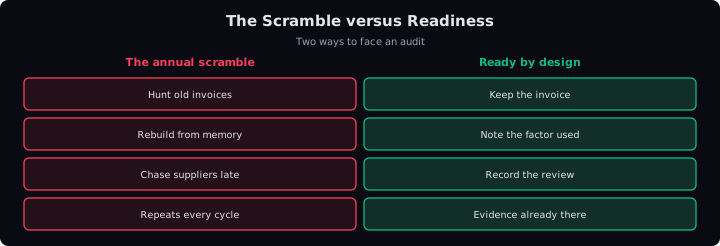
There are two ways to face an audit. The first is the scramble: when the auditor's request arrives, the team drops everything, hunts through inboxes and shared drives for old invoices, rebuilds calculations from memory, and chases suppliers for records that should have been kept. It is stressful, expensive, and it repeats every single cycle, because nothing was retained. The second is audit-readiness by design: the evidence for each figure is captured and filed as the figure is produced, so that when the request arrives it is already there. The difference is not effort; the ready firm often does less work overall. The difference is timing, capturing evidence once as work happens rather than reconstructing it under pressure later.

Readiness is an ordinary habit

Audit-readinessThe state of having captured and filed the evidence for each figure as the figure is produced, so that when an auditor's request arrives it is already available rather than reconstructed under pressure. sounds demanding, but it is built from small, ordinary habits rather than a grand project. Keep the invoice when it arrives, attached to the figure it supports. Write down the emission factor and its source at the moment it is used. Have a second person review a figure and record that they did. Reconcile the total against the source records each quarter, not each year. Each habit is minor; together they mean the evidence exists as a by-product of normal work. Consider a firm that files each supplier's certificate the day it comes in: when the auditor asks, there is nothing to reconstruct. That is the whole of audit-readiness, and it turns a yearly crisis into a routine hand-over.

The difference is timing: capture evidence once as work happens, not under pressure later.

Check your understanding

Answer each from memory. Your results are saved in this browser and count toward your readiness — sign in (account panel above) to keep them across devices.

  1. Which best describes what an assurer looks for behind a reported figure?

  2. Why is having the number not the same as being able to prove it?

  3. What distinguishes being audit-ready by design from the annual scramble?

13 min · Core

Verifiability as a Feature

The final step is to stop treating verifiability as a cost imposed by regulation and start treating it as a designed-in property of the data itself. This lesson makes the strategic case: when any number's origin can always be proven, the business moves faster, borrows more cheaply, and wins trust that competitors cannot easily match.

~4 min

By the end you can

  • Define verifiability as a designed-in property of the data infrastructure.
  • Contrast verifiability as a cost with verifiability as a strategic asset.
  • Explain how designed-in verifiability creates business advantage.
  • Recognise verifiability as the practical goal of provenance and lineage.

From an afterthought to a property

Most companies bolt proof on afterwards. They produce a number first and, when someone demands evidence, go looking for it. VerifiabilityThe designed-in property of a data infrastructure that any reported figure can always be traced to its origin and full chain of transformations, making proof a standing capability rather than a yearly scramble. reverses that order. It is the property of a data infrastructure that any reported figure can always be traced to its origin and its full chain of transformations, because the system was built to preserve that trail as a matter of course. Verifiability is what you get when provenance and chain of custody stop being things you reconstruct and become things the infrastructure guarantees. The number arrives already provable.

Cost or asset

How a leader frames verifiability decides how they invest in it. Framed as a cost, it is a grudging expense to satisfy auditors, minimised and deferred. Framed as an asset, it is a capability that pays back. The distinction is not wordplay. A firm that treats proof as a cost builds the minimum and scrambles each cycle. A firm that treats it as an asset designs the trail in once and then reaps the return every time proof is demanded, which, in an assured and investor-graded world, is constantly. The same spending buys either a recurring headache or a standing advantage, depending on the intent behind it.

Where the advantage shows up

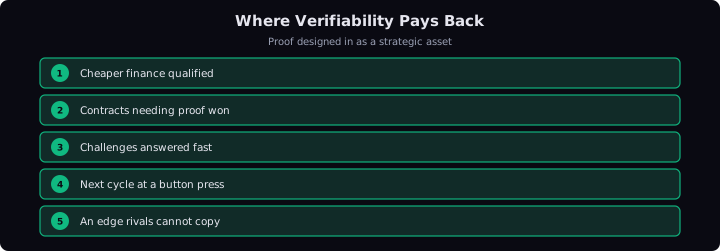
Designed-in verifiability creates concrete gains. When a bank offers cheaper finance to companies that can prove their sustainability performance, the verifiable firm qualifies and the unverifiable one does not. When a large customer demands audited supplier data before awarding a contract, the firm whose numbers are provable wins the business while a rival stalls. When a regulator or a journalist challenges a claim, the verifiable firm answers in an afternoon and the other spends weeks and lawyers. When the next reporting cycle comes, the verifiable firm presses a button and the other starts the scramble again. Each of these is a real advantage that flows directly from having built proof in.

The point of the whole module

Verifiability is where this module lands, because it is the practical purpose of everything before it. AssuranceIndependent examination of reported figures by an external auditor, who gives a formal opinion on whether the data can be relied upon, applied to sustainability data much as it has long been to financial accounts. sets the requirement; provenance records the origin; chain of custody preserves the journey; evidence and controls make it testable; and verifiability is the state a business reaches when all of that is designed in rather than reconstructed. For a leader, the takeaway is a single reframing. Do not ask how little proof you can get away with. Ask how to build the data so that any number's origin can always be shown, and treat that ability as an asset worth owning. In a world where trust is the binding constraint, the firm that can always prove its numbers holds something its rivals cannot quickly copy.

Treated as an asset, verifiability returns value every time proof is demanded.

Check your understanding

Answer each from memory. Your results are saved in this browser and count toward your readiness — sign in (account panel above) to keep them across devices.

  1. What does it mean to treat verifiability as a feature of the data infrastructure?

  2. Why does framing verifiability as an asset rather than a cost change what a business does?

  3. Which is a concrete advantage of designed-in verifiability?

Flashcards

Recall-first review of the load-bearing facts.

0 reviewed · 8 left

Ready to test yourself?

12 graded questions with real explanations. You commit a confidence before each reveal — that is how you find what you only think you know.

Start practice quiz →
Provenance and Verifiability — Sustainability Data as Infrastructure | Contested Futures Academy · The Contested Futures Institute